

Blog / Model Comparisons

2027 Hyundai Santa Fe: Trims, MPG, and Family Value

2027 Hyundai Santa Fe: Trims, MPG, and Family Value

The 2027 Hyundai Santa Fe is the right choice for families and commuters who need three rows, genuine towing capacity, and the option of a fuel-efficient hybrid powertrain in one package. The Limited (Bench seat) starts at $44,850 and seats seven, making it the entry point, while the Calligraphy Hybrid at $48,950 delivers an EPA-rated 36 combined MPG — more fuel-efficient than the gasoline trims. All four covered trims share a 12-speaker Bose audio system, a 12.3-inch touchscreen, and a full suite of active safety technology as standard equipment.

Table of Contents

How Efficient and Versatile Is the 2027 Hyundai Santa Fe for Middletown and Dover Drivers?

The hybrid trims return 36–37 MPG combined, which is the standout efficiency figure for drivers covering the daily stretch between Middletown and Dover. The gasoline Calligraphy 2.5 and Limited 2.5 (Bench seat) rate 20 city / 29 highway / 24 combined MPG — workable for suburban errands, but the hybrid's numbers translate to roughly 637 miles of calculated range on a 17.7-gallon tank, compared to 425 miles for the gasoline trims.

Towing tells a different story. The gasoline Calligraphy 2.5 and Limited 2.5 (Bench seat) are rated at 3,500 lbs with a braked trailer, enough for a small fishing boat or a loaded utility trailer for hauling agricultural supplies around the coastal plain. Both hybrid trims drop to a 2,000 lb tow rating — still adequate for a lightweight camper or a jet ski, but shoppers who prioritize towing should note the difference before choosing a powertrain. Payload holds steady across all trims at 1,191–1,224 lbs.

Every trim in this lineup carries about 15 cu ft of cargo space with all seats in place, expanding to about 80 cu ft with the rear seats folded. Seating varies: the Limited (Bench seat) fits seven passengers in a 2+3+2 configuration, while the other three trims seat six in a 2+2+2 layout with captain's chairs in the second row.

Shoppers interested in the hybrid's fuel economy can explore current Santa Fe Hybrid pricing at Winner Hyundai.

2027 Hyundai Santa Fe Fuel Economy by Trim

2027 Hyundai Santa Fe Dimensions and Capacity by Trim

2027 Hyundai Santa Fe Fuel Economy

Fuel economy and range by trim

Feature Calligraphy 2.5 Calligraphy 2.5 AWD Calligraphy Hybrid Calligraphy Hybrid AWD Limited 2.5 (Bench seat) Limited Hybrid (Captain's chairs)
MPG 20 city / 29 hwy / 24 combined 20 city / 28 hwy / 23 combined 37 city / 36 hwy / 36 combined 35 city / 34 hwy / 35 combined 20 city / 29 hwy / 24 combined 37 city / 36 hwy / 36 combined

Distinctive Exterior Styling of the 2027 Hyundai Santa Fe

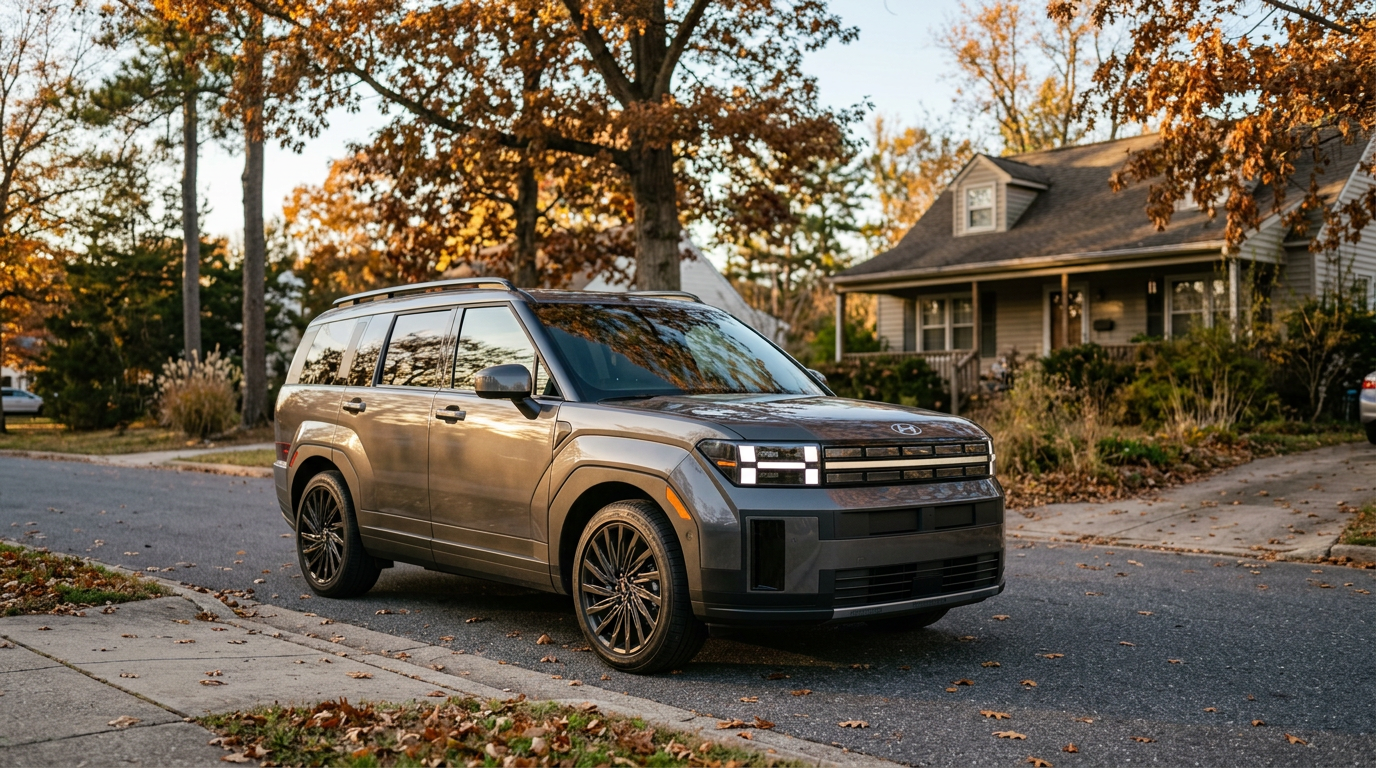
The 2027 Santa Fe wears a squared-off, upright silhouette that reads more purposeful than the rounded crossover shapes common to this segment. The body measures 190.2 inches long, 74.8 inches wide, and 69.7 inches tall, with a 110.8-inch wheelbase that gives the three-row cabin genuine interior room rather than packaging it as an afterthought. Ground clearance sits at 7 inches unladen — appropriate for Middletown's mix of residential streets and the occasional unpaved farm access road.

LED lighting runs the full perimeter: projector-beam LED low and high beams, LED daytime running lights, LED side indicators, LED rear lights, and LED brake lights. Auto high-beam control and a dusk sensor automate the lighting transitions. A roof spoiler adds a subtle aerodynamic note at the rear, and the power liftgate with hands-free release keeps grocery loading practical when your arms are full.

The exterior color palette covers nine choices, including the matte finishes Ecotronic Gray Matte and Earthy Brass Matte — both available as options on the Calligraphy trims — alongside solid and pearl options like Phantom Black, Serenity White, Shimmering Silver, Hampton Gray, Ultimate Red, and Atlantis Blue. Roof rails come standard in a toned finish, with optional black cross rails available through the dealer's accessories menu. If you already know this is the right vehicle and want to get ahead of the paperwork, you can apply for financing online before visiting the showroom.

Performance and Powertrain Options of the 2027 Hyundai Santa Fe for Suburban and Rural Driving

Two distinct powertrains define the 2027 Santa Fe lineup covered here, and choosing between them comes down to whether towing capacity or fuel efficiency is the higher priority.

The Smartstream 2.5L turbocharged four-cylinder in the Calligraphy 2.5 and Limited 2.5 (Bench seat) produces 277 hp and 311 lb-ft of torque, paired with an 8-speed SHIFTRONIC automatic with steering-wheel-mounted paddle shifters. Both are front-wheel drive. That torque figure is the key number for anyone planning to use the Santa Fe's full 3,500-lb tow rating — it arrives at 4,000 rpm and provides the pulling confidence needed for a loaded boat trailer or a utility trailer stacked with landscaping supplies. The Calligraphy 2.5 carries a curb weight of 4,343 lbs.

The Smartstream 1.6L turbocharged four-cylinder hybrid in the Calligraphy Hybrid and Limited Hybrid (Captain's chairs) pairs its gasoline engine with an electric motor producing 60 hp and 195 lb-ft of torque through a transmission-integrated motor generator. System output is 231 hp. Torque figures differ by trim: the Calligraphy Hybrid lists 271 lb-ft, while the Limited Hybrid (Captain's chairs) lists 200 lb-ft. Both use a 6-speed SHIFTRONIC automatic and are front-wheel drive. The 1.5 kWh lithium-ion battery pack supports energy recuperation but does not offer a plug-in mode — the hybrid system is self-charging. Towing is capped at 2,000 lbs on both hybrid trims.

The suspension architecture is identical across all four trims: MacPherson struts up front and a multi-link independent setup at the rear, both with coil springs and stabilizer bars. Four-wheel disc brakes with two ventilated front rotors, ABS, brake assist, electronic parking brake with auto-hold, and hill-hold control are standard. Electric power steering with variable speed-proportional assist rounds out the chassis package.

2027 Hyundai Santa Fe Engine and Performance by Trim

Feature Calligraphy 2.5 Calligraphy Hybrid Limited 2.5 (Bench seat) Limited Hybrid (Captain's chairs)
Engine 2.5L 1.6L 2.5L 1.6L
Horsepower 277 hp 231 hp 277 hp 231 hp
Torque 311 lb-ft 271 lb-ft 311 lb-ft 200 lb-ft
Drivetrain Front-wheel drive Front-wheel drive Front-wheel drive Front-wheel drive
Transmission SHIFTRONIC SHIFTRONIC SHIFTRONIC SHIFTRONIC

Interior Comfort and Space in the 2027 Hyundai Santa Fe for Families

Forty-four and four-tenths inches of front legroom and 40.2 inches of front headroom give the driver and front passenger genuine breathing room — numbers that matter on a 30-mile commute. Second-row passengers get 42.3 inches of legroom (41.5 in the hybrid trims), 39.6 inches of headroom, and 58.1 inches of shoulder room. Third-row occupants have 30 inches of legroom, 37.7 inches of headroom, and 53.5 inches of shoulder room — tight for adults on long trips, but practical for children heading to soccer practice.

The seating configuration is the sharpest differentiator between trims. The Limited 2.5 (Bench seat) uses a 2+3+2 layout for seven-passenger capacity, with a split-folding bench in the second row. The other three trims — Calligraphy 2.5, Calligraphy Hybrid, and Limited Hybrid (Captain's chairs) — use captain's chairs in the second row for a 2+2+2 configuration seating six. The captain's chair layout provides easier access to the third row and a more comfortable perch for the second-row passengers.

Driver seat adjustment is generous: 7-way power adjustment with memory settings on the Calligraphy 2.5 and Limited Hybrid, and 8-way power with memory plus an electric thigh support extension on the Calligraphy Hybrid. The front passenger gets 4-way power adjustment on the Calligraphy 2.5 and Limited Hybrid trims, stepping up to 5-way power with electric thigh support on the Calligraphy Hybrid. All front seats are heated and ventilated. Second-row captain's chairs in the Calligraphy trims recline electrically.

Interior trim uses premium leather on the Calligraphy trims and leather on the Limited trims. Color choices span Black Ink Nappa Leather, Gray Nappa Leather, and Pecan Brown Nappa Leather on the Calligraphy trims, and Black, Gray, or Pecan Brown leather on the Limited trims. Alloy-look accents appear on the instrument panel, doors, and gear selector across all four trims. A panoramic sunroof with electric sunshade, ambient lighting, illuminated entry, and a heated steering wheel round out the comfort package. USB charging ports cover every row: 2 in front, 2 in the second row, and 2 in the third row, plus a 12V outlet in the cargo area.

User-Friendly Technology Features in the 2027 Hyundai Santa Fe Enhancing Daily Commutes

A dual 12.3-inch screen setup defines the Santa Fe's cockpit: one panel serves as the digital instrument cluster and the second, fixed center-dashboard display handles infotainment. Both are touch-enabled, and the instrument cluster is reconfigurable. A head-up display projects key driving data onto the windshield, reducing the need to glance down during a busy school drop-off run.

Wireless Apple CarPlay and wireless Android Auto are standard across all four trims, with no subscription expiration — the data shows a 999-month included period for both platforms. Bluetooth connectivity, a voice activation system, and steering-wheel-mounted audio controls keep the driver's hands on the wheel. The 12-speaker Bose sound system with subwoofer and surround sound is standard on all covered trims, with satellite radio included for 3 months.

Navigation is built in with a 12.3-inch display, 3D mapping, voice guidance, and SD card data feed. Traffic information is included for 3 months, and map updates are covered for 36 months. The embedded SIM card enables the Blue Link connected services suite, which includes remote start, remote climate control (heating, cooling, and steering wheel heating), remote lock/unlock, vehicle diagnostics, geo-fencing, speed alerts, and theft notification — all on an included subscription. Over-the-air software updates keep the system current without a dealer visit.

A wireless charging pad handles daily phone top-offs without cables. The Surround View Monitor stitches together camera feeds from front, rear, and side cameras into a 3D overhead view — practical for parking in tight spots at community events or navigating a crowded lot. NSCC (Navigation-based Smart Cruise Control) with stop-and-go function uses map data and corner reaction to modulate speed proactively on familiar routes.


Advanced Safety and Driver Assistance Systems in the 2027 Hyundai Santa Fe

Every 2027 Santa Fe in this lineup carries a 5-star NHTSA overall safety rating, 5-star frontal crash and side impact ratings, a 4-star rollover rating, and an IIHS Top Safety Pick+ designation with Good scores in moderate overlap front, small overlap front (driver side), and side impact tests. The IIHS headlights and LATCH ratings both return Acceptable results.

The structural airbag count is nine, covering front driver and passenger, front and rear side airbags, side curtain airbags spanning all three rows, and a driver knee airbag. Front seatbelts include pre-tensioners and height adjustment. Rear center seatbelts are 3-point across all positions, including the third row.

Active safety technology is comprehensive and standard on all four trims. Forward Collision Avoidance Assist (FCA) with Junction Turning detects vehicles, pedestrians, and cyclists ahead and can apply automatic emergency braking, including at low speeds front and rear. It also monitors for vehicles turning at intersections, a scenario common on Delaware's suburban cross streets. Lane Keep Assist (LKA) applies steering correction to prevent unintended lane departures.

Blind Spot Collision Avoidance Assist (BCA) is standard on the Calligraphy trims, using radar to monitor adjacent lanes and applying corrective steering or braking if a lane change is initiated with a vehicle present. The Limited trims carry the Blind Spot View Monitor (BVM), which displays a camera feed of the blind spot area in the instrument cluster when the turn signal is activated. Rear Cross-Traffic Collision-Avoidance Assist (RCCA) uses radar to detect approaching traffic when reversing and can apply automatic braking. A trailer stability program is also included, relevant for the gasoline trims rated at 3,500 lbs towing. The system is rated at Level 2 partial automation, with highway assist and traffic jam assist included.

Comprehensive Pricing Breakdown of All 2027 Hyundai Santa Fe Trims

The Limited (Bench seat) at $44,850 is the entry point for this group of four trims and the only configuration that seats seven. For families where the third seat gets used regularly, it represents a straightforward choice in the lineup. The Limited Hybrid (Captain's chairs) adds the Smartstream hybrid powertrain and captain's chairs for $45,950 — a $1,100 premium over the bench-seat gasoline model that trades one seat for significantly better fuel economy.

Stepping up to the Calligraphy tier brings Nappa leather upholstery, a head-up display, additional seat adjustments including electric thigh support on the hybrid, and a more extensively equipped interior. The Calligraphy 2.5 starts at $47,600, and the Calligraphy Hybrid at $48,950. All four trims share a $1,650 destination charge.

Three dealer-installed packages are available across all covered trims: the Cargo Package (PIO), the Protection Package (PIO), and the Tow and Go Package (PIO). Pricing for these packages is contact-dealer pricing. Standalone accessories include cross rails, a tow hitch, a ball mount kit, mudguards, all-season fitted liners, carpeted floor mats, a cargo cover, a cargo net, cargo tray, cargo organizer, cargo blocks, wheel locks, and side steps — all available through the accessories menu.

2027 Hyundai Santa Fe MSRP by Trim

The decision between gasoline and hybrid powertrain is primarily a fuel economy question. At 24 combined MPG for the gasoline trims versus 36 combined MPG for the hybrid trims, the hybrid uses less fuel on every tank — a noticeable difference for anyone commuting daily across Delaware's flat coastal plain.

2027 Hyundai Santa Fe Pricing

Pricing by trim

Feature Calligraphy 2.5 Calligraphy 2.5 AWD Calligraphy Hybrid Calligraphy Hybrid AWD Limited 2.5 (Bench seat) Limited Hybrid (Captain's chairs)
Base MSRP $47,600 $49,650 $48,950 $50,750 $44,850 $45,950

Destination charge: $1,650 across all trims.

Warranty Coverage and Maintenance Services for the 2027 Hyundai Santa Fe

Hyundai backs the 2027 Santa Fe with a warranty structure that covers new owners comprehensively. The basic vehicle warranty runs 5 years or 60,000 miles, and the powertrain warranty extends to 10 years or 100,000 miles — one of the longest powertrain coverage periods in the class. Anti-corrosion protection runs 7 years with unlimited mileage. The paint warranty covers 3 years or 36,000 miles. Roadside assistance is included for 5 years with unlimited mileage, providing peace of mind whether you're on a Delaware back road or a busy interstate.

For the hybrid trims — the Calligraphy Hybrid and Limited Hybrid (Captain's chairs) — the battery system and electric components carry their own dedicated coverage: 10 years or 100,000 miles for the hybrid battery and 10 years or 100,000 miles for the electric systems. This extended hybrid coverage matches the powertrain warranty and removes a common concern about long-term hybrid ownership costs.

Buyers considering a certified pre-owned Hyundai as an alternative can browse certified pre-owned Hyundai pricing to compare coverage and value. For current Santa Fe owners, the Winner Hyundai service team is available to handle scheduled maintenance and warranty work — you can book a service appointment online at your convenience.

The Blue Link telematics system supports remote vehicle diagnostics and driving history analysis, giving owners visibility into vehicle health between service visits. Over-the-air updates ensure that infotainment and connected features stay current throughout the ownership period without requiring a trip to the dealership.

Awards, Expert Reviews, and Recognition of the 2027 Hyundai Santa Fe in 2027

The safety credentials here are independently verified and worth citing directly. The 2027 Santa Fe holds a 5-star NHTSA overall safety rating with 5-star results in both the frontal crash and side impact categories. The IIHS has awarded the model its Top Safety Pick+ designation — the organization's highest recognition — with Good scores in moderate overlap front, small overlap front (driver side), and side impact evaluations under the updated test protocols.

These ratings place the Santa Fe among the most rigorously tested three-row crossovers in the market. The IIHS LATCH ease-of-use rating returns Acceptable, relevant for families who regularly install and remove child safety seats. The updated IIHS test revision is noted in the data, meaning these scores reflect the more demanding current evaluation standards rather than an older, easier protocol.

The Santa Fe competes in a segment that includes the Toyota Venza, Kia Sorento, and Mazda CX-90. Its combination of a 10-year powertrain warranty, standard Bose audio across the covered trims, standard wireless smartphone integration, and a verified 5-star NHTSA rating supports comparison with those alternatives. The hybrid powertrain's 36 combined MPG figure is particularly notable in a three-row crossover segment where fuel efficiency often takes a back seat to cargo and passenger capacity.

2027 Hyundai Santa Fe Dimensions & Capacity

Capacity and dimensions by trim

Feature Calligraphy 2.5 Calligraphy 2.5 AWD Calligraphy Hybrid Calligraphy Hybrid AWD Limited 2.5 (Bench seat) Limited Hybrid (Captain's chairs)
Seating 6 6 6 6 7 6
Curb weight 4,343 lbs 4,486 lbs 4,431 lbs 4,575 lbs 4,343 lbs 4,431 lbs
Towing 3,500 lbs 3,500 lbs 2,000 lbs 2,000 lbs 3,500 lbs 2,000 lbs
Payload 1,191 lbs 1,191 lbs 1,224 lbs 1,223 lbs 1,191 lbs 1,224 lbs

Standard across all trims: Cargo 15 cu ft

Frequently Asked Questions About Owning a 2027 Hyundai Santa Fe

Q: Which trim seats seven passengers, and what is the trade-off?

Only the Limited 2.5 (Bench seat) seats seven, using a 2+3+2 configuration with a split-folding bench in the second row. Its MSRP starts at $44,850 before the $1,650 destination charge. The trade-off is the bench seat itself — second-row passengers have a flat cushion rather than individual captain's chairs, and the second-row center position is narrower. The other three trims seat six in a 2+2+2 captain's chair layout, which provides easier third-row access and more comfortable individual seating for second-row occupants. If you regularly carry more than six people, the bench-seat trim is the only option in this group.

Q: What is the maximum towing capacity, and which trims can achieve it?

The maximum towing capacity in this lineup is 3,500 lbs, available on the Calligraphy 2.5 and Limited 2.5 (Bench seat) — both powered by the 2.5L gasoline engine. The hybrid trims ( Calligraphy Hybrid and Limited Hybrid (Captain's chairs)) are rated at 2,000 lbs. A dealer-installed Tow Hitch (PIO) and Ball Mount Kit (PIO) are available as accessories. The Tow and Go Package (PIO) bundles towing-related accessories — contact Winner Hyundai for package pricing and availability.

Q: How does the Calligraphy Hybrid's fuel economy compare to the gasoline trims on a real commute?

The Calligraphy Hybrid is EPA-rated at 37 city / 36 highway / 36 combined MPG. The gasoline Calligraphy 2.5 rates 20 city / 29 highway / 24 combined MPG. On a 30-mile daily round trip that mixes suburban stop-and-go with highway segments, the hybrid's city efficiency advantage is especially pronounced — hybrids recover energy during braking and deceleration, so shorter, more varied routes tend to outperform the EPA estimate rather than fall short of it. The hybrid's calculated range is 637 miles versus 425 miles for the gasoline trims, based on the 17.7-gallon tank.

Q: What connected services are included, and do they require a subscription?

The Blue Link telematics suite is standard across all four trims and includes remote start, remote climate control, remote lock/unlock, vehicle diagnostics, geo-fencing, speed alerts, theft notification, and the ability to send a destination to the car. The catalog data shows a 999-month included subscription period for Blue Link remote services, wireless Apple CarPlay, and wireless Android Auto — effectively treating these as lifetime inclusions. The in-vehicle Wi-Fi hotspot includes 3 GB per month for 3 months before a data plan is required. Satellite radio is included for 3 months.

Q: Where is Winner Hyundai located, and how can I arrange a test drive?

Winner Hyundai is located at 591 S Dupont Hwy, Dover, DE 19901. To schedule a test drive or ask about current availability on any of the four covered trims, give the team (302) 877-2489. The showroom team can walk you through the differences between the bench-seat and captain's chair configurations, demonstrate the Surround View Monitor and Blue Link features in person, and help you identify whether the gasoline or hybrid powertrain better fits your typical driving patterns and towing needs.
© 2026 Winner Hyundai. All rights reserved.

Vehicle specification data © JATO Dynamics Limited.


Posted in:

Related Posts

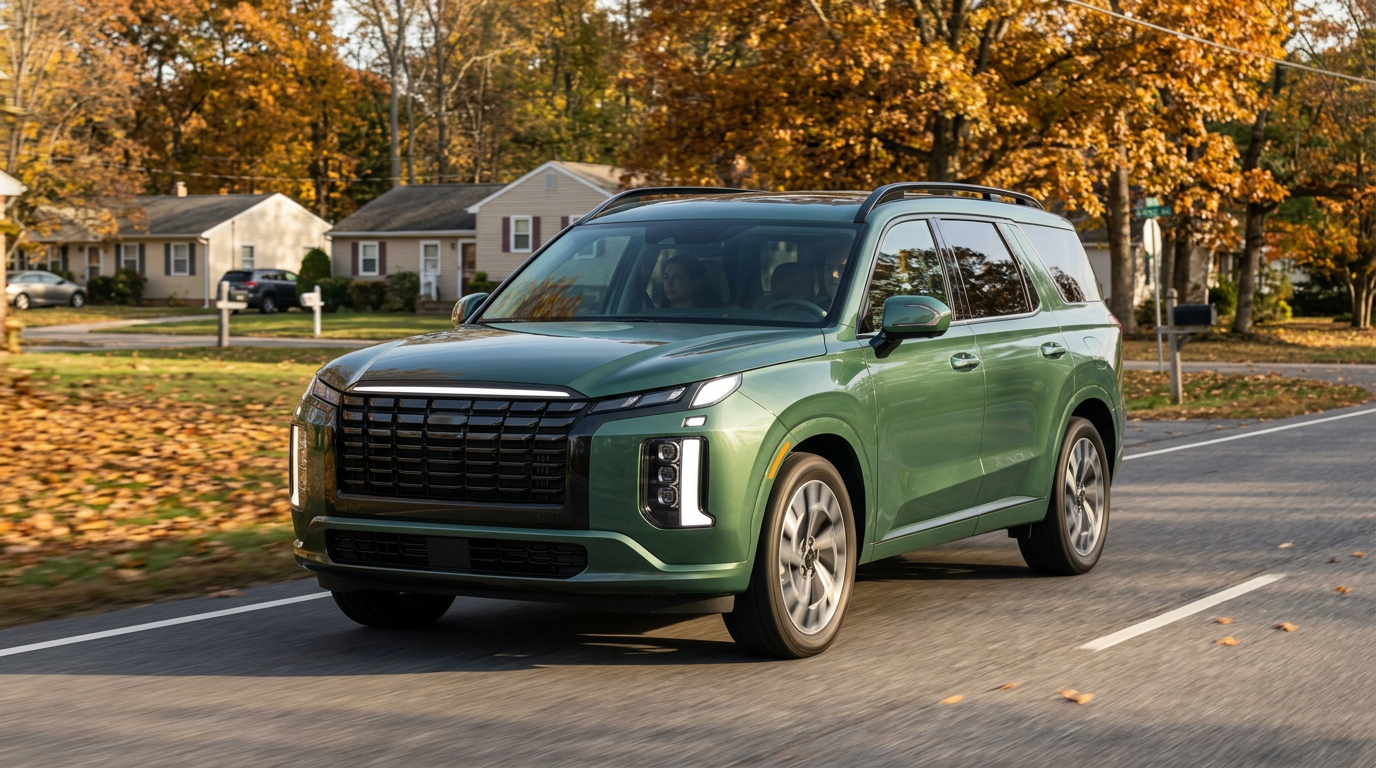
Why Families Are Choosing the 2027 Hyundai Palisade for Power, Efficiency & Luxury

Why Families Are Choosing the 2027 Hyundai Palisade for Power, Efficiency & Luxury

The 2027 Hyundai Palisade wins this three-row comparison by delivering an unmatched combination of standard performance, hybrid efficiency, and upscale executive refinement at an accessible price point. Powered by a standard 2.5L turbo hybrid engine producing 329 hp and 339 lb-ft of torque, the Palisade outperforms the base powertrains of the 2027 Toyota Grand Highlander and 2026 Honda Pilot while achieving up to 35 MPG on the highway. With a starting base MSRP of $44,560, the Palisade provides superior features and longer warranty coverage for less money. Table of Contents Which SUV Offers the Best Overall Value for Families: 2027 Hyundai Palisade, 2027 Toyota Grand Highlander, or 2026 Honda Pilot? Pricing and Trim Options That Fit Family Budgets Passenger Comfort and Cargo Space for Weekend Farm Visits and Community Events Power and Handling for Coastal and Suburban Roads Fuel Efficiency and Range for Busy Middletown and Dover Commuters Safety Systems Built for School Runs and Cultural Events Warranty Coverage and Maintenance Services Tailored for SUV Owners Frequently Asked Questions Comparing the 2027 Hyundai Palisade, 2027 Toyota Grand Highlander, and 2026 Honda Pilot Take the Next Step at Winner Hyundai Which SUV Offers the Best Overall Value for Families: 2027 Hyundai Palisade, 2027 Toyota Grand Highlander, or 2026 Honda Pilot? The 2027 Hyundai Palisade claims top honors as the best overall value for families by pairing a high-output 329 hp turbo hybrid powertrain with premium interior craftsmanship at a starting MSRP of $44,560. When evaluated against mainstream three-row competitors, the Palisade continuously delivers high-tier equipment that either costs extra or is completely unavailable on competing models. Shoppers evaluating the three-row crossover market often encounter compromise. The 2027 Toyota Grand Highlander Hybrid LE AWD starts higher at $45,910 base MSRP while providing just 245 hp and 175 lb-ft of torque from its non-turbo hybrid system. On the other hand, the 2026 Honda Pilot EX-L 2WD starts at $44,695 base MSRP with a traditional 3.5L V6 engine that achieves an underwhelming 21 MPG combined. The 2027 Hyundai Palisade eliminates this compromise entirely. Standard equipment across all trims includes a reconfigurable 12.3 in digital instrument cluster, a matching 12.3 in infotainment touch screen with full map navigation, a 300 v lithium-ion battery system, wireless device charging, and synthetic leather seat upholstery. Drivers navigating daily carpool routines around Middletown benefit from a versatile cabin engineered for serene long-distance comfort and instant electric torque assistance. Financially, the Palisade maintains an insurmountable edge. Buyers can contact us for current pricing to explore available incentive structures, or take advantage of online tools when applying for financing online through our secure platform. By providing superior standard horsepower, higher highway fuel economy, and comprehensive technology without forcing buyers into expensive option packages, the Palisade stands out as the smartest purchase in the segment. Pricing Manufacturer-listed pricing per trim, across compared vehicles. 2027 Hyundai Palisade Trim MSRP 2027 Toyota Grand Highlander Trim MSRP 2026 Honda Pilot Trim MSRP Blue SEL 7 Passenger Hybrid FWD $44,560 Hybrid LE AWD $45,910 EX-L 2WD $44,695 Blue SEL 8 Passenger Hybrid FWD $44,560 Hybrid Limited AWD $53,410 EX-L AWD $46,795 Blue SEL Premium 7 Passenger Hybrid FWD $47,920 Hybrid MAX Platinum AWD $60,475 Black Edition AWD $55,195 Pricing and Trim Options That Fit Family Budgets With price points spanning from $44,560 base MSRP for the entry Blue SEL trims up to $47,920 for the flagship Blue SEL Premium, the 2027 Hyundai Palisade maintains a remarkably focused, high-value lineup. Contact the dealership for current pricing and delivery details. The Palisade lineup simplifies family decision-making by offering clear, purpose-built configurations: Blue SEL 7 Passenger Hybrid FWD: $44,560 base MSRP (Delivered MSRP: $46,210). Standard 2+2+3 seating with second-row captain's chairs, H-Tex synthetic leather, dual 12.3 in screens, and 18 in alloy wheels. Blue SEL 8 Passenger Hybrid FWD: $44,560 base MSRP (Delivered MSRP: $46,210). Standard 2+3+3 seating with a second-row bench seat, sharing identical premium convenience and safety features. Blue SEL Premium 7 Passenger Hybrid FWD: $47,920 base MSRP (Delivered MSRP: $49,570). Adds a power glass sunroof, ventilated front seats, heated second-row seats, integrated door mirror position memory, and a 6-way electric driver seat adjustment with 2-way electric lumbar support. In stark contrast, competitor lineups quickly escalate into costly territory. The 2027 Toyota Grand Highlander carries a destination charge of $1,595 and scales from the base Hybrid LE AWD at $45,910 MSRP up to the Hybrid Limited AWD at $53,410 MSRP, before peaking at a staggering $60,475 MSRP for the Hybrid MAX Platinum AWD. While the Hybrid MAX Platinum trim offers 362 hp, its steep price tag severely limits its practical value for budget-conscious households. The 2026 Honda Pilot follows a similar pricing trajectory. Starting at $44,695 MSRP for the EX-L 2WD, it jumps to $46,795 MSRP for the EX-L AWD and reaches $55,195 MSRP for the top-tier Black Edition AWD. Despite these higher price tags, the Pilot lacks a hybrid powertrain across all trims, forcing buyers to pay more up front while spending significantly more at the fuel pump over time. For value-minded shoppers considering pre-owned alternatives, exploring our quality pre-owned inventory provides additional flexible choices across various price ranges. Dimensions & Capacity Capacity and dimensions by trim Specification 2027 Hyundai Palisade 2027 Toyota Grand Highlander 2026 Honda Pilot Cargo 19.1 cu ft 20.6 cu ft 18.6 cu ft Curb weight 4,652 lbs 4,565 lbs 4,678 lbs Towing 4,000 lbs 3,500 lbs 5,000 lbs Payload 1,631 lbs 1,575 lbs 1,164 lbs Seating 7 8 8 Passenger Comfort and Cargo Space for Weekend Farm Visits and Community Events The 2027 Hyundai Palisade delivers exceptional interior comfort with class-leading front legroom of 44.2 in and rear legroom of 41.4 in, ensuring ample space for adult passengers and growing children alike. Designed around executive-level ergonomics, the cabin utilizes horizontal design elements and high-grade materials to create an open, tranquil atmosphere. Interior dimensions highlight the Palisade's thoughtful spatial execution: Front Row: 41.7 in headroom ( 40.1 in with available sunroof), 44.2 in legroom, 61.4 in shoulder room, and 58.8 in hip room. Second Row: 40.7 in headroom ( 40.0 in with available sunroof), 41.4 in legroom, 61.0 in shoulder room, and 56.7 in hip room. Third Row: 37.8 in headroom ( 37.7 in with available sunroof), 32.1 in legroom, 55.6 in shoulder room, and 45.3 in hip room. When comparing third-row usability and cargo flexibility, the Palisade balances daily transportation needs with heavy-duty capacity. Behind the third row, the Palisade provides about 19 cu ft of standard cargo volume. Folding the rear seats down expands total cargo capacity to a massive about 87 cu ft. Crucially, the Palisade leads its class in payload capability with an impressive 1,631 lbs allowance, far outpacing the Grand Highlander's 1,575 lbs maximum payload and the Pilot's limited 1,164 lbs rating. While the Toyota Grand Highlander advertises about 21 cu ft of cargo space behind the third row and about 97.5 cu ft with seats folded, it compromises on front-passenger legroom ( 41.7 in) and second-row legroom ( 39.5 in). Taller drivers and second-row passengers will feel noticeably more restricted in the Toyota. The 2026 Honda Pilot falls behind both hybrid rivals, offering just about 19 cu ft of standard cargo volume behind its third row. Commuters and government professionals around Dover will appreciate the Palisade's serene cabin isolation. Laminated side acoustic glass, premium floor carpeting, and ergonomic seat contours ensure every passenger arrives relaxed, whether heading to work or taking a weekend trip. Engine & Performance Powertrain specs by trim Specification 2027 Hyundai Palisade 2027 Toyota Grand Highlander 2026 Honda Pilot Engine 2.5L 2.5L 3.5L Horsepower 329 hp 245 hp 285 hp Torque 339 lb-ft 175 lb-ft 262 lb-ft Transmission SHIFTRONIC® CVT automatic 10-speed Drivetrain Front-wheel drive All-wheel drive All-wheel drive Power and Handling for Coastal and Suburban Roads Equipped with a standard 2.5L inline 4-cylinder turbo hybrid engine generating a system total of 329 hp and 339 lb-ft of torque, the 2027 Hyundai Palisade easily outperforms the standard powertrains of both rivals. This advanced powertrain routes energy through a smooth SHIFTRONIC® 6-speed automatic transmission with manual mode and steering-wheel-mounted gearchange paddles, providing natural engine response without the rubber-band sensation common in continuously variable transmissions. The Palisade's active hybrid system incorporates two transmission-integrated motor generators: Electric Motor 1: AC permanent magnet synchronous motor delivering 17 hp ( 12.7 kW) and 75 lb-ft of torque. Electric Motor 2: AC permanent magnet synchronous motor delivering 72 hp ( 53.7 kW) and 195 lb-ft of torque. This dual-motor hybrid assistance allows the Palisade to deliver immediate low-end torque for confident merging and highway passing. Chassis dynamics are refined by a four-wheel independent suspension system featuring front MacPherson struts with a stabilizer bar and a rear multi-link design with an automatic rear leveling suspension. Stopping power is managed by 4-wheel disc brakes with 2 ventilated discs, ABS, brake assist, and electronic hand brake auto-hold. The competition struggles to match this standard mechanical refinement: 2027 Toyota Grand Highlander: The base 2.5L hybrid powertrain produces an underpowered 245 hp and 175 lb-ft of torque mated to an electronic CVT. Acceleration feels strained under full passenger loads. While Toyota offers a 362 hp Hybrid MAX variant, it requires stepping up to the $60,475 Platinum trim and sacrifices significant fuel economy. 2026 Honda Pilot: Powered by a conventional non-hybrid 3.5L V6 engine producing 285 hp and 262 lb-ft of torque paired with a 10-speed automatic transmission. The Pilot lacks electric motor torque fill, resulting in slower throttle response at lower RPMs. Regarding towing capabilities, the Palisade comes standard with a 4,000 lbs gross trailer weight braked rating ( 1,650 lbs unbraked) and standard trailer towing preparation. This comfortably exceeds the Toyota Grand Highlander Hybrid LE and Limited trims, which are capped at 3,500 lbs towing. Fuel Economy Fuel economy and range by trim Specification 2027 Hyundai Palisade 2027 Toyota Grand Highlander 2026 Honda Pilot MPG 33 city / 35 hwy / 34 combined 35 city / 32 hwy / 34 combined 19 city / 25 hwy / 21 combined Fuel Efficiency and Range for Busy Middletown and Dover Commuters The 2027 Hyundai Palisade delivers exceptional real-world efficiency with EPA-estimated fuel economy ratings of 33 city / 35 hwy / 34 combined MPG. Coupled with an 18.2 gal fuel tank capacity, the Palisade achieves a calculated total driving range of 619 mi on regular 87-octane unleaded fuel. Highway fuel economy is a key differentiator for long-distance drivers. The Palisade's 35 hwy MPG rating beats the Toyota Grand Highlander Hybrid AWD's 32 hwy MPG rating. Despite its all-wheel-drive system, the Grand Highlander Hybrid achieves 35 city / 32 hwy / 34 combined MPG with a smaller 17.2 gal fuel tank, restricting its total calculated cruising range to 585 mi —34 miles short of the Palisade. The non-hybrid 2026 Honda Pilot falls significantly behind in fuel economy analysis: 2026 Honda Pilot (3.5L V6): EPA-estimated 19 city / 25 hwy / 21 combined MPG. Driving the Honda Pilot means stopping for fuel far more frequently, resulting in higher annual fuel costs. The Palisade's energy recuperation system and 1.65 kWh usable lithium-ion battery maximize regenerative braking efficiency during stop-and-go driving, maintaining high fuel economy across all driving environments. Safety Systems Built for School Runs and Cultural Events The 2027 Hyundai Palisade sets a comprehensive safety benchmark for multi-passenger crossovers by equipping 10 standard airbags —including dual front airbags, front center airbag, front and rear side-impact airbags, driver knee airbag, and full-length side curtain airbags covering all three rows. Both the Toyota Grand Highlander and Honda Pilot carry only 8 total airbags, omitting critical rear side-impact and front center airbag protections. Hyundai integrates its complete suite of active driver assistance technologies under the Forward Collision Avoidance Assist (FCA) with Pedestrian Detection framework. Standard safety and driver assist features on the Palisade include: Forward Collision Avoidance Assist (FCA): Brakes automatically at low speeds with a minimum activation speed of just 5 mph. Lane Following Assist (LFA): Active lane control that centers the vehicle within marked travel lanes. Blind Spot Collision Warning (BCW): Radar-based overtaking sensors providing visual and acoustic alerts. Rear Cross-Traffic Collision Avoidance Assist (RCCA): Radar-based system designed to detect approaching cross-traffic while reversing. Highway Driving Assist (HDA): Level 2 partial automation highway assist combining adaptive cruise control with stop-and-go capability and map-linked corner speed adaptation. Rear Occupant Alert: Ultrasonic sensor-based detection to remind drivers of passengers in the rear seats. Demonstrating its structural integrity, the Hyundai Palisade earned the prestigious TOP SAFETY PICK+ award from the Insurance Institute for Highway Safety (IIHS) under their updated test revision criteria. While the 2027 Toyota Grand Highlander includes Toyota Safety Sense 3.0 and the 2026 Honda Pilot includes Honda Sensing, neither competitor matches the Palisade's standard 10-airbag protection array or its seamless Highway Driving Assist integration at the entry price point. Warranty Coverage and Maintenance Services Tailored for SUV Owners Hyundai backs the 2027 Palisade with America's Best Warranty, highlighted by a 10-year/100,000-mile powertrain limited warranty and a 5-year/60,000-mile new vehicle limited warranty. This extensive coverage provides double the duration and distance of the factory warranties offered by Toyota and Honda. A head-to-head warranty breakdown illustrates Hyundai's clear coverage advantage: Warranty Coverage Category 2027 Hyundai Palisade 2027 Toyota Grand Highlander 2026 Honda Pilot Bumper-to-Bumper (Whole Vehicle) 60 mth / 60,000 mi 36 mth / 36,000 mi 36 mth / 36,000 mi Powertrain Limited Warranty 120 mth / 100,000 mi 60 mth / 60,000 mi 60 mth / 60,000 mi Hybrid Battery Warranty 120 mth / 100,000 mi 120 mth / 150,000 mi N/A (Non-Hybrid) Hybrid Electrical Systems 120 mth / 100,000 mi 96 mth / 100,000 mi N/A (Non-Hybrid) Roadside Assistance 60 mth / Unlimited mi 24 mth / 25,000 mi 36 mth / 36,000 mi Anti-Corrosion Perforation 84 mth / Unlimited mi 60 mth / Unlimited mi 60 mth / Unlimited mi In unexpected breakdown or emergency situations, owners are covered exclusively by Hyundai roadside assistance programs. Drivers can connect directly with factory-trained specialists by calling Hyundai Roadside Assistance: 1-800-633-5151 for 24/7 towing to authorized service centers, flat tire assistance, and lockout support backed by genuine OEM replacement parts. To keep your vehicle operating at peak performance, owners can easily schedule service online with factory-certified technicians. Additionally, shoppers seeking pre-owned vehicles with extended factory protection can review our certified pre-owned Hyundai models for exceptional long-term reliability. Frequently Asked Questions Comparing the 2027 Hyundai Palisade, 2027 Toyota Grand Highlander, and 2026 Honda Pilot Q: Is the 2027 Hyundai Palisade more powerful than the base Toyota Grand Highlander and Honda Pilot? Yes, the 2027 Hyundai Palisade comes standard with a 2.5L turbo hybrid engine generating 329 hp and 339 lb-ft of torque. This significantly outperforms the base 2027 Toyota Grand Highlander Hybrid, which produces only 245 hp and 175 lb-ft of torque. It also offers more power and torque than the 2026 Honda Pilot's non-hybrid 3.5L V6, which generates 285 hp and 262 lb-ft of torque. Q: Which of these three-row SUVs gets the best highway fuel economy? The 2027 Hyundai Palisade achieves the highest highway fuel economy rating in this comparison at an EPA-estimated 35 MPG highway. By comparison, the 2027 Toyota Grand Highlander Hybrid AWD achieves 32 MPG highway, while the non-hybrid 2026 Honda Pilot achieves just 25 MPG highway. Combined with its 18.2 gal fuel tank, the Palisade offers a maximum calculated range of 619 mi. Q: Does the 2027 Hyundai Palisade offer a better warranty than Toyota and Honda? Yes, Hyundai provides far superior warranty protection. The 2027 Palisade includes a 10-year/100,000-mile powertrain limited warranty, a 10-year/100,000-mile hybrid system/battery warranty, and a 5-year/60,000-mile new vehicle limited warranty. Both Toyota and Honda limit their powertrain coverage to 5 years or 60,000 miles and their bumper-to-bumper coverage to 3 years or 36,000 miles. Q: How does the seating and payload capacity compare between these models? The 2027 Hyundai Palisade offers seating for 7 or 8 passengers with standard H-Tex synthetic leather seating surfaces. It boasts a class-leading maximum payload allowance of 1,631 lbs. The Toyota Grand Highlander offers up to 1,575 lbs payload capacity, while the Honda Pilot offers a significantly lower payload allowance of 1,164 lbs. Q: Where can I test drive the 2027 Hyundai Palisade? You can test drive the 2027 Hyundai Palisade at Winner Hyundai. Drivers can easily drop a pin to our Dover showroom location or give our sales team a quick call to check current vehicle availability and schedule a personal demonstration. Take the Next Step at Winner Hyundai When comparing overall value, standard performance, highway efficiency, passenger comfort, and long-term warranty peace of mind, the 2027 Hyundai Palisade emerges as the decisive winner over the 2027 Toyota Grand Highlander and 2026 Honda Pilot. Delivering 329 hp and 35 MPG highway at a starting base MSRP of $44,560, the Palisade represents the modern benchmark for family crossovers. Our professional team at Winner Hyundai is ready to help you explore every feature of this exceptional three-row SUV. Visit our showroom at 591 S Dupont Hwy, Dover, DE 19901 to compare trim levels in person, explore custom order options, and experience the refined performance of the 2027 Palisade on a test drive today. © 2026 Winner Hyundai. All rights reserved. Vehicle specification data © JATO Dynamics Limited.

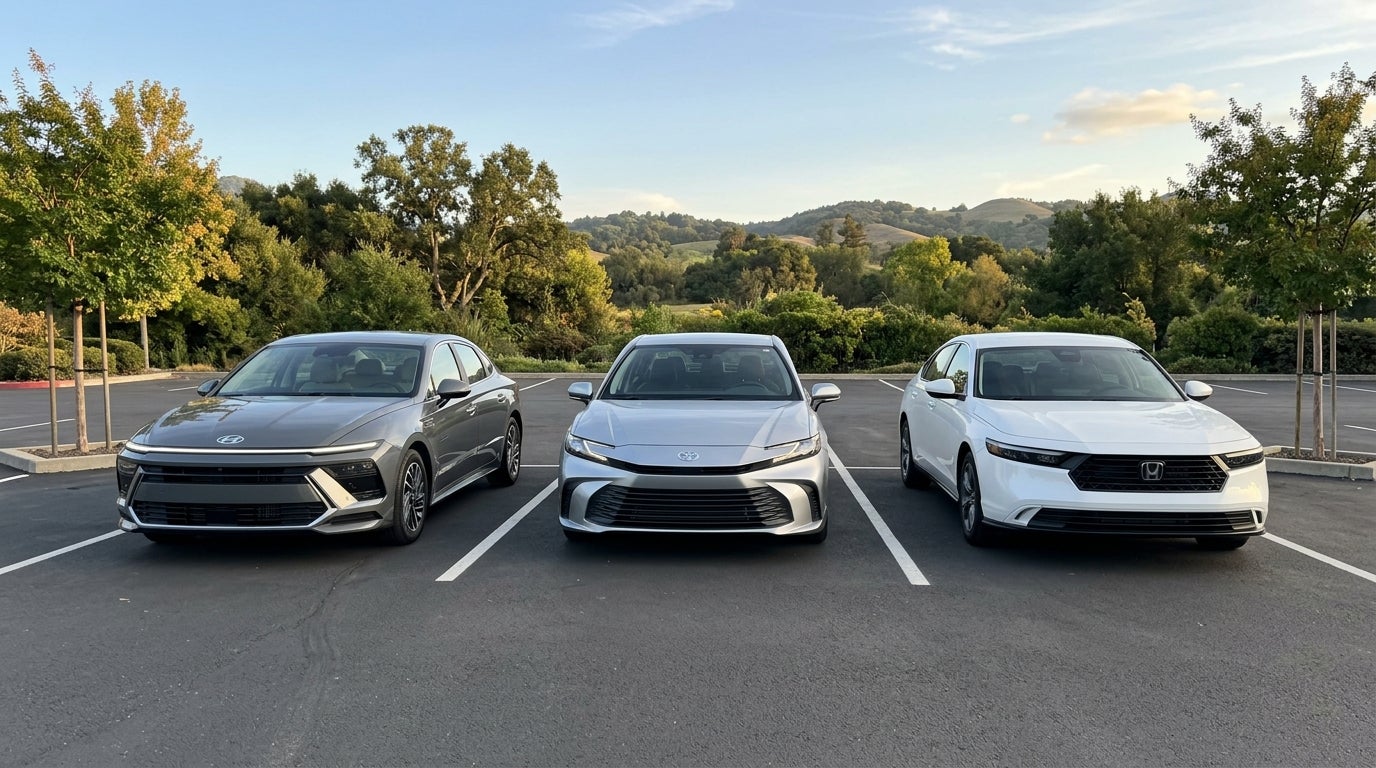
Three modern sedans—a grey Hyundai Sonata, silver Toyota Camry, and white Honda Accord—parked in an outdoor lot. (Representative image for illustration purposes only. Actual vehicle may vary based on trim and configuration.)

2026 Hyundai Sonata SE vs Camry LE vs Accord LX

For drivers seeking a refined, tech-forward, and exceptionally styled midsize sedan, the landscape of traditional passenger cars has never been more competitive. This head-to-head comparison evaluates how the newly updated 2026 Hyundai Sonata SE stacks up against its chief rivals, the 2026 Toyota Camry LE and the 2026 Honda Accord LX. We break down the pricing, real-world utility, safety suites, and ownership benefits to help you make an informed decision. Table of Contents Comparing Price and Value: 2026 Hyundai Sonata SE vs Toyota Camry LE vs Honda Accord LX Passenger Comfort and Cargo Space: Which 2026 Midsize Sedan Fits Your Lifestyle? Performance and Fuel Efficiency: Driving the 2026 Hyundai Sonata SE, Toyota Camry LE, and Honda Accord LX Technology and Safety Features in the 2026 Sonata SE, Camry LE, and Accord LX Warranty Coverage and Maintenance Benefits for 2026 Hyundai, Toyota, and Honda Sedans Frequently Asked Questions When Choosing Between the 2026 Sonata SE, Camry LE, and Accord LX Table of Contents Why the 2026 Hyundai Sonata SE, Toyota Camry LE, and Honda Accord LX Are Top Choices for Dover Drivers While the market is flooded with high-riding utility vehicles, a dedicated group of buyers still recognizes that a traditional passenger car offers superior highway dynamics and a much sleeker profile. The scenic, flat highway commutes around Dover are a perfect example of where a low-slung, aerodynamically efficient vehicle excels, saving fuel while delivering a quiet, composed ride. For those comparing the market's leading options, we invite you to discover why shop with us at Winner Hyundai to see these advantages firsthand. The 2026 Hyundai Sonata SE serves as a tech-forward, bold alternative to the crossover status quo. It is positioned to deliver premium aesthetics and an insulated cabin without forcing buyers to step up to expensive luxury tiers. By contrast, the 2026 Toyota Camry LE has transitioned to an exclusively hybrid powertrain, appealing to those focused strictly on fuel numbers, while the 2026 Honda Accord LX relies on its traditional reputation for conservative, unpretentious execution. If you are ready to experience the modern cabin and striking fastback silhouette of our featured sedan, you can easily schedule a test drive or visit our primary showroom to speak with our product specialists. Pricing Manufacturer-listed pricing per trim, across compared vehicles. 2026 Hyundai Sonata SE Trim MSRP 2026 Toyota Camry LE Trim MSRP 2026 Honda Accord LX Trim MSRP SE $27,450 LE $29,300 LX $28,395 Comparing Price and Value: 2026 Hyundai Sonata SE vs Toyota Camry LE vs Honda Accord LX Which midsize sedan offers the most features for your hard-earned dollar? When analyzing the financial landscape, the 2026 Hyundai Sonata SE establishes an immediate and undeniable advantage. With a starting base MSRP of $27,450 and a destination charge of $1,245, it represents the most accessible entry point in this comparison. In comparison, the 2026 Honda Accord LX carries a base MSRP of $28,395 (with a $1,195 destination charge), and the hybrid-only 2026 Toyota Camry LE demands a steeper entry fee of $29,300 (with a $1,195 destination charge). This means choosing the Sonata SE saves you $1,850 compared to the Camry LE and $945 compared to the Accord LX. What makes this price gap even more impressive is that Hyundai does not strip down the SE trim. It comes standard with high-value features like a massive 12.3-inch touchscreen, proximity keyless entry, push-button start, and hands-free smart trunk release. To find out exactly how much you can save on your next vehicle, you can request a price quote tailored to your specific preferences. Analyzing the True Value of Standard Equipment When comparing base models, manufacturers often exclude features to advertise a lower starting price. However, the Sonata SE breaks this pattern. It includes standard proximity keyless entry with push-button start and a hands-free smart trunk release—features that require buying the expensive Convenience Package on the Camry LE. Optional Packages and Customization The Sonata SE also excels in dealer-installed customization options, allowing buyers to tailor their vehicle to their exact lifestyle. For instance, the Cargo Package (PIO) is available for $160 and includes a custom cargo tray and cargo blocks to keep gear secure. Drivers facing harsh winters can opt for the Winter Weather Package (PIO) for $385, which adds custom-molded mud guards and all-season fitted liners to protect the footwells from mud and snow. ### Dimensions & Capacity *Capacity and dimensions by trim* Specification 2026 Hyundai Sonata SE 2026 Toyota Camry LE 2026 Honda Accord LX Seating 5 5 5 Cargo 15.6 cu ft 15.1 cu ft 16.7 cu ft Curb weight 3,232 lbs 3,450 lbs 3,239 lbs Passenger Comfort and Cargo Space: Which 2026 Midsize Sedan Fits Your Lifestyle? One of the first things families notice when stepping inside a modern sedan is how much more intimate and quiet the cabin feels compared to a noisy, cavernous SUV. The 2026 Hyundai Sonata SE is engineered to maximize this comfort, offering premium cloth seating surfaces and a quiet, insulated environment. In terms of trunk space, the Sonata SE provides about 16 cu ft of cargo volume, which easily outpaces the 2026 Toyota Camry LE's about 15 cu ft. While the 2026 Honda Accord LX offers a slightly larger about 17 cu ft trunk, it suffers from a significant practical drawback: a single-piece fold-down rear seatback. The Sonata SE, by contrast, features a standard 60/40 split-folding rear seat, allowing you to carry longer items like golf clubs or lumber while still maintaining seating for rear passengers. Cabin Ergonomics and Passenger Comfort The Sonata SE features a driver-centric cockpit designed with intuitive controls and clear sightlines. The lower dashboard design and slim A-pillars improve forward visibility, making tight parking maneuvers much easier. Rear passengers benefit from generous legroom and shoulder room, ensuring adults can ride comfortably on long road trips. Trunk Usability and Storage Solutions While volume numbers tell part of the story, the shape and opening of the cargo area are equally important. The Sonata SE features a wide trunk opening and a low liftover height, which reduces strain when loading heavy grocery bags or luggage. Standard cargo hooks and side bins help keep smaller items organized and prevent them from sliding around during transit. ### Engine & Performance *Powertrain specs by trim* Specification 2026 Hyundai Sonata SE 2026 Toyota Camry LE 2026 Honda Accord LX Engine 2.5L 2.5L 1.5L Horsepower 191 hp 225 hp 192 hp Torque 181 lb-ft 163 lb-ft 192 lb-ft Transmission 8-speed automatic eCVT CVT Drivetrain Front-wheel drive Front-wheel drive Front-wheel drive Fuel Economy Fuel economy and range by trim Specification 2026 Hyundai Sonata SE 2026 Toyota Camry LE 2026 Honda Accord LX MPG 28 city / 38 hwy / 32 combined 52 city / 49 hwy / 51 combined 29 city / 37 hwy / 32 combined Performance and Fuel Efficiency: Driving the 2026 Hyundai Sonata SE, Toyota Camry LE, and Honda Accord LX While peak horsepower numbers look great on paper, the way a vehicle delivers its power during daily driving is what truly defines the experience. The 2026 Hyundai Sonata SE utilizes a naturally aspirated Smartstream 2.5L GDI/MPI 4-Cylinder engine that produces 191 hp and 181 lb-ft of torque. What sets the Sonata apart from its rivals is its transmission: a traditional geared 8-speed automatic with SHIFTRONIC. This setup provides crisp, distinct gear changes and a highly connected driving feel. In comparison, the 2026 Honda Accord LX pairs its 1.5L turbocharged engine (192 hp, 192 lb-ft) with a continuously variable transmission (CVT), which can often result in a droning engine note under hard acceleration. The 2026 Toyota Camry LE features a 2.5L hybrid system making 225 hp, but its eCVT and heavy 3,450 lbs curb weight (compared to the Sonata SE's nimble 3,232 lbs) compromise its handling agility. Furthermore, the Camry's hybrid battery adds complexity and weight to the chassis. For highway commuters, the Sonata SE offers an excellent balance of performance and efficiency, achieving a highly competitive 28 city / 38 hwy / 32 combined MPG on regular unleaded fuel, making it a stellar long-distance companion. Transmission Dynamics: Geared vs. CVT The choice of transmission has a massive impact on daily driving enjoyment. The Sonata's 8-speed automatic uses physical gears to match engine speed with vehicle speed, providing immediate throttle response and predictable downshifts when passing. CVTs, like those in the Accord and Camry, continuously vary their ratios, which can create a "rubber-band" effect where engine noise rises rapidly before the vehicle accelerates. Chassis Engineering and Steering Precision Under the skin, the Sonata SE utilizes a Motor-Driven Power Steering (MDPS) rack-and-pinion system that is tuned to deliver precise feedback. The suspension setup is balanced to absorb road imperfections without feeling floaty, maintaining excellent body control through sweeping turns. This composed ride quality makes the Sonata SE feel like a much more expensive, near-luxury vehicle on the open highway. Technology and Safety Features in the 2026 Sonata SE, Camry LE, and Accord LX I often hear buyers express frustration about having to pay for expensive upper-tier trims just to get modern digital displays and essential driver-assistance systems. Hyundai completely rewrites this script with the 2026 Hyundai Sonata SE. It comes standard with a class-leading 12.3-inch touchscreen display featuring wireless Apple CarPlay® and wireless Android Auto™. This dwarfs the 8-inch screen found in the Camry LE and the 9-inch screen in the Accord LX. Additionally, Sonata buyers get standard Bluelink+ connectivity, which keeps you seamlessly connected to your vehicle. On the safety front, the Sonata SE is a fortress of advanced driver-assist systems. It features Smart Cruise Control (SCC) with Stop & Go and Forward Collision-Avoidance Assist with junction-turning detection. Crucially, the Sonata SE includes standard Blind-Spot Collision Warning (BCW) and Rear Cross-Traffic Collision-Avoidance Assist (RCCA). In stark contrast, the base Honda Accord LX completely lacks a blind-spot monitoring system, leaving drivers without this vital highway safety net. Standard Driver-Assistance Technologies The Sonata's standard safety suite is incredibly comprehensive. The Forward Collision-Avoidance Assist system does not just look straight ahead; its junction-turning detection can identify oncoming vehicles when you are making a left turn across traffic and apply the brakes if a collision is imminent. The Safe Exit Warning (SEW) is another brilliant standard feature that alerts passengers of approaching traffic before they open their doors. Infotainment and Connectivity The 12.3-inch display in the Sonata SE is not just large; it features high-resolution graphics and an intuitive menu structure. With dual front and dual rear USB-C ports, all passengers can keep their devices charged on long road trips. The inclusion of wireless smartphone integration means you can leave your charging cables in your pocket and still access your favorite navigation and music apps seamlessly. Warranty Coverage and Maintenance Benefits for 2026 Hyundai, Toyota, and Honda Sedans Many of our customers tell us that long-term peace of mind is the single most important factor when signing on the dotted line for a new vehicle. Hyundai has built its modern reputation on delivering exactly that, offering a comprehensive manufacturer warranty package that stands as a benchmark for the industry. When you purchase the 2026 Hyundai Sonata SE, you are backed by an exceptionally robust powertrain and limited warranty program that far outlasts the standard coverage packages offered by Toyota and Honda. Furthermore, you can view maintenance benefits to see how Hyundai's complimentary factory-scheduled maintenance program covers your initial oil changes and tire rotations, saving you significant out-of-pocket costs compared to rivals. To help you protect your investment over the miles, you can see shopper assurance benefits which detail our commitment to transparent pricing and worry-free ownership. When it is time for a checkup, our factory-trained technicians are ready to assist; you can easily schedule service at our state-of-the-art facility or book a service appointment online to secure a time that fits your busy calendar. Comparing Manufacturer Warranty Packages While we do not list specific years or miles due to potential regional variations, a simple side-by-side comparison of standard manufacturer-backed coverage reveals that Hyundai consistently provides longer and more comprehensive protection than both Toyota and Honda. This long-term commitment demonstrates Hyundai's confidence in the build quality and durability of its vehicles. Coverage Type Hyundai Sonata SE Toyota Camry LE Honda Accord LX Powertrain Warranty Industry-Leading Standard Standard New Vehicle Limited Warranty Excellent Standard Standard Complimentary Maintenance Included Limited Limited Roadside Assistance Comprehensive Standard Standard Frequently Asked Questions When Choosing Between the 2026 Sonata SE, Camry LE, and Accord LX To help simplify your shopping process, we have compiled the most common questions we receive from drivers comparing these three midsize sedans. Is the 2026 Toyota Camry LE worth the price premium over the 2026 Hyundai Sonata SE? For most buyers, the answer is no. The Camry LE starts at $29,300, which is $1,850 more than the Sonata SE's base MSRP of $27,450. While the Camry LE delivers high hybrid fuel numbers, the Sonata SE offers a far superior standard technology package—including a 12.3-inch screen compared to the Camry's 8-inch display—and a much more natural driving feel thanks to its geared 8-speed automatic transmission. Which sedan offers the most versatile cargo space? Although the Accord LX has a slightly larger trunk on paper, it only offers a single-piece fold-down rear seatback. The Sonata SE provides about 16 cu ft of cargo volume paired with a highly practical 60/40 split-folding rear seat, making it much easier to transport bulky items while still utilizing rear passenger seats. Does the Honda Accord LX include standard blind-spot monitoring? No. The base Accord LX does not offer a blind-spot information system. In contrast, the Sonata SE comes standard with Blind-Spot Collision Warning (BCW) and Rear Cross-Traffic Collision-Avoidance Assist (RCCA), providing critical peace of mind for daily driving. How can I test drive the 2026 Hyundai Sonata SE? You can easily get directions to our showroom at 591 S Dupont Hwy, Dover, DE 19901 to explore the Sonata in person, or give our friendly sales team a quick call to schedule a convenient appointment. © 2026 Winner Hyundai. All rights reserved.

Winner_Hyundai_Hyundai_vs_Toyota_Oct_2026

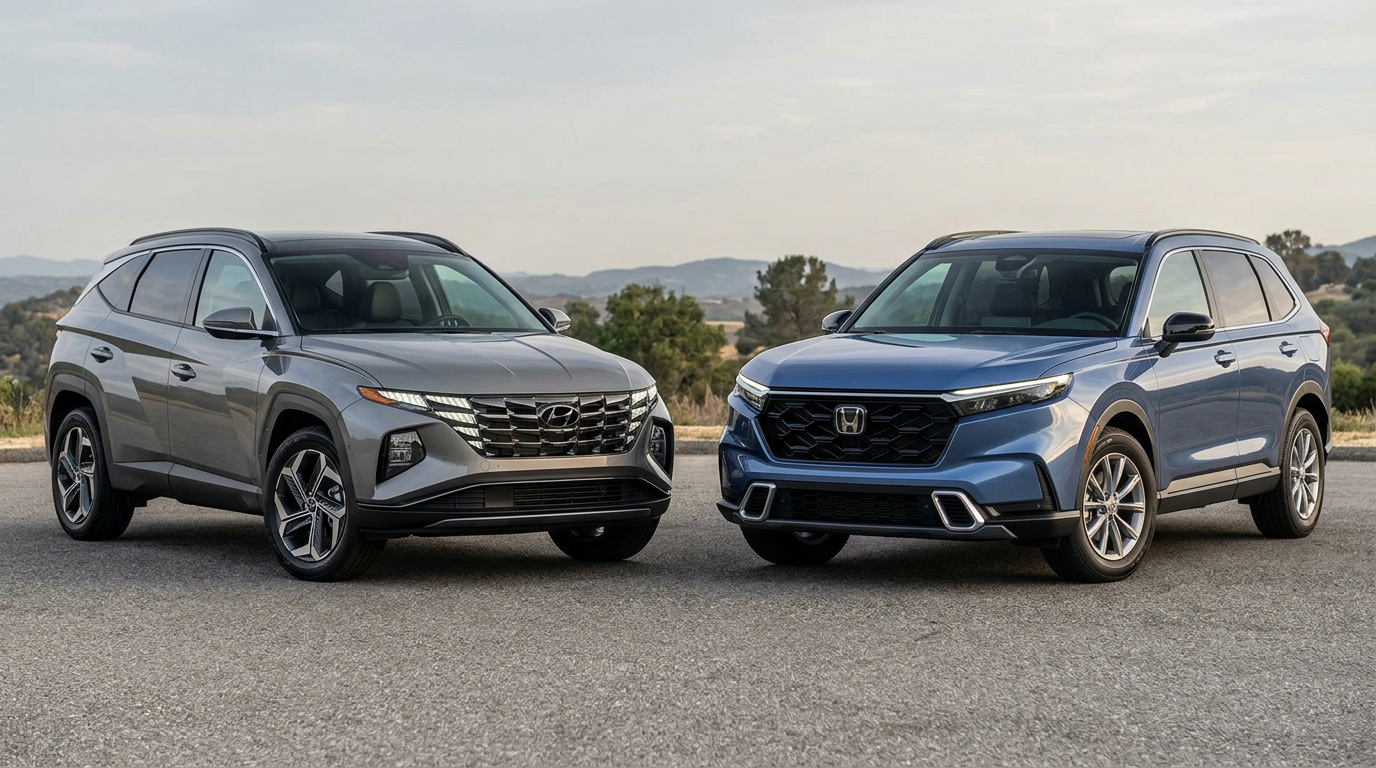
How Does the Engine Performance of the 2026 Hyundai Tucson Compare to the 2026 Honda CR-V?

The 2026 Hyundai Tucson delivers strong overall performance flexibility and power compared to the 2026 Honda CR-V, offering up to 231 horsepower in its hybrid trim and 268 horsepower in its plug-in hybrid model, whereas the Honda CR-V maxes out at 204 horsepower in its hybrid trim. While the base CR-V gas model provides 190 horsepower from a turbocharged 1.5-liter engine, the Tucson gas model features a naturally aspirated 2.5L four-cylinder engine with 187 horsepower and 178 lb-ft of torque mated to an eight-speed automatic transmission, offering a different driving feel than Honda's continuously variable transmission. When comparing standard gas engines, the non-turbo 2.5L engine in the Tucson generates strong, linear power across the rev band. Power transfers directly through a conventional torque-converter eight-speed automatic transmission, giving drivers sharp gear shifts and predictable pedal response. The standard Honda CR-V uses a smaller 1.5-liter turbocharged engine generating 190 horsepower and 179 lb-ft of torque, but pairs it exclusively with a continuously variable transmission (CVT). Drivers who prefer distinct step-gear shifting may appreciate the Tucson during highway merging and passing maneuvers. For buyers seeking upgraded efficiency and muscle, the powertrain gap widens further in favor of Hyundai. The 2026 Hyundai Tucson Hybrid pairs a 1.6L turbocharged engine with an electric motor to generate a combined 231 horsepower and 271 lb-ft of torque, shifting through a proven six-speed automatic transmission. By contrast, the Honda CR-V Hybrid uses a 2.0-liter naturally aspirated engine with dual electric motors for 204 horsepower and 247 lb-ft of torque. Furthermore, Hyundai offers the Tucson Plug-in Hybrid with 268 horsepower and standard all-wheel drive, a high-output PHEV configuration not offered in the CR-V lineup. For drivers taking on daily commutes through Dover, the Tucson provides balanced power delivery that handles flat coastal plain routes and merging highway traffic with equal ease. To inspect the full lineup or arrange a test drive, feel free to give our team a call at (302) 877-2489 or stop by our Dover showroom location. Table of Contents How Do the Hybrid Powertrains and EPA Fuel Economy Ratings Compare? Transmission Response and Towing Capacity: 8-Speed Automatic vs. CVT How Does Tucson and CR-V Performance Compare to the Toyota RAV4? What Reliability Ratings, Maintenance Costs, and Warranties Support Long-Term Value? Frequently Asked Performance Questions About the 2026 Tucson and CR-V Experience 2026 Hyundai Tucson Performance How Do the Hybrid Powertrains and EPA Fuel Economy Ratings Compare? The 2026 Hyundai Tucson Hybrid delivers an EPA-estimated 38 mpg combined in its Blue SE HEV AWD trim while providing significantly more horsepower and torque than the Honda CR-V Hybrid. While front-wheel drive CR-V Hybrid trims achieve up to 43 mpg combined and all-wheel drive CR-V Hybrids reach up to 40 mpg combined, the Tucson Hybrid trades a minor mileage delta for a substantial performance advantage of 231 horsepower and 271 lb-ft of torque, compared to Honda's 204 horsepower and 247 lb-ft of torque. Hyundai achieves this higher torque output by utilizing a 1.6L turbocharged engine paired with a parallel electric motor and a geared six-speed automatic transmission. Most hybrid crossovers in this segment employ naturally aspirated engines connected to electronic continuously variable transmissions (e-CVTs), which can cause high engine RPM droning during sustained uphill climbs or rapid acceleration. The Tucson Hybrid’s geared setup preserves traditional shift feel while delivering immediate low-end electric torque. For commuters comparing standard gas efficiency, the non-hybrid Tucson gas model delivers an EPA-rated 25 mpg city / 33 mpg highway / 28 mpg combined with front-wheel drive, and 24 mpg city / 30 mpg highway / 26 mpg combined when equipped with all-wheel drive. Standard gas CR-V models achieve 28 mpg city / 34 mpg highway in front-wheel drive and 27 mpg city / 32 mpg highway in all-wheel drive. Drivers interested in zero-emission daily commuting can opt for the Tucson Plug-in Hybrid ( 268 horsepower), which delivers an EPA-rated 77 MPGe combined in electric operation, 35 mpg combined in hybrid operation, and 32 miles of all-electric driving range. Honda currently offers no plug-in hybrid variant for the CR-V. 2026 Hyundai Tucson Blue SE HEV AWD: 38 mpg combined ( 38 city / 38 hwy), 231 horsepower, 271 lb-ft of torque. 2026 Hyundai Tucson Hybrid (SEL / Limited AWD): 36 mpg combined, 231 horsepower, 271 lb-ft of torque. 2026 Hyundai Tucson PHEV AWD: 77 MPGe combined, 35 mpg combined gas-hybrid, 32 miles EV range, 268 horsepower. 2026 Honda CR-V Hybrid AWD: 40 mpg combined, 204 horsepower, 247 lb-ft of torque. 2026 Honda CR-V Hybrid FWD: 43 mpg combined, 204 horsepower, 247 lb-ft of torque. If you are open to pre-owned options, you can also browse our pre-owned vehicle selection. Transmission Response and Towing Capacity: 8-Speed Automatic vs. CVT The standard gas 2026 Hyundai Tucson out-tows the standard gas Honda CR-V with a maximum towing capacity of 2,000 lbs (and up to 2,750 lbs when maximum equipped) compared to the CR-V gas model's 1,500-pound limit. In addition to towing more weight, the Tucson uses a standard eight-speed automatic transmission ( SHIFTRONIC®) that provides crisp gear engagement, contrasting with the continuous gear-ratio adjustments of the CR-V's continuously variable transmission. Buyers comparing these crossovers on a test drive often notice how the Tucson's traditional eight-speed automatic transmission provides distinct, predictable shift points when accelerating onto highway merging ramps compared to the continuous engine speed of a CVT. Under hard throttle application, CVTs often force the engine to hold high revolutions, creating a noticeable cabin hum. The SHIFTRONIC® transmission in the Tucson lets drivers manually select gears when descending grades or pulling a light trailer, maintaining direct mechanical connection and engine braking control. Towing capabilities further separate these two compact SUVs: Hyundai Tucson Gas (2.5L): Standard tow rating of 2,000 lbs, with maximum capability reaching 2,750 lbs when properly equipped with trailer brakes. Honda CR-V Gas (1.5L Turbo): Rated for up to 1,500 lbs towing capacity. Honda CR-V Hybrid (2.0L): Rated for up to 1,000 lbs towing capacity. Whether hauling small utility trailers, personal watercraft, or weekend camping gear, the Tucson provides a higher margin of towing confidence. Buyers exploring value-minded choices with strong capability can check certified pre-owned Hyundai pricing to compare late-model availability. How Does Tucson and CR-V Performance Compare to the Toyota RAV4? The standard Toyota RAV4 gas model delivers 203 horsepower from its 2.5-liter engine, outpowering the base 187-horsepower Tucson gas engine and the 190-horsepower CR-V gas engine, but the 2026 Hyundai Tucson Hybrid ( 231 horsepower) and Tucson Plug-in Hybrid ( 268 horsepower) comfortably exceed the peak output of both the RAV4 gas (203 hp) and RAV4 Hybrid (219 hp). In terms of torque, the Hyundai Tucson Hybrid family generates 271 lb-ft of torque, outclassing the RAV4 Hybrid's 163 lb-ft of gas engine torque and the CR-V Hybrid's 247 lb-ft of system torque. This extra low-end power gives the Tucson Hybrid an advantage when pulling away from stops or passing slower traffic on two-lane roads. Base Gas Engine Horsepower: Toyota RAV4 (203 hp) > Honda CR-V (190 hp) > Hyundai Tucson 2.5L ( 187 hp). Hybrid System Horsepower: Hyundai Tucson Hybrid ( 231 hp) > Toyota RAV4 Hybrid (219 hp) > Honda CR-V Hybrid (204 hp). Plug-In Hybrid Horsepower: Toyota RAV4 Prime (302 hp) > Hyundai Tucson PHEV ( 268 hp) > Honda CR-V (No PHEV offered). Standard Towing Capacity: Hyundai Tucson ( 2,000 lbs standard / 2,750 lbs max) > Toyota RAV4 (1,500 lbs standard) = Honda CR-V (1,500 lbs). For suburban commuters navigating the farmland connectors around Middletown, the Tucson Hybrid's combined torque and geared automatic transmission offer responsive acceleration through variable road conditions. When you are ready to explore purchase options, you can get started by prequalifying for credit online. What Reliability Ratings, Maintenance Costs, and Warranties Support Long-Term Value? The 2026 Hyundai Tucson offers long-term protection with America's Best Warranty, featuring a 10-year/100,000-mile powertrain warranty and a 5-year/60,000-mile limited warranty, whereas Honda covers the CR-V with a 3-year/36,000-mile basic warranty and a 5-year/60,000-mile powertrain warranty. In addition, Hyundai includes complimentary factory maintenance for the first 3 years or 36,000 miles, helping lower initial 5-year out-of-pocket ownership costs relative to rivals. While the Honda CR-V maintains a strong historical reputation for low unscheduled repair frequency, Hyundai narrows the ownership cost gap through comprehensive warranty backing and bundled factory service. By eliminating routine oil change and tire rotation costs during early ownership, Tucson owners retain lower predictable routine maintenance expenses. Entry pricing across the 2026 Tucson lineup provides options across a range of price points, starting with the SE FWD at a base MSRP of $29,700 (plus a $1,650 destination charge). Moving to the standard all-wheel drive Blue SE HEV AWD hybrid brings an entry base MSRP of $32,800. Higher trim levels like the SEL Convenience HEV AWD start at $35,250 base MSRP, while the fully equipped Limited PHEV AWD reaches $48,900 base MSRP. To keep your crossover running at peak efficiency throughout its lifecycle, our factory-trained service technicians are ready to assist with routine care when you are scheduling a maintenance appointment online. Frequently Asked Performance Questions About the 2026 Tucson and CR-V Q: Does the 2026 Hyundai Tucson Hybrid require a plug or external charger? No, the standard 2026 Hyundai Tucson Hybrid uses regenerative braking and engine power to self-charge its onboard battery automatically during driving. Only the Tucson Plug-in Hybrid (PHEV) features an external charge port, which allows drivers to plug in and receive up to 32 miles of all-electric driving before switching over to standard hybrid operation. Q: Which SUV offers higher overall horsepower in its hybrid configuration? The 2026 Hyundai Tucson Hybrid provides 231 horsepower and 271 lb-ft of torque, outperforming the Honda CR-V Hybrid's total system output of 204 horsepower and 247 lb-ft of torque. The Tucson achieves this higher rating by combining a 1.6L turbocharged engine with an electric motor and a geared six-speed automatic transmission. Q: Can the 2026 Hyundai Tucson handle light trail driving or inclement weather? Yes, Tucson models equipped with Hyundai's active all-wheel drive system continuously monitor road traction to distribute engine torque between the front and rear axles. With ample ground clearance and selectable drive modes, the Tucson manages wet pavement, light mud, unpaved gravel, and slippery winter conditions with confidence. Q: How does standard gas engine acceleration compare between the Tucson and CR-V? The Honda CR-V's 1.5-liter turbocharged engine delivers slightly faster 0-60 mph launch times, but the Tucson's naturally aspirated 2.5L engine paired with an eight-speed automatic transmission provides linear acceleration without reliance on turbo spooling or the engine droning associated with continuous variable transmissions. Q: What routine document preparation helps speed up a vehicle test drive or purchase visit? Arriving with a valid driver's license, a current auto insurance card, and recent proof of income or trade-in documentation allows our dealership staff to quickly organize test drives and complete financing steps without delays. Experience 2026 Hyundai Tucson Performance With its advanced hybrid system delivering up to 268 horsepower and an eight-speed automatic transmission, the 2026 Hyundai Tucson offers a compelling performance package that surpasses many competitors. Combined with America's Best Warranty—including a 10-year/100,000-mile powertrain warranty —the Tucson delivers driving confidence, competitive fuel efficiency, and overall value. Our team at Winner Hyundai is dedicated to helping you explore the Tucson lineup firsthand. Whether you want to test drive the standard gas 2.5L engine or experience the torque of the 1.6L turbocharged engine hybrid, we are here to assist you. Contact our sales team directly at (302) 877-2489 to ask questions or set up your appointment. when you are ready to visit us, visit our Dover showroom at 591 S Dupont Hwy, Dover, DE 19901 to compare trims and get behind the wheel today. © 2026 Winner Hyundai. All rights reserved. Vehicle specification data © JATO Dynamics Limited.