
Blog / Lease Specials & Incentives

Blog

All Lease Specials & Incentives Buying Guides Community Events New Vehicle Reviews Model Comparisons Financing & Insurance Safety Features Technology & Innovation Maintenance & Service New Vehicle Sales New Vehicle Specials & Incentives Automotive Sales & Promotions New Inventory Used Vehicle Guides Dover Hyundai Dealer Inventory & Availability Seasonal Driving Tips Vehicle Specials & Incentives Automotive Parts & Repairs Inventory Updates Air Conditioning & Climate Control Electric Vehicle (EV) Maintenance OEM Parts & Repairs OEM Parts & Warranty Service Repair & Diagnostics Seasonal Vehicle Care Service Process & Claims Tire Care & Safety Used Vehicle Purchasing Vehicle Care Tips Vehicle Cooling Systems Warranty & Protection Plans
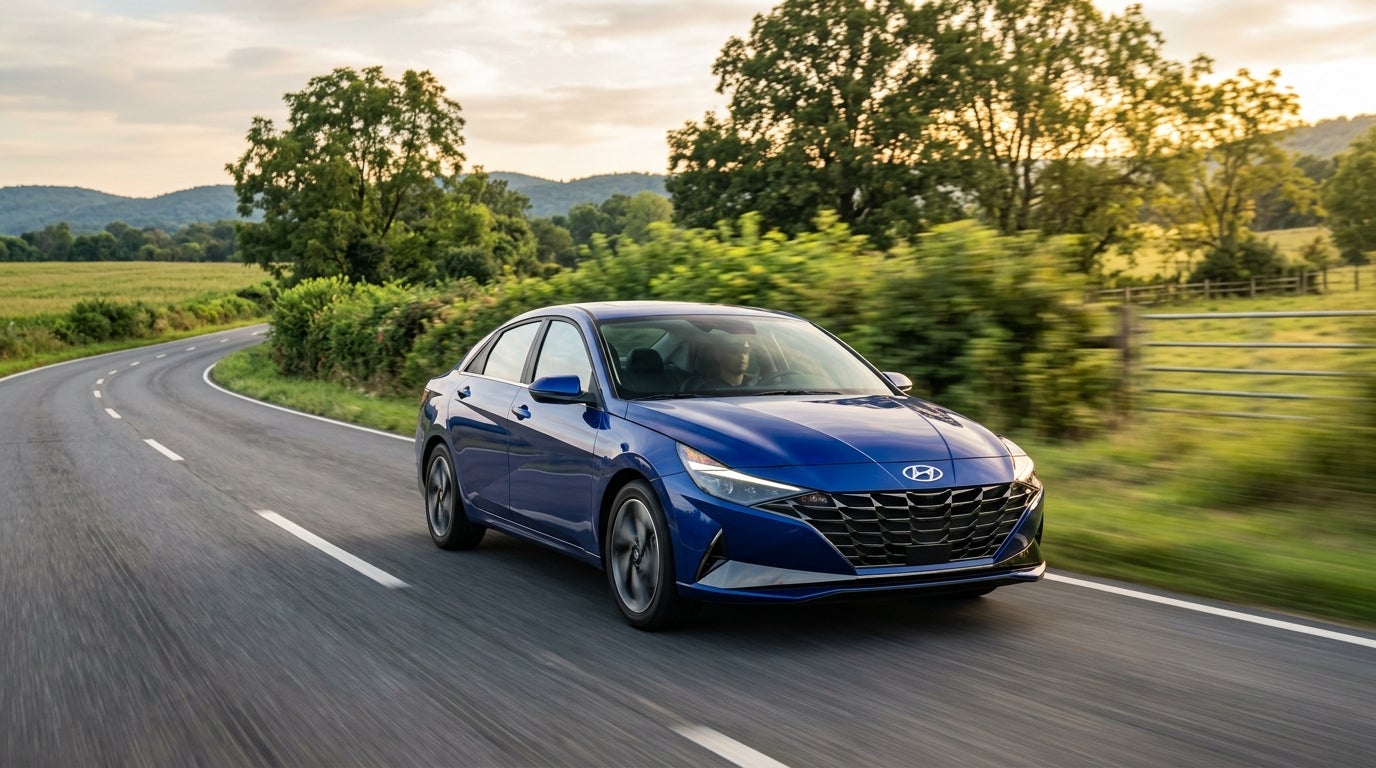
Blue Hyundai Elantra sedan driving along a winding country road flanked by green fields and trees at sunset. (Representative image for illustration purposes only. Actual vehicle may vary based on trim and configuration.)

Discover How the 2026 Hyundai Elantra Delivers 50 MPG, Power, and Family Comfort

The 2026 Hyundai Elantra is well suited for commuters and families who want distinctive style, proven efficiency, and modern tech at an available pricing. The standout figure is 50 mpg combined on the 1.6 HEV Limited DCT hybrid trim, which stretches a single tank to a 550-mile range. Shoppers who want performance instead can step up to the 2.0 N at 286 hp, while value-minded buyers get a solid daily driver in the 2.0 SEL Sport IVT starting at $23,950. Table of Contents How Efficient and Versatile Is the 2026 Hyundai Elantra for Local Drivers? Urban Style Meets Small-Town Charm: 2026 Hyundai Elantra Exterior Design for Delaware Roads Fuel Efficiency and Performance Tailored for Wilmington-to-Dover Commutes in the 2026 Hyundai Elantra Cabin Comfort and Space Designed for Delaware Family Weekends in the 2026 Hyundai Elantra Stay Connected During Workdays and Festivals with 2026 Hyundai Elantra Technology Protecting Your Loved Ones on Local Streets and Roads: 2026 Hyundai Elantra Safety Features Breaking Down 2026 Hyundai Elantra Pricing and Trims, Camden, and Milford Buyers Warranty, Maintenance, and Service Insights for 2026 Hyundai Elantra Owners in Delaware Awards and Expert Recognition Highlighting the 2026 Hyundai Elantra's Value for Delaware Drivers 2026 Hyundai Elantra Buyer FAQs: Answers for Local Shoppers How Efficient and Versatile Is the 2026 Hyundai Elantra for Local Drivers? The 2026 Elantra lineup covers three very different buyer priorities in a single model family, with fuel economy ranging from 24 mpg combined on the performance-focused 2.0 N to 50 mpg combined on the 1.6 HEV Limited DCT hybrid. That spread matters because the right trim depends almost entirely on how you plan to use the car day to day. All three trims share front-wheel drive and a 5-passenger, 4-door sedan layout with about 14 cu ft of trunk space. The powertrain differences, however, are significant. Feature 1.6 HEV Limited DCT 2.0 N 2.0 SEL Sport IVT Engine 1.6L 2L 2L Horsepower 139 hp 286 hp 147 hp Torque 195 lb-ft 289 lb-ft 132 lb-ft Transmission EcoShift manual 6-speed Smart Stream IVT All trims share: Drivetrain: Front-wheel drive Feature 1.6 HEV Limited DCT 2.0 N 2.0 SEL Sport IVT MPG 49 city / 52 hwy / 50 combined 21 city / 29 hwy / 24 combined 30 city / 40 hwy / 34 combined The 1.6 HEV Limited DCT pairs its 1.6L four-cylinder with an active hybrid system — a front-mounted AC permanent magnet synchronous electric motor producing 43 hp and 125 lb-ft of torque on top of the gasoline engine — and routes power through a 6-speed EcoShift dual-clutch transmission. The result is a car that makes a lot of sense for drivers who cover regular miles between Dover and Wilmington and want to minimize fuel stops. Shoppers interested in a pre-owned alternative can also browse pre-owned vehicles in our inventory for additional options. The 2.0 SEL Sport IVT uses a naturally aspirated 2.0L four-cylinder with the continuously variable Smart Stream IVT transmission, landing at 34 mpg combined — a practical middle ground for families and professionals who prioritize value over maximum efficiency or performance. ​ Urban Style Meets Small-Town Charm: 2026 Hyundai Elantra Exterior Design for Delaware Roads The 2026 Elantra's exterior is one of the most visually distinctive in the compact sedan segment, and that statement holds whether you're parking it near Wilmington's Christina River waterfront or pulling up to a Camden community event. Hyundai's seventh-generation design language — sharp, angular body lines and a low, fastback-influenced roofline — gives the Elantra a presence that reads as premium well above its price class. The body measures 185.4 in long, 71.9 in wide, and 55.7 in tall on a 107.1 in wheelbase. That footprint is compact enough to navigate historic downtown streets and crowded festival parking lots without stress, yet the proportions feel substantial on the road. LED projector beam headlights with LED daytime running lights are standard across all three trims, giving the car a consistent, modern face regardless of which version you choose. The 2.0 N adds blacked-out exterior trim details and a trunk-lid spoiler that visually distinguish it from the efficiency-focused hybrid. The 1.6 HEV Limited DCT carries chrome bright trim around the side windows — a subtle luxury touch that reinforces its top-of-the-hybrid-range positioning. Color choices include Abyss Black Pearl, Serenity White Pearl, Quantum Gray Metallic, Volcanic Red Pearl, Kodiak Blue Pearl, Ecotronic Gray Pearl, and Amazon Gray Pearl. The 2.0 N also offers Performance Blue and Cyber Gray, colors exclusive to the sport trim that reinforce its sport-oriented character. Painted door mirrors are standard on the 1.6 HEV Limited DCT and 2.0 SEL Sport IVT, while the 2.0 N wears body-toned mirrors. All three sit on alloy wheels — 17-inch units on the 1.6 HEV Limited DCT and 2.0 SEL Sport IVT, and 19-inch units on the 2.0 N. ​ Fuel Efficiency and Performance Tailored for Wilmington-to-Dover Commutes in the 2026 Hyundai Elantra Pick the right trim and the 2026 Elantra handles a daily commute with real efficiency advantages that translate directly into lower fuel costs over time. The 1.6 HEV Limited DCT is the clearest example: rated at 49 mpg city / 52 mpg highway / 50 mpg combined, it carries a calculated range of 550 miles on its 11-gallon tank and requires only regular unleaded (87 octane). That kind of range means a driver making regular trips between Dover and Wilmington might refuel once every two to three weeks depending on distance. The hybrid system pairs the 1.6L inline-four — producing 139 hp and 195 lb-ft of torque — with a 1.32 kWh lithium-ion battery pack running at 240 volts and an electric motor that adds 43 hp and 125 lb-ft independently. Power flows through the 6-speed EcoShift dual-clutch transmission. The system also includes energy recuperation and a start/stop function that reduces idle fuel consumption in stop-and-go traffic. At the opposite end of the spectrum, the 2.0 N is a turbocharged performance sedan. Its 2.0L four-cylinder develops 286 hp at 5,500 rpm and 289 lb-ft of torque at 2,100 rpm, routed through a 6-speed manual transmission with an electronic limited-slip differential and launch control. The suspension is sport-tuned with an electronic responsive system, and the braking system uses four fully ventilated discs — compared to two ventilated and two solid on the other trims — with painted calipers. Fuel economy is rated at 21 mpg city / 29 mpg highway / 24 combined, and the 2.0 N requires premium unleaded (91 octane) and has a 12.4-gallon tank. Car and Driver notes that the Elantra's handling dynamics feel tuned by people who genuinely enjoy driving, with excellent body control in corners and well-balanced steering. The 2.0 SEL Sport IVT sits between these poles. Its 2.0L naturally aspirated engine produces 147 hp at 6,200 rpm and 132 lb-ft at 4,500 rpm through the Smart Stream IVT continuously variable transmission. At 30 mpg city / 40 mpg highway / 34 mpg combined on a 12.4-gallon tank (range: 422 miles), it delivers meaningful efficiency without the hybrid price premium. Front suspension is MacPherson strut with coil springs and stabilizer bar; rear is a torsion beam — a simpler setup than the multi-link rear found on the 1.6 HEV Limited DCT and 2.0 N. ​ Cabin Comfort and Space Designed for Delaware Family Weekends in the 2026 Hyundai Elantra Five adults fit comfortably, and the trunk handles a full grocery run or a picnic setup for a day at the Christina River waterfront. Front headroom is 38.7 in on the 1.6 HEV Limited DCT and 40.6 in on both the 2.0 N and 2.0 SEL Sport IVT, rear headroom is 37.3 in across all trims, and rear legroom is 38 in — enough for adults on trips around Delaware without complaint. Shoulder room measures 56.5 in front and 55.6 in rear, and front hip room is 53.4 in. Feature 1.6 HEV Limited DCT 2.0 N 2.0 SEL Sport IVT Curb weight 3,069 lbs 3,186 lbs 2,725 lbs All trims share: Seating: 5 · Cargo: about 14 cu ft The rear bench folds asymmetrically on the 1.6 HEV Limited DCT for flexible cargo loading, while the 2.0 N and 2.0 SEL Sport IVT use a one-piece fold. Trunk access is handled by a hands-free boot release on the 1.6 HEV Limited DCT — useful when your hands are full coming back from a Milford farmers market — while the other two trims use a standard remote-control trunk release. Seat materials differ meaningfully by trim. The 1.6 HEV Limited DCT is upholstered in H-Tex synthetic leather, available in Light Gray, Black, or Sage Gray, with a power-adjustable driver's seat featuring 4-way electrical adjustment, electric lumbar, heated front seats, and ventilated front seats. The driver's position also includes memory settings for seat height, reach, and recline. The 2.0 N uses Black Leather/Alcantara sport seats — a material combination that signals its performance intent — with manual adjustment front and rear. The 2.0 SEL Sport IVT offers cloth seating in Gray or Black with fully manual adjustment. All three trims include a 2-zone automatic climate control system, a front center armrest, front and rear cup holders, and illuminated vanity mirrors for both driver and passenger. The 1.6 HEV Limited DCT adds selectable ambient lighting color — a detail that elevates the cabin feel during evening drives. Edmunds notes that the Elantra delivers a wonderfully roomy cabin that punches well above its price point. ​ Stay Connected During Workdays and Festivals with 2026 Hyundai Elantra Technology The 2026 Elantra's tech stack is one of its strongest selling points, and the gap between trims is real and worth understanding before you decide. The 1.6 HEV Limited DCT and 2.0 N share a 10.25 in touchscreen infotainment display paired with a 10.25 in digital instrument cluster — a fully digital dual-screen setup that feels genuinely modern. The 2.0 SEL Sport IVT pairs an 8 in center touchscreen with a smaller 4.2 in instrument cluster display, a meaningful step down that affects daily usability. Apple CarPlay and Android Auto are standard across all three trims, with indefinite subscription terms (999 months in the catalog data). The 2.0 SEL Sport IVT adds wireless CarPlay and Android Auto connectivity — a convenience that the other two trims do not include. All three trims provide 2 front USB charging ports and 2 rear USB charging ports, plus a wireless charging pad and a front 12V power outlet. The 1.6 HEV Limited DCT and 2.0 N both include Hyundai's Blue Link telematics system with a 36-month included subscription, covering remote lock/unlock, vehicle start, speed alert, geo-fencing, theft alert, vehicle diagnostics, and driving history analysis. Blue Link also includes 36 months of remote HVAC control — useful for pre-cooling the car on a hot summer afternoon before heading to a Wilmington riverfront event. Over-the-air software updates are standard on both trims. The 1.6 HEV Limited DCT adds a built-in 3D voice-guided navigation system with a 10.25 in screen, 3 months of traffic information, and 36 months of map updates. The 2.0 N shares this navigation capability. The 2.0 SEL Sport IVT does not include the built-in navigation system. The 1.6 HEV Limited DCT and 2.0 N also include an 8-speaker Bose audio system with subwoofer and satellite radio with a 3-month trial — a meaningful upgrade over the 6-speaker setup in the 2.0 SEL Sport IVT. An embedded Wi-Fi hotspot with a 3 GB/month data allowance for 3 months is included on both upper trims. For a deeper look at how these systems work in practice, explore Hyundai's technology feature details on our site. ​ Protecting Your Loved Ones on Local Streets and Roads: 2026 Hyundai Elantra Safety Features The 2026 Elantra earned a TOP SAFETY PICK designation from the Insurance Institute for Highway Safety (IIHS) — 2026 — with Good ratings in moderate overlap front, small overlap front driver-side, side impact, and roof strength tests, plus Good-rated headlights. NHTSA awarded it a 5-star overall safety rating, including 5 stars in side impact and rollover, and 4 stars frontal. Every trim includes a substantial passive safety foundation. The 1.6 HEV Limited DCT and 2.0 SEL Sport IVT each carry 8 airbags — dual front, front side, rear side, and front-and-rear side curtain airbags. The 2.0 N carries 6 airbags (front side, rear side curtain, and dual front). All trims include front and rear seat belt pre-tensioners, height-adjustable front seat belts, and a rear center 3-point belt. LATCH child seat anchors are present on all three. A rear occupant alert system is standard across the lineup. Active safety systems are consistent across all three trims and include Forward Collision Avoidance Assist (FCA) — with pedestrian detection on the 2.0 N and 2.0 SEL Sport IVT, and with junction turning detection on the 1.6 HEV Limited DCT — activating from as low as 6 mph. Blind Spot Detection, Rear Cross-Traffic Alert (radar-based), automatic hazard lights, and a car exit warning system are all standard. The 1.6 HEV Limited DCT adds Highway Drive Assist — a Level 2 partial automation system combining adaptive cruise control with stop-and-go capability and active lane control — making highway driving between Dover and Wilmington noticeably less fatiguing. The 2.0 N and 2.0 SEL Sport IVT include Lane Following Assist. A millimeter-wave radar sensor is standard on the 1.6 HEV Limited DCT and 2.0 N. You can review the full breakdown of Elantra safety features on our website, or explore the broader Hyundai safety technology overview to compare across the lineup. ​ Breaking Down 2026 Hyundai Elantra Pricing and Trims, Camden, and Milford Buyers Three trims, three very different value propositions — and the spread between them is $11,350 from lowest to highest. Here is the exact pricing before destination: Feature 1.6 HEV Limited DCT 2.0 N 2.0 SEL Sport IVT Base MSRP $30,000 $35,300 $23,950 All trims share: Destination charge: $1,295 The 2.0 SEL Sport IVT at $23,950 is the entry point and the strongest value play for buyers who prioritize low purchase price and reasonable fuel economy. It includes a Proximity Key with push-button start, 2-zone automatic climate control, wireless Apple CarPlay and Android Auto, an 8 in touchscreen, LED projector headlights, a rearview camera with guidance display, Blind Spot Detection, Forward Collision Avoidance Assist with pedestrian detection, Rear Cross-Traffic Alert, and 17-inch alloy wheels. For a family in Camden or Milford managing a household budget while still wanting a modern, well-equipped sedan, this trim delivers a compelling package. The 1.6 HEV Limited DCT at $30,000 adds the hybrid powertrain, the full 10.25 in dual-screen digital cockpit, Bose 8-speaker audio with subwoofer, built-in navigation, Blue Link telematics, adaptive cruise control with stop-and-go, Highway Drive Assist, ambient interior lighting, a power driver's seat with memory, ventilated front seats, and H-Tex synthetic leather upholstery. The fuel savings over the 2.0 SEL Sport IVT will partially offset the price premium for high-mileage commuters. Wilmington professionals who drive regularly to Dover or beyond will find the math works in the hybrid's favor over time. The 2.0 N at $35,300 is purpose-built for driving enthusiasts. The turbocharged engine, 6-speed manual, electronic limited-slip differential, launch control, sport suspension, 19-inch wheels, and Alcantara sport seats are not available on any other Elantra trim. It is a niche choice, but a well-executed one for buyers who want a genuinely engaging compact performance sedan. All three trims are eligible for service and parts financing options at Winner Hyundai. Destination charges of $1,295 apply to all trims. ​ Warranty, Maintenance, and Service Insights for 2026 Hyundai Elantra Owners in Delaware Hyundai backs the 2026 Elantra with one of the most comprehensive warranty packages in the compact sedan segment. The basic coverage is 5 years / 60,000 miles bumper-to-bumper and 10 years / 100,000 miles powertrain — both applying to all three trims. Anti-corrosion protection runs 72 months, and paint coverage extends to 36 months / 36,000 miles. Roadside assistance is included for 60 months with unlimited distance. The 1.6 HEV Limited DCT also carries a separate 10-year / 100,000-mile battery warranty and an identical 10-year / 100,000-mile electric systems warranty, providing long-term peace of mind for hybrid system components. For owners who prefer a certified pre-owned path, Winner Hyundai also maintains certified pre-owned Hyundai inventory with transparent pricing for shoppers considering that route. Routine maintenance scheduling is straightforward through Hyundai's Blue Link connected services on the 1.6 HEV Limited DCT and 2.0 N, which include vehicle diagnostics and driving history analysis accessible remotely. When service time arrives, Winner Hyundai's service team at 591 S Dupont Hwy, Dover, DE 19901 is equipped to handle all Hyundai maintenance and warranty work. You can book a service appointment online at your convenience. Hyundai roadside assistance is manufacturer-backed and available for the full 60-month coverage period — no third-party service required. ​ Awards and Expert Recognition Highlighting the 2026 Hyundai Elantra's Value for Delaware Drivers Independent recognition of the 2026 Elantra's value is consistent across major automotive authorities. U.S. News & World Report named it Best Compact Hybrid for the Money — 2026, a designation that speaks directly to the hybrid trim's combination of efficiency, features, and purchase price. Cars.com went further, naming the Elantra Best Hybrids for the Money: Overall Winner — 2026. Newsweek's Readers' Choice Awards recognized it as Best New Car — 2026, reflecting broad consumer satisfaction across the lineup. The IIHS awarded it TOP SAFETY PICK — 2026, underscoring the structural and active safety performance documented in this article. Press commentary reinforces these accolades. Edmunds describes the Elantra as delivering excellent efficiency, an impressive technology suite, and a roomy, comfortable cabin at immense overall value. Capital One's automotive editorial team notes that the sport-styled trims are practical, quick, and offer genuinely eye-catching compact styling alongside sharp handling — a fair summary of what the 2.0 N and 2.0 SEL Sport IVT bring to the table. For Delaware buyers comparing the Elantra against the Honda Civic, Toyota Corolla, Kia K4, or Mazda3, this level of third-party validation across efficiency, safety, and value categories is a notable comparison point. ​ 2026 Hyundai Elantra Buyer FAQs: Answers for Local Shoppers Q: Which 2026 Elantra trim makes the most sense for a daily commute between Dover and Wilmington? The 1.6 HEV Limited DCT is the strongest commuter choice if fuel cost is a priority. At 50 mpg combined and a calculated range of 550 miles on its 11-gallon tank, it minimizes fuel stops on regular highway runs. If the $30,000 starting price is not the right fit for every budget, the 2.0 SEL Sport IVT at $23,950 still delivers 34 mpg combined and a 422-mile range — solid numbers for everyday driving without the hybrid premium. Q: How much cargo space does the 2026 Elantra have, and is it enough for family use? All three trims share an about 14 cu ft trunk, which is a competitive figure for a compact sedan. The rear seats fold to extend cargo capacity — asymmetrically on the 1.6 HEV Limited DCT and as a one-piece fold on the 2.0 N and 2.0 SEL Sport IVT. For grocery runs, weekend gear, or a day trip, the space is practical. Families with larger cargo needs may want to consider a crossover, but for most daily and weekend uses the trunk handles the job. Q: Does the 2026 Elantra come with a sunroof? Yes — the 1.6 HEV Limited DCT includes an electrically operated glass sunroof with one-touch opening, a sliding panel, tilt function, and a sunshade. The 2.0 N and 2.0 SEL Sport IVT do not include a sunroof in the catalog data provided. Q: What is the warranty on the hybrid battery in the 1.6 HEV Limited DCT? The hybrid battery carries a separate 10-year / 100,000-mile warranty, matching the powertrain warranty. The electric systems warranty is also 10 years / 100,000 miles. This coverage is significantly longer than the basic 5-year / 60,000-mile bumper-to-bumper warranty and provides meaningful long-term protection for the hybrid components. Q: How do I see the 2026 Elantra in person or get more information from Winner Hyundai? Winner Hyundai is located at 591 S Dupont Hwy, Dover, DE 19901. You can also reach the sales team directly at (302) 877-2489 to ask about current inventory, schedule a test drive, or get answers to any trim-specific questions before you visit. Recent customers including Matt, who purchased a 2026 Tucson, specifically praised the staff's willingness to walk through all the vehicle technology in detail — the same level of attention applies to every Elantra model on the lot. © 2026 Winner Hyundai. All rights reserved. Vehicle specification data © JATO Dynamics Limited. 2026 Hyundai Elantra Models in Dover DE | Winner Hyundai
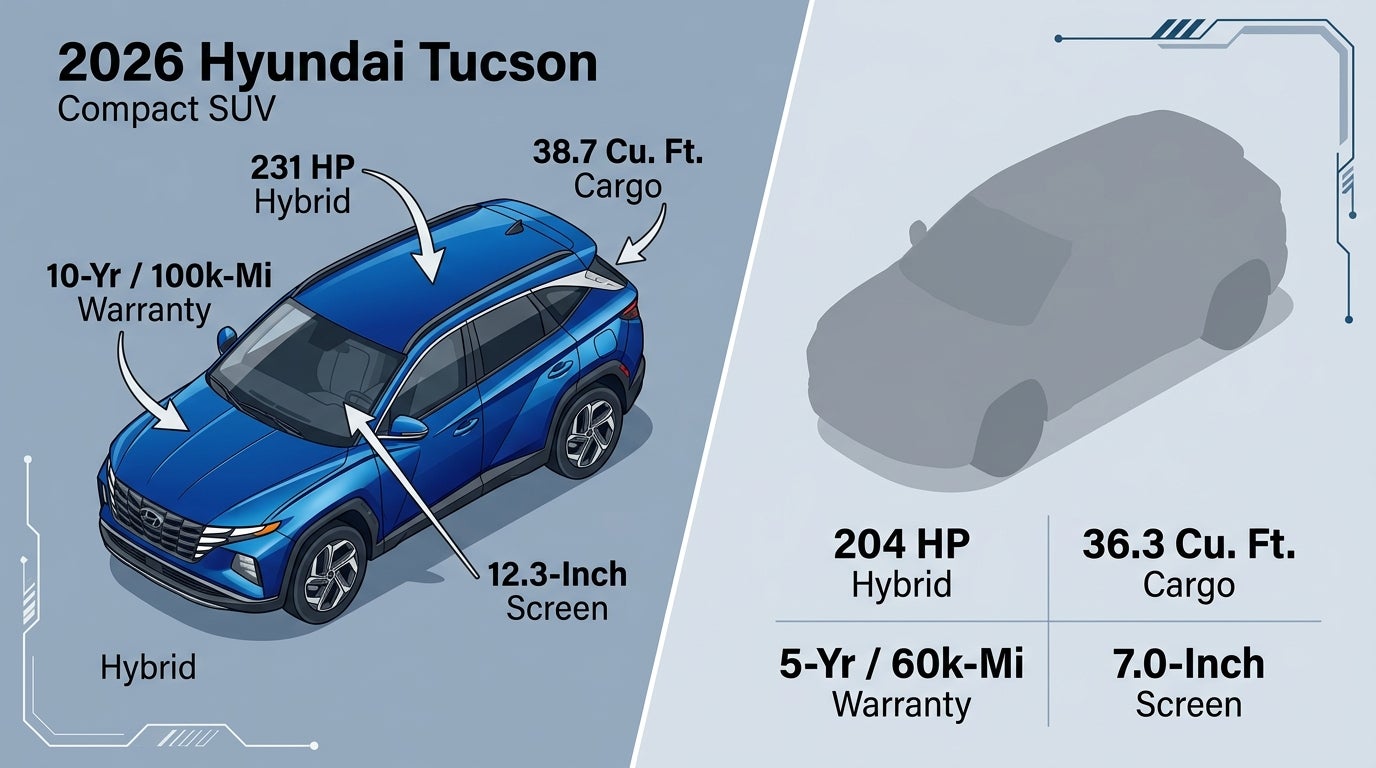
Infographic comparing key specifications of the 2026 Hyundai Tucson Hybrid against a generic competitor SUV. (Representative image for illustration purposes only. Actual vehicle may vary based on trim and configuration.)

Why the 2026 Hyundai Tucson’s Power and Value Outshine the Honda CR-V

The 2026 Hyundai Tucson offers different advantages than the 2026 Honda CR-V for most compact SUV buyers by delivering lower starting price points, higher hybrid horsepower ( 231 hp vs. 204 hp), greater rear cargo volume ( about 39 cubic feet vs. 36 cubic feet), and double the powertrain warranty duration ( 10-year/100,000-mile vs. 5-year/60,000-mile). While the CR-V offers a minor advantage in front-wheel-drive hybrid fuel economy ( 40 mpg combined vs. 38 mpg combined), the Tucson counters with superior standard technology, richer available interior luxury features, and better overall value across its lineup. Choosing between these two popular compact crossovers often comes down to what you get for your money. The Honda CR-V has long been a familiar sight on American roads, but the latest Tucson model year brings substantial updates that elevate its competitiveness. Hyundai equips the Tucson with a standard 12.3-inch touchscreen infotainment system on base trims, compared to the smaller 7.0-inch or available 9.0-inch screens found in the CR-V lineup. Furthermore, the Tucson offers a traditional 8-speed SHIFTRONIC automatic transmission on gas models and a 6-speed SHIFTRONIC automatic transmission on hybrid trims, providing a direct, conventional shifting feel that many drivers prefer over Honda's continuously variable transmission (CVT) and e-CVT setups. At Winner Hyundai, our team is dedicated to helping you compare features, test-drive different powertrains, and secure competitive financing. You can drop by our showroom on South Dupont Highway to experience the Tucson lineup in person, or give our sales specialists (302) 877-2489 a quick call to check current availability. Table of Contents What Is the Biggest Difference Between the 2026 Hyundai Tucson and 2026 Honda CR-V? How Do the Engine Options, Transmissions, and Horsepower Compare? Which Compact SUV Offers More Rear Passenger Legroom and Cargo Space? Does the Hyundai Tucson Offer Remote Smart Parking Assist and High-Tech Features? How Long Does the Hyundai Powertrain Warranty Last Compared to Honda? Common Questions About the 2026 Hyundai Tucson vs Honda CR-V Where Is Winner Hyundai Located and How Can You Test Drive a 2026 Tucson? What Is the Biggest Difference Between the 2026 Hyundai Tucson and 2026 Honda CR-V? Standard equipment and pricing set the 2026 Hyundai Tucson apart from the 2026 Honda CR-V, with the Tucson offering more tech features for less money. Entry and mid-level Tucson trims cost several thousand dollars less than comparable CR-V models while offering larger display screens, more complete driver-assistance software, and available high-tier amenities that Honda reserves exclusively for top-spec trims or omits entirely. Inside the cabin, Hyundai redesigned the dashboard to integrate physical rotary dials alongside dual 12.3-inch panoramic displays, solving common driver complaints regarding touch-only controls. The CR-V maintains a simpler interior layout, but top comfort options like ventilated front seats, heated rear seats, a 12-inch head-up display, and a 12.3-inch digital instrument cluster are available on the Tucson while missing from the CR-V feature list. For commuters navigating busy financial corridors in Wilmington, the quiet cabin insulation, standard wireless smartphone connectivity, and crisp digital displays make long highway drives refined and relaxed. Shoppers interested in exploring how Hyundai's crossover sizing fits different family needs can read our guide comparing the Tucson to the Santa Fe. If you are considering alternatives across various price points, you can also explore our inventory of pre-owned vehicles to see all available compact crossovers. ​ How Do the Engine Options, Transmissions, and Horsepower Compare? The 2026 Hyundai Tucson provides stronger horsepower and higher combined torque figures in its hybrid variants than the 2026 Honda CR-V, while giving buyers a choice of gas, hybrid, and plug-in hybrid powertrains. The base gas Tucson features a 2.5-liter four-cylinder engine generating 187 hp at 6,100 RPM and 178 lb-ft of torque at 4,000 RPM, mated to an 8-speed SHIFTRONIC automatic transmission. The standard gas Honda CR-V relies on a 1.5-liter turbocharged engine producing 191 hp paired with a CVT. When comparing hybrid configurations, the performance advantage shifts decisively toward Hyundai: 2026 Hyundai Tucson Hybrid: Combines a 1.6-liter turbocharged four-cylinder engine with a 47.7 kW electric motor to produce 231 hp and 271 lb-ft of combined torque. Power routes through a tuned 6-speed SHIFTRONIC automatic transmission with standard HTRAC All-Wheel Drive. 2026 Honda CR-V Hybrid: Uses a naturally aspirated 2.0-liter engine paired with electric motors for a total output of 204 hp and 247 lb-ft of torque, managed by an electronic e-CVT. 2026 Hyundai Tucson Plug-In Hybrid: Ups the electric output with a 72 kW electric motor and a 13.8 kWh lithium-ion battery, generating 268 hp and 271 lb-ft of torque while delivering up to 33 miles of pure electric driving range. Honda does not offer a plug-in hybrid CR-V in North America. When buyers walk around our showroom comparing hybrid setups, they usually ask whether the standard hybrid needs to be plugged in—and our team explains that the Tucson Hybrid recharges its battery automatically through regenerative braking during normal deceleration without requiring external charging cables. Fuel economy ratings remain competitive across both lineups. The entry Tucson Blue SE HEV AWD achieves an EPA-estimated 38 mpg city / 38 mpg highway / 38 mpg combined, while standard gas front-wheel-drive models earn 25 mpg city / 33 mpg highway / 28 mpg combined. Gas-powered Tucson models equipped with factory tow packages are rated to tow up to 2,750 pounds with trailer brakes, surpassing the CR-V's standard 1,500-pound tow rating. To learn more about how Hyundai vehicles stack up against other market segment rivals, check out our compact comparison reviews and sedan matchup analyses. For current owners seeking to maintain peak engine efficiency, scheduling factory-scheduled service with our certified technicians ensures your powertrain runs smoothly for miles to come. ​ Which Compact SUV Offers More Rear Passenger Legroom and Cargo Space? The 2026 Hyundai Tucson offers superior cargo capacity and more rear passenger legroom than the 2026 Honda CR-V, making it one of the most practical choices in the compact crossover class. Rear-seat passengers in the Tucson benefit from about 41 inches of legroom alongside multi-stage reclining seatbacks, providing midsize-SUV levels of comfort for adult passengers and growing children alike. Utility and cargo storage measurements highlight the Tucson's space efficiency: Rear Cargo Space (Seats Up): The Tucson holds about 39 cubic feet of luggage space behind the second row (and up to 41 cubic feet on select hybrid configurations), whereas the CR-V Hybrid holds 36 cubic feet. Maximum Cargo Space (Seats Folded): Folding the 60/40 split-folding rear seats flat in the Tucson expands total volume to about 80 cubic feet, outmeasuring the CR-V Hybrid's 72 cubic feet maximum capacity. Cabin Passenger Volume: The Tucson supplies about 108 cubic feet of interior passenger volume compared to 103 cubic feet in the CR-V. Families driving past central Delaware farmland near Camden appreciate how easily sports gear, farm-market hauls, and oversized strollers slide into the wide, low rear hatch opening without crowding back-seat riders. Available utility options include a hands-free smart liftgate that opens automatically when you stand behind the bumper with the proximity key. If you are ready to structure your purchase, you can save time at the dealership by getting pre-approved for financing online through our secure finance portal. ​ Does the Hyundai Tucson Offer Remote Smart Parking Assist and High-Tech Features? Yes, the 2026 Hyundai Tucson offers Remote Smart Parking Assist, a cutting-edge driver-assist technology that allows you to park or extract the vehicle from tight parallel or perpendicular parking spaces remotely. By using the forward and reverse buttons on the Smart Key fob while standing outside the SUV, the system controls steering, acceleration, and braking automatically to guide the Tucson into narrow spots safely. Honda does not offer a remote parking feature on any 2026 CR-V trim level. In addition to remote parking, the Tucson provides an expansive suite of standard and available Hyundai SmartSense safety features, including: Forward Collision-Avoidance Assist with Pedestrian, Cyclist, and Junction Turning Detection Blind-Spot View Monitor, which projects a live video feed of your side blind spots directly onto the digital gauge instrument cluster when signaling Surround View Monitor providing a 360-degree aerial camera perspective for effortless parking maneuvers Highway Driving Assist, combining adaptive cruise control with lane-centering capabilities for reduced driver fatigue on long highway trips Safe Exit Assist, which prevents passengers from opening rear doors if an approaching vehicle is detected from behind Both crash-testing authorities have recognized the Tucson's safety engineering. The Insurance Institute for Highway Safety designated the model a TOP SAFETY PICK+, while the National Highway Traffic Safety Administration awarded it a 5-Star Overall Safety Rating. ​ How Long Does the Hyundai Powertrain Warranty Last Compared to Honda? The Hyundai Powertrain Limited Warranty covers your vehicle for 10 years or 100,000 miles, which is double the 5-year/60,000-mile powertrain coverage offered by Honda. This industry-leading warranty protection covers essential engine, transmission, and transaxle components originally manufactured or installed by Hyundai. A complete comparison of standard factory warranty protection highlights Hyundai's clear ownership advantage: Powertrain Limited Warranty: Hyundai offers 10 years / 100,000 miles; Honda offers 5 years / 60,000 miles. New Vehicle Limited Warranty: Hyundai provides 5 years / 60,000 miles of bumper-to-bumper protection; Honda provides 3 years / 36,000 miles. Complimentary Maintenance: Hyundai includes 3 years or 36,000 miles of factory-scheduled maintenance (covering oil changes, tire rotations, and multi-point inspections); Honda offers 2 years or 24,000 miles of basic maintenance. Roadside Assistance: Hyundai includes 5 years / unlimited miles of 24-hour coverage, including towing, flat-tire changes, and lock-out assistance. If you are stranded on the roadside due to an unexpected mechanical issue or flat tire, manufacturer-backed support is just a phone call away via Hyundai Roadside Assistance: 1-800-243-7766. For shoppers looking for verified long-term reliability backed by factory protection, exploring our certified pre-owned Hyundai options provides added confidence with thorough multi-point vehicle inspections. ​ Common Questions About the 2026 Hyundai Tucson vs Honda CR-V Q: What is the primary price difference between the base 2026 Hyundai Tucson and Honda CR-V? The entry-level 2026 Hyundai Tucson SE FWD opens with a base MSRP of $29,200 (plus destination), undercutting the base Honda CR-V LX starting price by roughly $1,000 to $1,500 depending on regional packaging. On hybrid models, the Tucson Blue SE HEV starts under $33,000, which is over $4,000 less expensive than the entry Honda CR-V Sport Hybrid MSRP of $37,080. Q: Which hybrid SUV offers better fuel economy, the Tucson or CR-V? The front-wheel-drive Honda CR-V Hybrid achieves higher EPA fuel economy figures at 40 mpg combined (43 city / 36 highway) compared to the Tucson Hybrid's 38 mpg combined (40 city / 35 highway). However, the Tucson Hybrid compensates for the 2-mpg difference by delivering 231 hp and 271 lb-ft of torque, representing 27 more horsepower and 24 more lb-ft of torque than the CR-V Hybrid. Q: Does the 2026 Hyundai Tucson require an external charging plug for its standard hybrid model? No, the standard 2026 Hyundai Tucson Hybrid does not require an external charging cable or wall outlet. The hybrid system recharges its 1.49 kWh lithium-ion battery automatically using regenerative braking energy captured while decelerating. Only the separately available Tucson Plug-In Hybrid (PHEV) connects to Level 1 or Level 2 EV charging stations to replenish its larger battery pack. Q: How do rear passenger legroom dimensions compare between both crossovers? The 2026 Hyundai Tucson provides about 41 inches of rear legroom, while the Honda CR-V offers 41 inches of rear legroom. Both vehicles lead the compact crossover class in back-seat passenger space, but the Tucson adds multi-stage rear seat recline and available heated rear outboard seats on upper trims, which are unavailable on the CR-V. Q: What is included in Hyundai's complimentary maintenance program for new Tucson buyers? Hyundai Complimentary Maintenance covers factory-scheduled maintenance for 3 years or 36,000 miles, whichever comes first. This program includes engine oil and filter changes, tire rotations, and multi-point vehicle inspections performed by factory-trained technicians at authorized Hyundai dealerships like Winner Hyundai. ​ Where Is Winner Hyundai Located and How Can You Test Drive a 2026 Tucson? Winner Hyundai is located at 591 S Dupont Hwy, Dover, DE 19901, positioning our showroom as a convenient automotive destination for drivers across central Delaware. Our dealership features a complete lineup of new 2026 Hyundai Tucson models in gas, hybrid, and plug-in hybrid configurations, available across popular trims including SE, SEL, SEL Convenience, XRT, and Limited. When you visit our sales desk, our knowledgeable staff can walk you through trim differences, demonstrate safety technology like Remote Smart Parking Assist, appraise your current trade-in vehicle, and present current lease and finance information. To get step-by-step driving instructions to our showroom, access our Dover dealership address on Google Maps or contact our sales specialists directly at (302) 877-2489 to schedule your 2026 Tucson test drive today. © 2026 Winner Hyundai. All rights reserved.

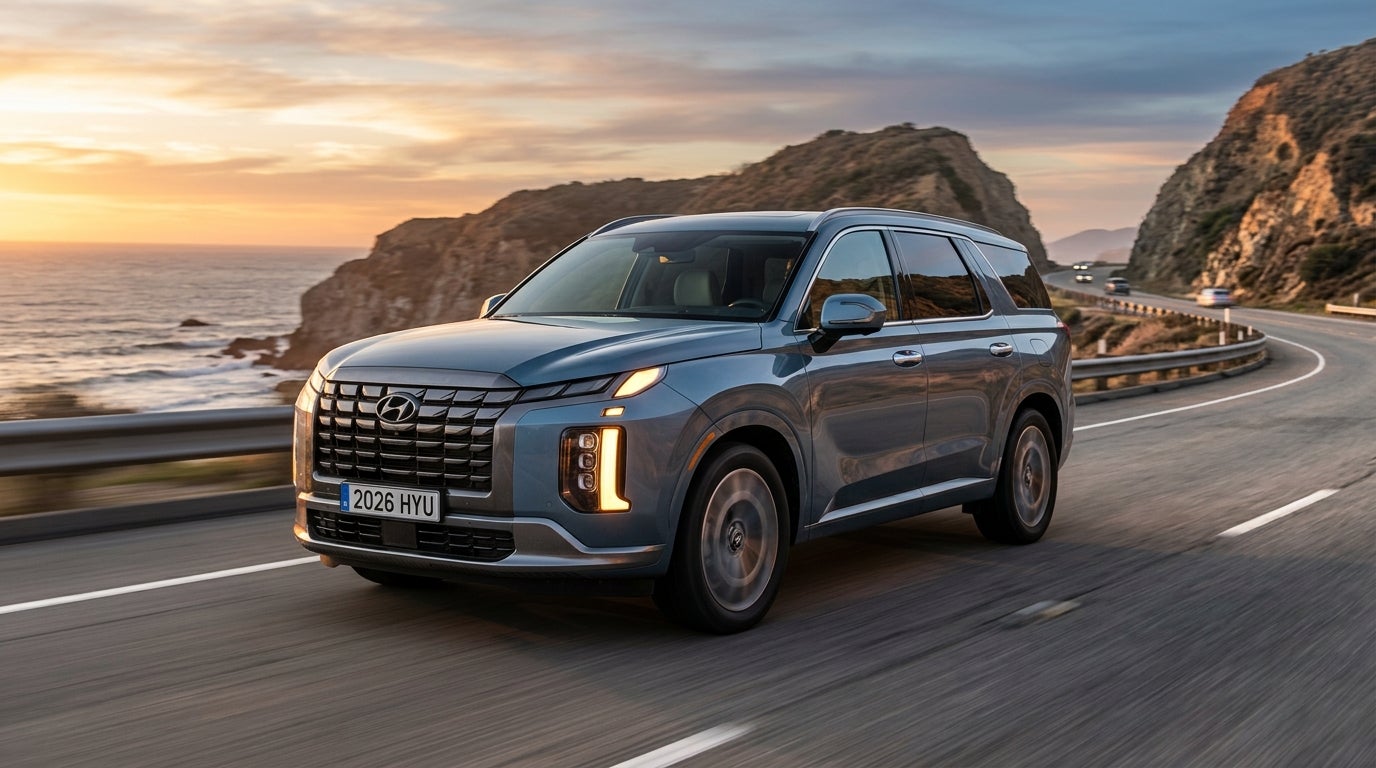
A light blue Hyundai SUV drives along a scenic coastal highway with cliffs and ocean views during sunset. (Representative image for illustration purposes only. Actual vehicle may vary based on trim and configuration.)

Discover How the 2026 Hyundai Palisade Elevates Family Luxury and Power

Yes, the redesigned 2026 Hyundai Palisade is worth buying because it pairs a premium three-row cabin with versatile performance, featuring an updated 3.5-liter V6 engine alongside a new 329-horsepower hybrid powertrain option. With standard dual 12.3-inch displays, a maximum tow rating of 5,000 pounds, and an IIHS Top Safety Pick+ award for models produced after November 2025, it delivers luxury-level refinement and strong long-term value for growing families. The second-generation Palisade grows slightly over its predecessor, expanding its wheelbase to 116.9 inches and overall length to 199.2 inches. That extra length translates directly into a roomier interior, giving passengers in all three rows more shoulder and leg clearance. The exterior steps out with a boxier, more commanding silhouette anchored by vertical LED lighting, clean body lines, and an available hidden tow hitch integrated into the rear bumper. For buyers looking to balance everyday driving dynamics with long-distance comfort, this redesigned SUV presents a compelling package. Beyond its striking aesthetic, the platform brings enhanced sound insulation that isolates road noise on highway stretches. Shoppers ready to explore payment options or take a test drive can contact us for current financing information or give our sales team a quick call at (302) 877-2489. You can also drop by to see the lineup in person by visiting our showroom on South Dupont Highway. Table of Contents What Are the Key New Features and Interior Tech in the 2026 Hyundai Palisade? What Are the Benefits of the 2026 Hyundai Palisade Hybrid and V6 Powertrains? What Safety Features and Driver-Assist Systems Protect Your Family? How Does the 2026 Hyundai Palisade Compare to the Kia Telluride? How Much Does the 2026 Hyundai Palisade Cost Across Trim Levels? Common Questions About the 2026 Hyundai Palisade Where Can You Test Drive and Buy a 2026 Hyundai Palisade Near Wilmington? What Are the Key New Features and Interior Tech in the 2026 Hyundai Palisade? The 2026 Hyundai Palisade introduces a completely updated digital cockpit dominated by panoramic curved dual 12.3-inch screens that merge the instrument cluster and central infotainment display into a single seamless panel. Standard tech upgrades include wireless Apple CarPlay and Android Auto, dynamic voice recognition, an in-car intercom system, six USB-C charging ports spread across all three rows, and Hyundai Digital Key 2 Premium capability. Inside the cabin, the layout embraces a relaxed, modern aesthetic. Higher trim levels feature front- and second-row relaxation seating that reclines at the touch of a button, alongside an available UV-C sanitizing tray in the center console and an integrated front and rear dash camera. Seating arrangements accommodate either seven passengers with second-row captain's chairs or eight passengers with the standard second-row bench. When cargo takes priority over passengers, folding the rear seats expands the total cargo volume from about 19 cubic feet behind the third row up to 87 cubic feet total. Families browsing our showroom floor often compare the walkthrough access of the second-row captain's chairs against the extra seat belt of the bench before making a final choice. If you want to evaluate earlier model years alongside the redesigned lineup, you can browse our pre-owned vehicle selection. To learn how Hyundai shields your vehicle on every journey, explore Hyundai safety technology integrated into the digital dash. ​ What Are the Benefits of the 2026 Hyundai Palisade Hybrid and V6 Powertrains? The 2026 Hyundai Palisade offers two distinct engine choices: a refined gasoline 3.5-liter V6 producing 287 horsepower and 260 lb-ft of torque, and an all-new hybrid system delivering a combined 329 horsepower and 339 lb-ft of torque. The traditional V6 connects to an 8-speed automatic transmission, while the hybrid pairs a 2.5-liter turbocharged engine with electric motors for swift, responsive acceleration and improved overall efficiency. Standard gas models with front-wheel drive deliver EPA fuel economy estimates of 19 mpg city / 25 mpg highway and 21 mpg combined. Adding HTRAC All Wheel Drive adjusts those figures slightly while providing extra confidence during wet or slippery weather. For drivers who want off-road styling and enhanced trail traction, the rugged XRT Pro trim features standard all-wheel drive, an electronic rear limited-slip differential, front and rear recovery hooks, 18-inch all-terrain tires, and an increased ground clearance of 8.4 inches. Commuters taking rural secondary routes out of Camden will appreciate how the hybrid system delivers quick electric torque off the line while maintaining a quiet, hushed cabin over unpaved shoulders and uneven pavement. Both engine options preserve serious utility, offering up to a 5,000-pound towing capacity when properly equipped with trailer brakes. To review alternative three-row options and pricing strategies, shoppers can shop certified pre-owned pricing across our wider inventory. ​ What Safety Features and Driver-Assist Systems Protect Your Family? Every 2026 Hyundai Palisade comes standard with the Hyundai SmartSense safety suite, providing comprehensive driver-assist features designed to prevent collisions and simplify highway travel. Key standard systems include Forward Collision-Avoidance Assist, Blind-Spot Collision Warning, Lane Keeping Assist, Safe Exit Assist, and navigation-based Smart Cruise Control. Upper trims expand this protection with advanced semi-autonomous features, including Highway Driving Assist 2 with automatic lane-changing capability, Remote Smart Parking Assist, and a Surround View Monitor. Structural enhancements and updated airbag deployments earned the 2026 Palisade an IIHS Top Safety Pick+ designation for models manufactured after November 2025. Forward Collision-Avoidance Assist: Detects vehicles, pedestrians, and cyclists ahead, applying emergency braking automatically if necessary. Blind-Spot Collision Warning: Scans side blind zones and actively helps guide the vehicle back into the lane if a hazard is detected during a lane change. Highway Driving Assist 2: Controls cruising speed, distance to the vehicle ahead, and steering assistance while automatically facilitating safe lane changes on designated highways. Rear Cross-Traffic Collision-Avoidance Assist: Warns drivers of cross-traffic behind the vehicle while reversing out of tight driveways or parking spots. To see how Hyundai's active safety design translates across different body styles, you can review Hyundai driver-assist features offered across our sedan and SUV lineups. ​ How Does the 2026 Hyundai Palisade Compare to the Kia Telluride? While the 2026 Hyundai Palisade and Kia Telluride share core mechanical foundations, the Palisade sets itself apart with a more futuristic exterior design, an updated curved dual-display layout, and the introduction of an available hybrid powertrain. The Telluride retains a traditional boxy utility aesthetic, but the Palisade offers a higher level of interior tech integration and near-luxury appointments on its top-tier Calligraphy trim. Under the hood, both base models utilize strong V6 engines outputting 287 horsepower, paired with 8-speed automatic transmissions and a 5,000-pound maximum tow rating. However, buyers seeking lower fuel consumption will find the Palisade's 329-horsepower hybrid setup a major deciding factor, as it generates significantly more torque ( 339 lb-ft) than standard non-hybrid midsize rivals. In terms of interior comfort, the Palisade Calligraphy features Ergo Motion driver seating, second-row wing-out headrests, and power third-row folding controls that make passenger and cargo management easier during family road trips. Those cross-shopping different brands and platform designs can see model comparisons to evaluate standard feature lists and overall ownership value. ​ How Much Does the 2026 Hyundai Palisade Cost Across Trim Levels? The 2026 Hyundai Palisade spans a wide price range designed to accommodate different budget targets, starting near $40,000 for entry gas models and extending into the mid-$50,000 range for fully equipped luxury and hybrid trims. Value is reinforced by Hyundai's factory coverage, which includes a 10-year / 100,000-mile powertrain limited warranty and a 5-year / 60,000-mile new vehicle limited warranty. Starting with the entry-level SE trim, standard equipment includes the 3.5-liter V6 engine, 12.3-inch touchscreen display with navigation, proximity key entry, and the SmartSense safety suite. Moving up to the SEL and SEL Premium trims adds popular comfort upgrades such as H-Tex leatherette seating, second-row captain's chairs, heated and ventilated front seats, a hands-free smart liftgate, and a heated steering wheel. For drivers seeking maximum luxury or rugged capability, the top tier is anchored by three distinctive trims: XRT Pro: Designed for off-road utility with standard HTRAC All Wheel Drive, electronic rear limited-slip differential, 18-inch all-terrain tires, recovery hooks, and an integrated tow hitch. Limited: Features 20-inch alloy wheels, genuine leather-trimmed seats, heated third-row seating, a 14-speaker Bose audio system, and a Surround View Monitor. Calligraphy: Serves as the flagship trim, offering 21-inch wheels, Premium Nappa leather upholstery, Ergo Motion driver seat massage features, front and second-row relaxation seats, and a digital rear-view mirror. ​ Common Questions About the 2026 Hyundai Palisade Q: Does the 2026 Hyundai Palisade offer a hybrid model? The 2026 Hyundai Palisade's hybrid powertrain pairs a 2.5-liter turbocharged four-cylinder engine with electric motors to boost efficiency and power. This system produces a combined 329 horsepower and 339 lb-ft of torque, delivering smooth acceleration and higher efficiency while preserving three-row passenger seating and available all-wheel drive. Q: How many passengers can sit in the 2026 Hyundai Palisade? The 2026 Palisade seats up to eight passengers when configured with the standard second-row 60/40 split-folding bench seat. Choosing optional second-row captain's chairs on trims like the SEL, Limited, or Calligraphy reduces overall seating capacity to seven passengers while creating an easy center walkthrough aisle to the third row. Q: What is the maximum towing capacity of the 2026 Palisade? When equipped with trailer brakes and proper towing accessories, the gas-powered 2026 Hyundai Palisade offers a maximum towing capacity of 5,000 pounds. Trims like the XRT Pro, Limited, and Calligraphy include a standard integrated trailer hitch and pre-wiring to simplify hooking up utility trailers or recreational boats. Q: What warranty coverage comes with a new 2026 Palisade? Every new 2026 Hyundai Palisade includes Hyundai Assurance coverage, which is highlighted by a 10-year / 100,000-mile powertrain limited warranty and a 5-year / 60,000-mile bumper-to-bumper new vehicle limited warranty. It also includes 5 years of 24-hour roadside assistance with unlimited mileage. Q: What display screens are inside the 2026 Palisade dashboard? The redesigned Palisade features a single panoramic curved panel housing dual 12.3-inch digital displays. One screen serves as the customizable driver instrument gauge cluster, while the second 12.3-inch touchscreen manages navigation, audio, wireless smartphone integration, and vehicle settings. ​ Where Can You Test Drive and Buy a 2026 Hyundai Palisade Near Wilmington? You can test drive and purchase the 2026 Hyundai Palisade at Winner Hyundai, located conveniently on South Dupont Highway in Dover. Our dealership offers a complete selection of new Palisade trims, transparent buying options, and a dedicated team ready to walk you through every feature and powertrain choice. Professionals commuting south from Wilmington via the I-95 and Route 1 corridor will find our showroom an easy, straightforward drive for weekend test drives or afternoon trade-in evaluations. Whether you want to test the 329-horsepower hybrid engine, explore the off-road features on the XRT Pro, or sink into the Nappa leather seats of the Calligraphy, our inventory is ready for your inspection. To arrange a test drive or speak directly with a sales specialist, call us at (302) 877-2489 or get turned-by-turn directions to our Dover sales center today. Keep Your Vehicle Running Strong Keep your vehicle performing at its best with our service team: Schedule Your Service Today Book A Service Appointment © 2026 Winner Hyundai. All rights reserved.

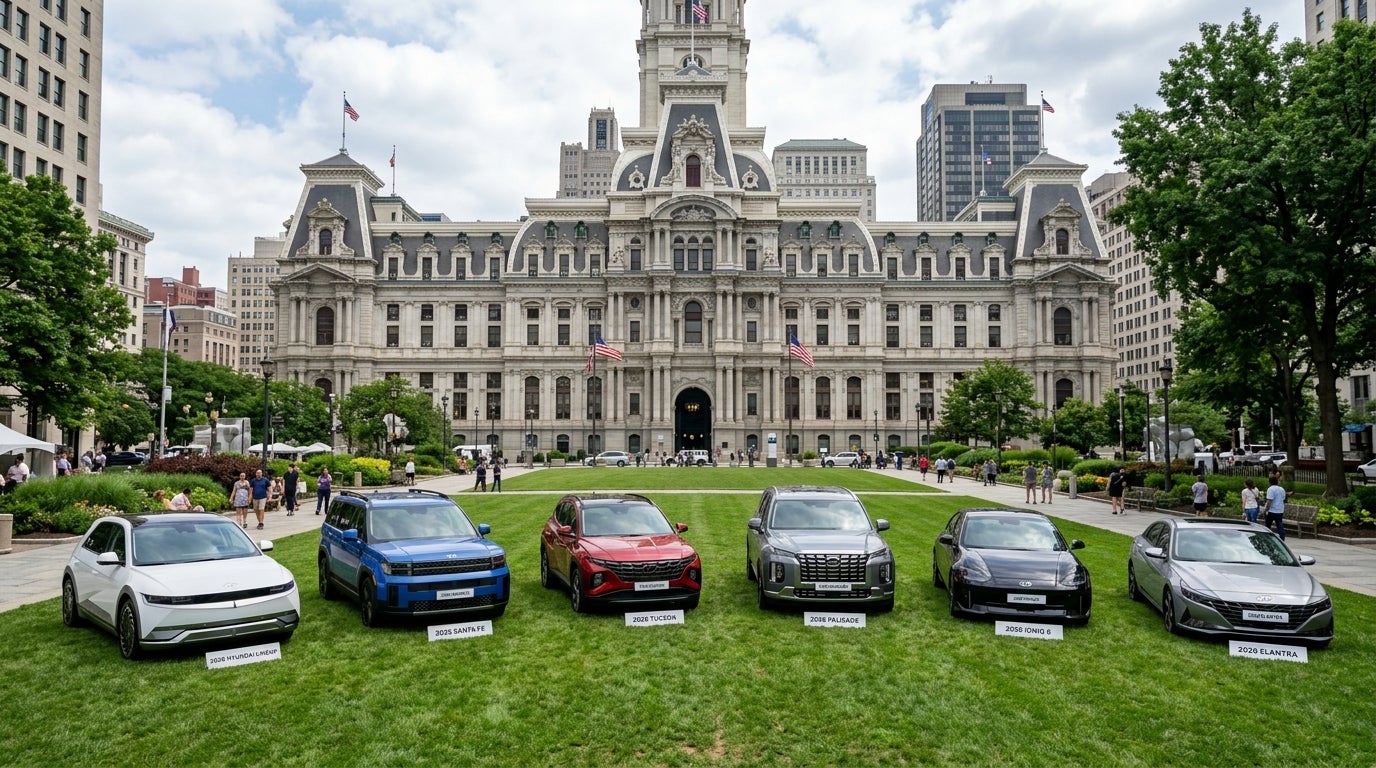
Six Hyundai cars, including electric and SUV models, parked on a lawn in front of Philadelphia City Hall. (Representative image for illustration purposes only. Actual vehicle may vary based on trim and configuration.)

Unlock Huge Savings and 0% APR: Why Now’s the Best Time to Buy Your Hyundai

An end-of-model-year inventory is the most financially advantageous time to purchase a new vehicle because manufacturers and dealerships combine factory incentives and promotional financing offers to clear remaining lot inventory. Buyers securing an outgoing model year maximize upfront savings on proven vehicles before incoming inventory arrives. As new inventory arrives at Winner Hyundai, outgoing models receive significant factory incentives that drastically lower the overall cost of ownership. Beyond initial sticker price adjustments, shoppers benefit from specialized promotional finance rates, such as 0% APR financing for up to 72 months on select models, or substantial cash-back incentives reaching several thousand dollars. Every vehicle purchased during this period retains full manufacturer protection, including Hyundai's landmark 10-year/100,000-mile powertrain limited warranty and 5-year/60,000-mile new-vehicle limited warranty. To explore available models or arrange a test drive in person, visit our Dover showroom location or give our team a direct phone call to discuss current arrival schedules and promotional programs. When do end-of-model-year inventory sales start and how much can you save? End-of-model-year inventory events typically launch in late summer—starting around July or August—and run through late autumn as dealerships transition inventory. During these events, potential savings vary by model, trim, and current offers through factory cash rebates, dealer price discounts, and reduced interest rates. Manufacturer incentive structures peak during late summer to accelerate turn rates on current inventory. For example, national programs during clear-out periods frequently offer standalone factory cash rebates alongside promotional financing rates. On select models like the redesigned Santa Fe or Tucson, combining promotional financing with current offers can affect total financing costs. For buyers considering various trims, price points vary depending on equipment and powertrain. The Santa Fe SE 2.5 begins at a base MSRP of $35,300 with a $1,650 destination charge, while the top-tier Santa Fe Calligraphy Hybrid AWD carries a base MSRP of $50,750 plus a $1,650 destination charge. Intermediate choices like the Santa Fe SEL 2.5 AWD sit at $39,640 base MSRP with a $1,650 destination fee. Choosing an outgoing model year allows buyers to select higher trim levels—equipped with leather seating, advanced driver-assist safety suites, and upgraded infotainment—for payments comparable to mid-level trims on newly arrived model years. Buyers looking for additional value beyond current model-year inventory can also explore our pre-owned vehicle lineup to compare overall savings across different vehicle years. Table of Contents Why choose a Hyundai Tucson SUV over an Elantra sedan for your daily commute? How does buying a Hyundai in Delaware benefit out-of-state and local shoppers on sales tax? Are 2026 Hyundai models and remaining vehicle inventory still available at Winner Hyundai? What shoppers ask most about end-of-model-year Hyundai savings How to secure your end-of-model-year Hyundai at Winner Hyundai Why choose a Hyundai Tucson SUV over an Elantra sedan for your daily commute? Choosing a Tucson over an Elantra comes down to prioritizing elevated seating, higher ground inventory, available all-wheel drive, and flexible cargo capacity over the compact footprint and maximum highway efficiency of a sedan. The Tucson provides greater utility for varying road conditions, while the Elantra offers a lower entry price and nimbler urban maneuvering. For commuters traveling along flat central Delaware stretches like those around Camden, the Tucson delivers elevated seating that improves forward visibility in traffic. The Tucson offers standard front-wheel drive alongside available HTRAC All-Wheel Drive for enhanced traction during wet weather. Powertrain options range from a standard 2.5-liter engine to advanced hybrid configurations, delivering up to 231 hp and 271 lb-ft of torque paired with a SHIFTRONIC automatic transmission. Ground inventory of 7.1 inches and up to 65 cubic feet of maximum cargo volume with the rear seats folded down make the Tucson ideal for drivers needing cargo versatility. Conversely, the Elantra sedan features a sleek profile powered by an updated naturally aspirated 2.0-liter 4-cylinder engine generating 147 hp, making it an agile commuter option with lower operating costs. When buyers compare the Tucson and Elantra on our lot, the decision usually turns on whether they need the 3,638-lb maximum braked towing capacity and command-of-the-road height of an SUV or the light handling and high fuel efficiency of a compact sedan. Drivers interested in comparing benefits across ownership history can learn why customers shop with us or review certified pre-owned Hyundai options to evaluate warranty coverage and value points across both body styles. Pricing Pricing by trim Feature Calligraphy 2.5 Calligraphy 2.5 AWD Calligraphy Hybrid Calligraphy Hybrid AWD Limited 2.5 (Bench seat) Limited 2.5 (Captain's chairs) Limited 2.5 AWD (Bench seat) Limited 2.5 AWD (Captain's chairs) Limited Hybrid (Bench seat) Limited Hybrid (Captain's chairs) Limited Hybrid AWD (Bench seat) Limited Hybrid AWD (Captain's chairs) SE 2.5 SE 2.5 AWD SE Hybrid SE Hybrid AWD SEL 2.5 SEL 2.5 AWD SEL Hybrid SEL Hybrid AWD XRT 2.5 AWD Base MSRP $47,600 $49,650 $48,950 $50,750 $44,850 $44,850 $46,650 $46,650 $45,950 $45,950 $47,750 $47,750 $35,300 $37,100 $36,650 $38,450 $37,840 $39,640 $38,940 $40,740 $42,290 Destination charge $1,650 $1,650 $1,650 $1,650 $1,650 $1,650 $1,650 $1,650 $1,650 $1,650 $1,650 $1,650 $1,650 $1,650 $1,650 $1,650 $1,650 $1,650 $1,650 $1,650 $1,650 ​ How does buying a Hyundai in Delaware benefit out-of-state and local shoppers on sales tax? Delaware does not levy a state retail sales tax, meaning local residents pay zero state sales tax when purchasing a vehicle at Winner Hyundai. Out-of-state buyers do not pay Delaware tax, but instead pay their home state's applicable sales tax and registration fees when titling the vehicle in their home jurisdiction. For Delaware residents, the absence of a state sales tax represents significant upfront savings compared to surrounding states, reducing the out-of-the-door transaction price. For out-of-state commuters driving down from urban finance centers in Wilmington or nearby state lines, buying in Delaware offers transparent pricing and streamlined titling coordination. Winner Hyundai processes out-of-state titling documents directly with home-state motor vehicle agencies, ensuring correct tax calculations and registration handling without double taxation or extra administrative burden on the buyer. In addition, purchasing during an end-of-model-year event amplifies tax efficiency. Because home-state sales taxes for out-of-state buyers are calculated as a percentage of the final net purchase price, securing an outgoing model year with thousands of dollars in inventory discounts directly lowers the taxable base amount. Shoppers planning their purchase can complete an online financing application to secure pre-approval and structure payment terms before visiting the dealership. Engine & Performance Powertrain specs by trim Feature Calligraphy 2.5 Calligraphy 2.5 AWD Calligraphy Hybrid Calligraphy Hybrid AWD Limited 2.5 (Bench seat) Limited 2.5 (Captain's chairs) Limited 2.5 AWD (Bench seat) Limited 2.5 AWD (Captain's chairs) Limited Hybrid (Bench seat) Limited Hybrid (Captain's chairs) Limited Hybrid AWD (Bench seat) Limited Hybrid AWD (Captain's chairs) SE 2.5 SE 2.5 AWD SE Hybrid SE Hybrid AWD SEL 2.5 SEL 2.5 AWD SEL Hybrid SEL Hybrid AWD XRT 2.5 AWD Engine 2.5L 2.5L 1.6L 1.6L 2.5L 2.5L 2.5L 2.5L 1.6L 1.6L 1.6L 1.6L 2.5L 2.5L 1.6L 1.6L 2.5L 2.5L 1.6L 1.6L 2.5L Horsepower 277 hp 277 hp 231 hp 231 hp 277 hp 277 hp 277 hp 277 hp 231 hp 231 hp 231 hp 231 hp 277 hp 277 hp 231 hp 231 hp 277 hp 277 hp 231 hp 231 hp 277 hp Torque 311 lb-ft 311 lb-ft 271 lb-ft 271 lb-ft 311 lb-ft 311 lb-ft 311 lb-ft 311 lb-ft 200 lb-ft 200 lb-ft 200 lb-ft 200 lb-ft 311 lb-ft 311 lb-ft 271 lb-ft 271 lb-ft 311 lb-ft 311 lb-ft 271 lb-ft 271 lb-ft 311 lb-ft Transmission SHIFTRONIC SHIFTRONIC SHIFTRONIC SHIFTRONIC SHIFTRONIC SHIFTRONIC SHIFTRONIC SHIFTRONIC SHIFTRONIC SHIFTRONIC SHIFTRONIC SHIFTRONIC SHIFTRONIC SHIFTRONIC SHIFTRONIC SHIFTRONIC SHIFTRONIC SHIFTRONIC SHIFTRONIC SHIFTRONIC SHIFTRONIC Drivetrain Front-wheel drive All-wheel drive Front-wheel drive All-wheel drive Front-wheel drive Front-wheel drive All-wheel drive All-wheel drive Front-wheel drive Front-wheel drive All-wheel drive All-wheel drive Front-wheel drive All-wheel drive Front-wheel drive All-wheel drive Front-wheel drive All-wheel drive Front-wheel drive All-wheel drive All-wheel drive ​ Are 2026 Hyundai models and remaining vehicle inventory still available at Winner Hyundai? Yes, select 2026 Hyundai models remain in stock at Winner Hyundai alongside incoming 2027 models, providing inventory opportunities across popular sedans, crossovers, and electrified lineups. Inventory is actively moving during inventory transitions, making vehicle availability model- and trim-dependent. Our current showroom floor and vehicle lot feature remaining 2026 inventory including the Tucson, Elantra, Santa Fe, and select electrified models. Outgoing 2026 models feature comprehensive standard technology and safety suites, such as Forward Collision-Avoidance Assist, Lane Keeping Assist, and 10.25-inch navigation screens on mid-to-high trims. These vehicles offer identical factory warranty protections—including the 10-year/100,000-mile powertrain limited warranty —while carrying peak inventory incentives. For buyers weighing an outgoing model year against new releases, side-by-side comparison reveals that major mechanical architectures and core features often remain consistent between adjacent model years. To evaluate trim differences, tech upgrades, or electric range specs before visiting, shoppers can compare Hyundai models against key competitors or explore our dedicated EV model research hub. ​ What shoppers ask most about end-of-model-year Hyundai savings Q: Can factory cash rebates be combined with 0% APR promotional financing during inventory sales? In most manufacturer promotional programs, factory cash-back rebates and subvented low APR financing are offered as standalone incentives, meaning buyers choose whichever incentive yields greater overall savings. However, during specific end-of-model-year inventory pushes, select models may feature smaller stackable bonus cash offers alongside promotional interest rates. Comparing total finance charges against an upfront cash price reduction determines the best value for your budget. Q: What documentation should I bring to the dealership to qualify for clear-out financing? To streamline loan approval and secure promotional financing rates during inventory events, bring a valid driver's license, current proof of auto insurance, your two most recent pay stubs or proof of income, and a recent utility bill confirming your current residential address. If trading in a vehicle, bring the vehicle title or loan payoff statement along with all keys and registration documents. Q: How does Hyundai's factory warranty apply to outgoing model year vehicles? Outgoing model year vehicles sold as brand-new inventory receive full factory warranty coverage starting on the date of purchase, regardless of calendar month or incoming model year arrivals. Coverage includes Hyundai's standard 10-year/100,000-mile powertrain limited warranty and 5-year/60,000-mile new-vehicle limited warranty, providing identical long-term protection as a newly introduced model year. Q: Do out-of-state buyers have to pay Delaware taxes when buying at Winner Hyundai? Out-of-state buyers do not pay Delaware state sales tax because Delaware has no state retail sales tax. Instead, Winner Hyundai collects and remits the appropriate vehicle sales tax and titling fees required by the buyer's home state at the time of purchase, allowing out-of-state shoppers to complete registration smoothly without paying tax twice. Q: Does buying an outgoing model year impact vehicle resale value down the road? While an outgoing model year is technically one calendar year older on paper, the lower purchase price achieved through end-of-model-year rebates and dealer discounts offsets early depreciation. Because the initial acquisition price is substantially lower than original MSRP, long-term cost-of-ownership and value retention remain highly competitive over typical 3-to-5-year ownership cycles. ​ How to secure your end-of-model-year Hyundai at Winner Hyundai Securing an outgoing model year at peak inventory value requires checking while remaining 2026 inventory and promotional financing offers are available on the lot. Shopping early in the inventory window ensures the best selection of color combinations, trim levels, and option packages. Whether you are choosing between a versatile crossover like the Tucson or an efficient commuter like the Elantra, our team at Winner Hyundai is ready to guide you through available inventory, trade-in valuations, and incentive combinations. Stop by our Dover showroom or reach out with a quick call to our sales team to confirm availability and schedule your test drive today. Keep Your Vehicle Running Strong Keep your vehicle performing at its best with our service team: Schedule Your Service Today Book A Service Appointment © 2026 Winner Hyundai. All rights reserved. Vehicle specification data © JATO Dynamics Limited. End-of-Model-Year Vehicle Deals in Dover DE | Winner Hyundai

A woman signs paperwork at a desk with a sales representative inside a Hyundai car dealership showroom. (Representative image for illustration purposes only. Actual vehicle may vary based on trim and configuration.)

Is Leasing a Car Worth It?

Leasing a car is worth it for drivers who prefer lower monthly payments, predictable driving habits within standard annual mileage allowances, and the flexibility to drive a new vehicle protected by factory warranties every two to three years. Instead of financing the full purchase price, lessees only pay for the projected depreciation over the lease term, making higher trim levels and advanced safety technologies significantly more accessible. When you evaluate a vehicle lease, you are essentially paying for the portion of the vehicle's life that you use. Traditional auto loans require paying down the entire balance of the vehicle, which results in higher monthly outlays. Leasing structures allow drivers to upgrade their technology, safety features, and comfort every few years without the long-term commitment or resale hassles of ownership. Drivers interested in exploring current options can visit our showroom on Dupont Highway or give our team a quick call at (302) 877-2489 to review current inventory. If you are debating between pre-owned vehicles and leasing, you can search our pre-owned finder tool or use our custom vehicle finder service. For a complete breakdown of contract options, consult our buying versus leasing analysis alongside our pre-owned vehicle buying guide. Table of Contents Is It Cheaper to Lease a Car Than Buy Outright, and What Upfront Costs Are Required? How Does Delaware Tax Treatment Favor Car Leasing Over Buying? What Are Standard Lease Mileage Limits, Excess Fees, and GAP Insurance Requirements? What Key Factors Should You Weigh When Choosing Between Leasing and Buying? What Are Your Options at the End of a Lease and How Can You Avoid Disposition Fees? Common Questions About Leasing a Vehicle in Delaware Is It Cheaper to Lease a Car Than Buy Outright, and What Upfront Costs Are Required? Leasing is often less expensive on a monthly cash-flow basis than buying a car outright or financing with a traditional auto loan because lease payments cover only depreciation and finance charges rather than the total principal balance. Upfront costs when starting a lease typically include the first monthly payment, state registration fees, an acquisition fee, and any agreed-upon down payment or capitalized cost reduction. The financial mechanics of a lease center around three core numbers: the agreed purchase price (capitalized cost), the projected value at contract end (residual value), and the interest rate (money factor). Because the lessee only pays the difference between the capitalized cost and the residual value, monthly payments remain considerably lower than loan installments for the same model. When establishing a lease contract, upfront drive-off fees generally include: First month's payment Acquisition fee charged by the leasing institution State title, tag, and registration fees Optional down payment to reduce monthly payments Dealer documentation fees Prospective lessees can manage initial expenses by exploring structured financing options. You can apply for flexible service financing for protection accessories, apply for financing online, or get pre-approved for auto financing before selecting a vehicle. We offer available options across our lineup, including Tucson lease specials, Sonata leasing options, Santa Fe lease promotions, and versatile Santa Cruz payment plans. Families looking for maximum room can check Palisade lease figures, while compact shoppers can evaluate Kona lease packages and Elantra finance and lease specials. Shoppers across the region can review current new vehicle lease offers, compare regional lease incentives, look through coastal region lease specials, check nearby lease promotions, view lease offers for Milford drivers, evaluate local lease deals, or inspect lease structures near Lewes. ​ How Does Delaware Tax Treatment Favor Car Leasing Over Buying? Delaware provides a distinct tax advantage for vehicle leases by assessing its 4.25% document fee only on the total sum of monthly lease payments rather than the vehicle's full purchase price. Because Delaware has no statewide sales tax or personal vehicle property tax, leasing significantly reduces upfront tax liability compared to outright vehicle purchases. When purchasing a vehicle in Delaware, the 4.25% document fee applies to the entire negotiated sales price of the automobile. On a $35,000 purchase, that tax burden amounts to nearly $1,488 due at signing or rolled into the loan balance. Conversely, on a three-year lease where the total sum of monthly payments equals $12,000, the 4.25% fee is calculated strictly on that $12,000 payment stream, resulting in just $510 in total tax obligations. This policy creates potential tax benefits for commuters traveling daily along Route 1 through Milford who want to upgrade their vehicle every few years without paying full tax on the unaged portion of the vehicle's MSRP. What Are Standard Lease Mileage Limits, Excess Fees, and GAP Insurance Requirements? Standard automotive lease contracts establish annual driving limits of 10,000-mile, 12,000-mile, or 15,000-mile increments, with excess mileage assessed at a rate between 15 and 25 cents per mile at turn-in. Guaranteed Asset Protection (GAP) insurance is required on virtually all manufacturer leases and comes automatically included in Hyundai Motor Finance lease agreements. Selecting the correct mileage tier is vital when structuring your initial lease contract. Choosing a higher annual allowance upfront is far more cost-effective than paying overage charges at turn-in. For example, exceeding a 36-month lease limit by 5,000 miles at a rate of $0.20 per mile results in a $1,000 charge at lease expiration. Lease Term Mileage Tier Total 36-Month Allowance Ideal Driver Profile 10,000-mile / year 30,000 miles total Local commuters & low-distance drivers 12,000-mile / year 36,000 miles total Average daily highway & suburban commuters 15,000-mile / year 45,000 miles total Frequent long-distance drivers GAP insurance protects the lessee if the vehicle is totaled or stolen during the contract term. Standard auto insurance policies only pay out the vehicle's fair market value, which can be thousands of dollars less than the remaining lease payoff balance. GAP insurance waives that financial shortfall, eliminating out-of-pocket loss. Drivers taking weekend coastal trips near Lewes to visit Cape Henlopen State Park should account for highway miles when choosing an annual allowance. ​ What Key Factors Should You Weigh When Choosing Between Leasing and Buying? Choosing between leasing and buying requires balancing annual mileage patterns, monthly budget expectations, desire to customize the vehicle, and long-term ownership goals. Drivers who prefer lower monthly payments and minimal repair risks benefit from leasing, while high-mileage drivers and modification enthusiasts are better suited for traditional financing. When reviewing your decision, consider these core operational comparisons: Vehicle Ownership: Leasing grants temporary operational use, whereas buying builds long-term equity once the loan is paid in full. Warranty Coverage: Leased vehicles remain covered under factory warranties like Hyundai's 5-year/60,000-mile new vehicle limited warranty and 10-year/100,000-mile powertrain limited warranty, minimizing out-of-pocket repair costs. Customization: Purchased vehicles allow custom window tinting, aftermarket wheels, and trailer hitch installations, while leased vehicles must be returned in factory-original condition. Vehicle Technology: Leasing can provide access to updated driver-assist safety suites, infotainment software, and modern electric powertrains every two to three years. What Are Your Options at the End of a Lease and How Can You Avoid Disposition Fees? At the conclusion of a car lease, you have three primary paths: return the vehicle, buy it outright for the contractually set residual value, or trade it in toward a new lease or purchase. You can avoid the standard $350 to $595 disposition fee by purchasing the leased vehicle or transitioning directly into a new lease with the same brand. The contract's residual value serves as a guaranteed financial safety net. If market conditions cause the vehicle's real-world value to drop below the pre-set residual figure—due to market shifts or an accident listed on a vehicle history report—you can drop off the keys and walk away. The leasing institution absorbs the market loss, not the driver. However, if market value exceeds the residual payoff, you hold positive equity. You can exercise your purchase option to buy the car outright or trade it in, applying that equity as a down payment toward your next vehicle. Common Questions About Leasing a Vehicle in Delaware Q: Can I lease a car with a lower credit score? Options exist for leasing with average or fair credit scores, though lower scores may require a security deposit or result in a higher money factor interest rate. Lessors evaluate steady income history, debt-to-income ratios, and previous vehicle payment records alongside credit scores when reviewing lease applications. Providing a larger down payment can also help secure approval. Q: How does Hyundai Motor Finance calculate the monthly lease payment? The monthly lease payment consists of two core elements: depreciation charges and rent charges. Depreciation equals the agreed capitalized cost minus the residual value, divided by the lease term length in months. The rent charge acts as the financial interest rate, calculated by multiplying the sum of the capitalized cost and residual value by the contract money factor. Q: What documentation is required to finalize a car lease contract? Bringing recent pay stubs, valid government identification, proof of auto insurance meeting lessor liability limits, and a recent utility bill for address verification streamlines the lease approval process. Having these documents prepared allows our finance department to process underwriters efficiently and complete contract paperwork in a single showroom visit. Q: What happens if my leased vehicle is damaged during the lease term? Normal wear and use, such as minor paint scuffs or minimal tire tread wear, incurs no penalty at lease turn-in. Excess damage, including deep door dings, torn upholstery, or cracked glass, must be repaired at an authorized facility using genuine parts prior to turn-in to avoid end-of-lease reconditioning charges. Q: Are maintenance costs covered during a new Hyundai lease? Every new Hyundai model year 2020-2025 included Hyundai Complimentary Maintenance for 3-year/36,000-mile duration, covering factory-scheduled oil changes and tire rotations. That program has changed. Speak with a member of our team to discuss pre-paid maintenance options. To begin your vehicle search or ask specific lease questions, get showroom directions to 591 S Dupont Hwy or call our team directly at (302) 877-2489. You can also view pre-owned vehicle specials, request a pre-owned price quote, or browse new vehicle special offers. To learn about factory warranty coverage or explore electric vehicle charging details give us a call or review or website resources. You can also visit our regional vehicle research hub, explore Hyundai Bluelink connected services, or check college graduate rebate programs today. Keep Your Vehicle Running Strong Keep your vehicle performing at its best with our service team: Schedule Your Service Today © 2026 Winner Hyundai. All rights reserved.

Contact Us

Fill out this form below and we'll contact you shortly

By submitting your information, you agree to the sharing of your information between Hyundai Motor America and its authorized dealers.

*Required Fields