



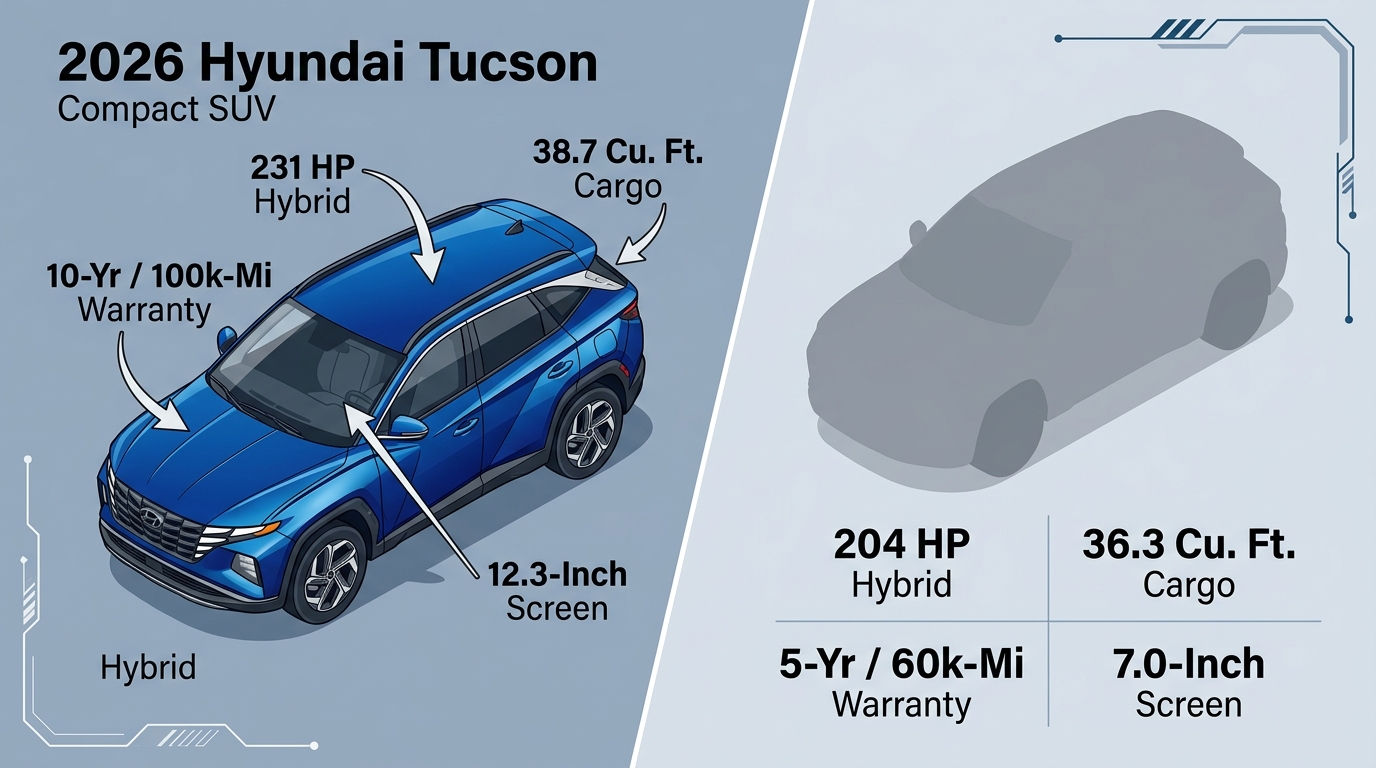
The 2026 Hyundai Tucson offers different advantages than the 2026 Honda CR-V for most compact SUV buyers by delivering lower starting price points, higher hybrid horsepower ( 231 hp vs. 204 hp), greater rear cargo volume ( about 39 cubic feet vs. 36 cubic feet), and double the powertrain warranty duration ( 10-year/100,000-mile vs. 5-year/60,000-mile). While the CR-V offers a minor advantage in front-wheel-drive hybrid fuel economy ( 40 mpg combined vs. 38 mpg combined), the Tucson counters with superior standard technology, richer available interior luxury features, and better overall value across its lineup.
Choosing between these two popular compact crossovers often comes down to what you get for your money. The Honda CR-V has long been a familiar sight on American roads, but the latest Tucson model year brings substantial updates that elevate its competitiveness. Hyundai equips the Tucson with a standard 12.3-inch touchscreen infotainment system on base trims, compared to the smaller 7.0-inch or available 9.0-inch screens found in the CR-V lineup. Furthermore, the Tucson offers a traditional 8-speed SHIFTRONIC automatic transmission on gas models and a 6-speed SHIFTRONIC automatic transmission on hybrid trims, providing a direct, conventional shifting feel that many drivers prefer over Honda’s continuously variable transmission (CVT) and e-CVT setups.
At Winner Hyundai, our team is dedicated to helping you compare features, test-drive different powertrains, and secure competitive financing. You can drop by our showroom on South Dupont Highway to experience the Tucson lineup in person, or give our sales specialists (302) 877-2489 a quick call to check current availability.
Table of Contents
- What Is the Biggest Difference Between the 2026 Hyundai Tucson and 2026 Honda CR-V?
- How Do the Engine Options, Transmissions, and Horsepower Compare?
- Which Compact SUV Offers More Rear Passenger Legroom and Cargo Space?
- Does the Hyundai Tucson Offer Remote Smart Parking Assist and High-Tech Features?
- How Long Does the Hyundai Powertrain Warranty Last Compared to Honda?
- Common Questions About the 2026 Hyundai Tucson vs Honda CR-V
- Where Is Winner Hyundai Located and How Can You Test Drive a 2026 Tucson?
What Is the Biggest Difference Between the 2026 Hyundai Tucson and 2026 Honda CR-V?
Standard equipment and pricing set the 2026 Hyundai Tucson apart from the 2026 Honda CR-V, with the Tucson offering more tech features for less money. Entry and mid-level Tucson trims cost several thousand dollars less than comparable CR-V models while offering larger display screens, more complete driver-assistance software, and available high-tier amenities that Honda reserves exclusively for top-spec trims or omits entirely.
Inside the cabin, Hyundai redesigned the dashboard to integrate physical rotary dials alongside dual 12.3-inch panoramic displays, solving common driver complaints regarding touch-only controls. The CR-V maintains a simpler interior layout, but top comfort options like ventilated front seats, heated rear seats, a 12-inch head-up display, and a 12.3-inch digital instrument cluster are available on the Tucson while missing from the CR-V feature list. For commuters navigating busy financial corridors in Wilmington, the quiet cabin insulation, standard wireless smartphone connectivity, and crisp digital displays make long highway drives refined and relaxed.
Shoppers interested in exploring how Hyundai’s crossover sizing fits different family needs can read our guide comparing the Tucson to the Santa Fe. If you are considering alternatives across various price points, you can also explore our inventory of pre-owned vehicles to see all available compact crossovers.
How Do the Engine Options, Transmissions, and Horsepower Compare?
The 2026 Hyundai Tucson provides stronger horsepower and higher combined torque figures in its hybrid variants than the 2026 Honda CR-V, while giving buyers a choice of gas, hybrid, and plug-in hybrid powertrains. The base gas Tucson features a 2.5-liter four-cylinder engine generating 187 hp at 6,100 RPM and 178 lb-ft of torque at 4,000 RPM, mated to an 8-speed SHIFTRONIC automatic transmission. The standard gas Honda CR-V relies on a 1.5-liter turbocharged engine producing 191 hp paired with a CVT.
When comparing hybrid configurations, the performance advantage shifts decisively toward Hyundai:
- 2026 Hyundai Tucson Hybrid: Combines a 1.6-liter turbocharged four-cylinder engine with a 47.7 kW electric motor to produce 231 hp and 271 lb-ft of combined torque. Power routes through a tuned 6-speed SHIFTRONIC automatic transmission with standard HTRAC All-Wheel Drive.
- 2026 Honda CR-V Hybrid: Uses a naturally aspirated 2.0-liter engine paired with electric motors for a total output of 204 hp and 247 lb-ft of torque, managed by an electronic e-CVT.
- 2026 Hyundai Tucson Plug-In Hybrid: Ups the electric output with a 72 kW electric motor and a 13.8 kWh lithium-ion battery, generating 268 hp and 271 lb-ft of torque while delivering up to 33 miles of pure electric driving range. Honda does not offer a plug-in hybrid CR-V in North America.
When buyers walk around our showroom comparing hybrid setups, they usually ask whether the standard hybrid needs to be plugged in—and our team explains that the Tucson Hybrid recharges its battery automatically through regenerative braking during normal deceleration without requiring external charging cables.
Fuel economy ratings remain competitive across both lineups. The entry Tucson Blue SE HEV AWD achieves an EPA-estimated 38 mpg city / 38 mpg highway / 38 mpg combined, while standard gas front-wheel-drive models earn 25 mpg city / 33 mpg highway / 28 mpg combined. Gas-powered Tucson models equipped with factory tow packages are rated to tow up to 2,750 pounds with trailer brakes, surpassing the CR-V’s standard 1,500-pound tow rating.
To learn more about how Hyundai vehicles stack up against other market segment rivals, check out our compact comparison reviews and sedan matchup analyses. For current owners seeking to maintain peak engine efficiency, scheduling factory-scheduled service with our certified technicians ensures your powertrain runs smoothly for miles to come.
Which Compact SUV Offers More Rear Passenger Legroom and Cargo Space?
The 2026 Hyundai Tucson offers superior cargo capacity and more rear passenger legroom than the 2026 Honda CR-V, making it one of the most practical choices in the compact crossover class. Rear-seat passengers in the Tucson benefit from about 41 inches of legroom alongside multi-stage reclining seatbacks, providing midsize-SUV levels of comfort for adult passengers and growing children alike.
Utility and cargo storage measurements highlight the Tucson’s space efficiency:
- Rear Cargo Space (Seats Up): The Tucson holds about 39 cubic feet of luggage space behind the second row (and up to 41 cubic feet on select hybrid configurations), whereas the CR-V Hybrid holds 36 cubic feet.
- Maximum Cargo Space (Seats Folded): Folding the 60/40 split-folding rear seats flat in the Tucson expands total volume to about 80 cubic feet, outmeasuring the CR-V Hybrid’s 72 cubic feet maximum capacity.
- Cabin Passenger Volume: The Tucson supplies about 108 cubic feet of interior passenger volume compared to 103 cubic feet in the CR-V.
Families driving past central Delaware farmland near Camden appreciate how easily sports gear, farm-market hauls, and oversized strollers slide into the wide, low rear hatch opening without crowding back-seat riders. Available utility options include a hands-free smart liftgate that opens automatically when you stand behind the bumper with the proximity key.
If you are ready to structure your purchase, you can save time at the dealership by getting pre-approved for financing online through our secure finance portal.
Does the Hyundai Tucson Offer Remote Smart Parking Assist and High-Tech Features?
Yes, the 2026 Hyundai Tucson offers Remote Smart Parking Assist, a cutting-edge driver-assist technology that allows you to park or extract the vehicle from tight parallel or perpendicular parking spaces remotely. By using the forward and reverse buttons on the Smart Key fob while standing outside the SUV, the system controls steering, acceleration, and braking automatically to guide the Tucson into narrow spots safely.
Honda does not offer a remote parking feature on any 2026 CR-V trim level. In addition to remote parking, the Tucson provides an expansive suite of standard and available Hyundai SmartSense safety features, including:
- Forward Collision-Avoidance Assist with Pedestrian, Cyclist, and Junction Turning Detection
- Blind-Spot View Monitor, which projects a live video feed of your side blind spots directly onto the digital gauge instrument cluster when signaling
- Surround View Monitor providing a 360-degree aerial camera perspective for effortless parking maneuvers
- Highway Driving Assist, combining adaptive cruise control with lane-centering capabilities for reduced driver fatigue on long highway trips
- Safe Exit Assist, which prevents passengers from opening rear doors if an approaching vehicle is detected from behind
Both crash-testing authorities have recognized the Tucson’s safety engineering. The Insurance Institute for Highway Safety designated the model a TOP SAFETY PICK+, while the National Highway Traffic Safety Administration awarded it a 5-Star Overall Safety Rating.
How Long Does the Hyundai Powertrain Warranty Last Compared to Honda?
The Hyundai Powertrain Limited Warranty covers your vehicle for 10 years or 100,000 miles, which is double the 5-year/60,000-mile powertrain coverage offered by Honda. This industry-leading warranty protection covers essential engine, transmission, and transaxle components originally manufactured or installed by Hyundai.
A complete comparison of standard factory warranty protection highlights Hyundai’s clear ownership advantage:
- Powertrain Limited Warranty: Hyundai offers 10 years / 100,000 miles; Honda offers 5 years / 60,000 miles.
- New Vehicle Limited Warranty: Hyundai provides 5 years / 60,000 miles of bumper-to-bumper protection; Honda provides 3 years / 36,000 miles.
- Complimentary Maintenance: Hyundai includes 3 years or 36,000 miles of factory-scheduled maintenance (covering oil changes, tire rotations, and multi-point inspections); Honda offers 2 years or 24,000 miles of basic maintenance.
- Roadside Assistance: Hyundai includes 5 years / unlimited miles of 24-hour coverage, including towing, flat-tire changes, and lock-out assistance.
If you are stranded on the roadside due to an unexpected mechanical issue or flat tire, manufacturer-backed support is just a phone call away via Hyundai Roadside Assistance: 1-800-243-7766. For shoppers looking for verified long-term reliability backed by factory protection, exploring our certified pre-owned Hyundai options provides added confidence with thorough multi-point vehicle inspections.
Common Questions About the 2026 Hyundai Tucson vs Honda CR-V
Q: What is the primary price difference between the base 2026 Hyundai Tucson and Honda CR-V?
The entry-level 2026 Hyundai Tucson SE FWD opens with a base MSRP of $29,200 (plus destination), undercutting the base Honda CR-V LX starting price by roughly $1,000 to $1,500 depending on regional packaging. On hybrid models, the Tucson Blue SE HEV starts under $33,000, which is over $4,000 less expensive than the entry Honda CR-V Sport Hybrid MSRP of $37,080.
Q: Which hybrid SUV offers better fuel economy, the Tucson or CR-V?
The front-wheel-drive Honda CR-V Hybrid achieves higher EPA fuel economy figures at 40 mpg combined (43 city / 36 highway) compared to the Tucson Hybrid’s 38 mpg combined (40 city / 35 highway). However, the Tucson Hybrid compensates for the 2-mpg difference by delivering 231 hp and 271 lb-ft of torque, representing 27 more horsepower and 24 more lb-ft of torque than the CR-V Hybrid.
Q: Does the 2026 Hyundai Tucson require an external charging plug for its standard hybrid model?
No, the standard 2026 Hyundai Tucson Hybrid does not require an external charging cable or wall outlet. The hybrid system recharges its 1.49 kWh lithium-ion battery automatically using regenerative braking energy captured while decelerating. Only the separately available Tucson Plug-In Hybrid (PHEV) connects to Level 1 or Level 2 EV charging stations to replenish its larger battery pack.
Q: How do rear passenger legroom dimensions compare between both crossovers?
The 2026 Hyundai Tucson provides about 41 inches of rear legroom, while the Honda CR-V offers 41 inches of rear legroom. Both vehicles lead the compact crossover class in back-seat passenger space, but the Tucson adds multi-stage rear seat recline and available heated rear outboard seats on upper trims, which are unavailable on the CR-V.
Q: What is included in Hyundai’s complimentary maintenance program for new Tucson buyers?
Hyundai Complimentary Maintenance covers factory-scheduled maintenance for 3 years or 36,000 miles, whichever comes first. This program includes engine oil and filter changes, tire rotations, and multi-point vehicle inspections performed by factory-trained technicians at authorized Hyundai dealerships like Winner Hyundai.
Where Is Winner Hyundai Located and How Can You Test Drive a 2026 Tucson?
Winner Hyundai is located at 591 S Dupont Hwy, Dover, DE 19901, positioning our showroom as a convenient automotive destination for drivers across central Delaware. Our dealership features a complete lineup of new 2026 Hyundai Tucson models in gas, hybrid, and plug-in hybrid configurations, available across popular trims including SE, SEL, SEL Convenience, XRT, and Limited.
When you visit our sales desk, our knowledgeable staff can walk you through trim differences, demonstrate safety technology like Remote Smart Parking Assist, appraise your current trade-in vehicle, and present current lease and finance information.
To get step-by-step driving instructions to our showroom, access our Dover dealership address on Google Maps or contact our sales specialists directly at (302) 877-2489 to schedule your 2026 Tucson test drive today.
© 2026 Winner Hyundai. All rights reserved.
Connect with us


- Air Conditioning & Climate Control
- Automotive Parts & Repairs
- Automotive Sales & Promotions
- Buying Guides
- Community Events
- Dover Hyundai Dealer
- Financing & Insurance
- Inventory & Availability
- Inventory Updates
- Lease Specials & Incentives
- Maintenance & Service
- Maintenance & Service
- Model Comparisons
- New Inventory
- New Vehicle Reviews
- New Vehicle Sales
- New Vehicle Specials & Incentives
- OEM Parts & Repairs
- Safety Features
- Seasonal Driving Tips
- Service Process & Claims
- Technology & Innovation
- Tire Care & Safety
- Used Vehicle Guides
- Used Vehicle Purchasing
- Vehicle Care Tips
- Vehicle Cooling Systems
- Vehicle Specials & Incentives
- Warranty & Protection Plans
Categories
Winner Hyundai
Address
591 S Dupont Hwy
Dover, DE 19901
Phone
- Sales 302-497-3004302-497-3622
- Service 302-497-3620
- Parts 302-497-3621
| Monday | 9:00AM - 8:00PM |
| Tuesday | 9:00AM - 8:00PM |
| Wednesday | 9:00AM - 8:00PM |
| Thursday | 9:00AM - 8:00PM |
| Friday | 9:00AM - 8:00PM |
| Saturday | 9:00AM - 6:00PM |
| Sunday | Closed |
| Monday | 7:30AM - 6:00PM |
| Tuesday | 7:30AM - 6:00PM |
| Wednesday | 7:30AM - 6:00PM |
| Thursday | 7:30AM - 6:00PM |
| Friday | 7:30AM - 6:00PM |
| Saturday | 8:00AM - 5:00PM |
| Sunday | Closed |
| Monday | 7:30AM - 5:00PM |
| Tuesday | 7:30AM - 5:00PM |
| Wednesday | 7:30AM - 5:00PM |
| Thursday | 7:30AM - 5:00PM |
| Friday | 7:30AM - 5:00PM |
| Saturday | 8:00AM - 5:00PM |
| Sunday | Closed |