

Blog / Model Research

Blog

All Model Research Buying Guides Model Comparisons New Vehicle Reviews Community Events Financing & Insurance Maintenance & Service Safety Features Technology & Innovation New Vehicle Sales New Vehicle Specials & Incentives Automotive Sales & Promotions New Inventory Lease Specials & Incentives Ownership & Service Used Vehicle Guides Dover Hyundai Dealer Inventory & Availability Seasonal Driving Tips Vehicle Specials & Incentives Automotive Parts & Repairs Financing Fuel Economy & Efficiency Inventory Updates Air Conditioning & Climate Control Certified Pre-Owned Electric Vehicle (EV) Maintenance Engine & Performance Financing & Incentives Financing Tips Hybrid & Electric Vehicles Inventory Clearance Events New Vehicle Buying Guides OEM Parts & Repairs OEM Parts & Warranty Service Repair & Diagnostics Seasonal Vehicle Care Service Process & Claims Tire Care & Safety Title Transfer Process Trade-In & Purchase Strategies Used Car Buying Used Vehicle Purchasing Vehicle Care Tips Vehicle Cooling Systems Vehicle History Reports Vehicle Sales & Promotions Warranty & Protection Plans
Hyundai Line Up

Which Hyundai Model Is Right for You?

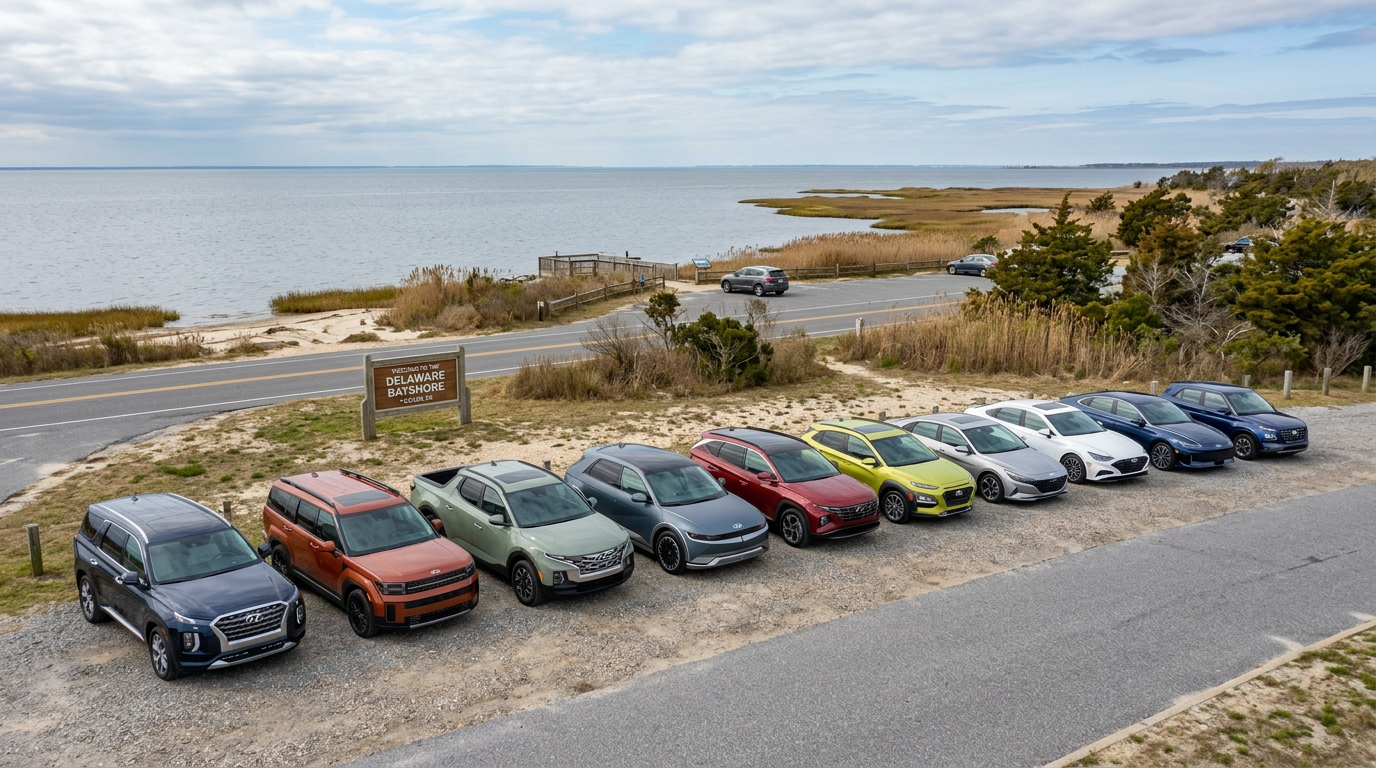
The right Hyundai model for your lifestyle depends on whether you prioritize fuel economy, interior cargo capacity, passenger seating, or advanced electric performance. Drivers looking for maximum daily commuting efficiency should consider compact options like the Elantra sedan or Tucson crossover, while growing families needing three rows of seating will find the Santa Fe or flagship Palisade best suited to their routine. Drivers wanting standard dynamic safety features across every price point will appreciate that all core models feature Hyundai SmartSense technology backed by a 10-Year/100,000-Mile Powertrain Limited Warranty. Choosing among sedan, crossover, SUV, and electric vehicle configurations comes down to evaluating how you use your vehicle every single day. Sedan drivers gain exceptional highway mileage and nimble maneuverability, making commuting effortless. Crossovers like the Tucson deliver elevated seating positions, standard or available HTRAC All-Wheel Drive, and flexible rear cargo room without the larger footprint of a traditional midsize SUV. For larger households requiring flexible seating and towing capability, three-row crossovers provide dedicated passenger space and adaptable fold-flat seating layouts. Electric vehicles offer immediate electric torque, low routine operating costs, and rapid public charging capabilities. At Winner Hyundai, our team walks you through every vehicle class to help you balance cabin space, technology, and performance. You can reach out to our team at (302) 877-2489 or stop by our Dover showroom location to compare models side by side. Table of Contents What Is the Difference Between Hyundai SUV Sizes Across the Lineup? How Do the Hyundai Tucson and Hyundai Santa Fe Compare in Cargo and Space? What Is the Estimated Electric Driving Range of the Hyundai IONIQ 5? What Is the Starting Price and Value of the Hyundai Elantra Sedan? What Features and Protection Come Standard with Hyundai SmartSense and America's Best Warranty? Common Questions About the Hyundai Model Lineup What Is the Difference Between Hyundai SUV Sizes Across the Lineup? Hyundai structures its SUV lineup across four primary size categories ranging from urban subcompact crossovers to spacious flagship three-row family haulers. The subcompact Venue and Kona anchor the entry level with high maneuverability and efficient engine choices, followed by the compact Tucson, the midsize three-row Santa Fe, and the full-size three-row Palisade. Understanding how dimensions translate to real-world capability helps clarify which size class meets your space requirements: Subcompact crossovers offer exceptional urban parking ease, efficient 2.0L 4-cylinder engines, and elevated sightlines for individual drivers or small households. Compact crossovers step up to expanded rear legroom, versatile rear hatch utility, and available hybrid or plug-in hybrid powertrains. Midsize crossovers introduce available three-row passenger configurations, square rear cargo openings, and enhanced towing capabilities up to 3,500 lbs. Full-size SUVs deliver standard three-row seating for up to eight passengers, an expansive 114-inch wheelbase, and maximum towing ratings reaching 4,000 lbs to 5,000 lbs. In suburban areas like Middletown, where residential developments connect directly to agricultural corridors and highway routes, buyers frequently ask how crossover ground clearance and cargo accessibility handle changing seasonal needs. Compact options handle tight garage parking effortlessly while offering plenty of hatch room for athletic gear or weekend supplies. Moving up to midsize and full-size models provides wide-opening rear doors and power-folding seating buttons that make loading large cargo items or car seats straightforward. You can explore our complete pre-owned inventory selection to compare sizing, seating variations, and cargo layouts across multiple model years. How Do the Hyundai Tucson and Hyundai Santa Fe Compare in Cargo and Space? The fundamental space difference between the Tucson and Santa Fe centers on row capacity and total cargo volume, with the compact Tucson featuring two rows for five passengers and the midsize Santa Fe offering three rows for up to seven passengers. The Tucson provides 39 cubic feet of cargo room behind its second row and expands to 75 cubic feet with the rear seats folded flat. By contrast, the larger Santa Fe provides 15 cubic feet behind its third row, 41 cubic feet behind its second row, and a maximum total capacity of 80 cubic feet. Choosing between these two popular crossovers depends on how often you haul passengers versus gear. The Tucson utilizes its compact footprint to deliver crisp handling and an EPA-estimated 38 mpg city / 38 mpg highway on hybrid variants, making it a favorite for commuters who want hatchback versatility without extra exterior bulk. Its lower lift-over height makes sliding heavy luggage or groceries into the rear cargo hold simple and strain-free. The Santa Fe caters to expanding family schedules with a boxier, exterior profile designed to optimize interior headroom and rear cargo width. Its standard or available third row folds flat into the load floor when not in use, creating an expansive utility space ideal for family road trips or bulky cargo. What Is the Estimated Electric Driving Range of the Hyundai IONIQ 5? The Hyundai IONIQ 5 delivers an EPA-estimated electric driving range between 220 miles and 303 miles on a single charge, depending on the selected battery capacity and drivetrain configuration. Standard range models equipped with a 58-kWh battery and rear-wheel drive offer up to 220 miles, while long-range variants featuring a 77.4-kWh battery achieve up to 303 miles in single-motor rear-wheel drive or 260 miles in dual-motor HTRAC All-Wheel Drive trim. Real-world driving distance varies based on driving speed, ambient outdoor temperatures, terrain, and climate control usage. The IONIQ 5 utilizes an advanced 800V ultra-fast charging architecture that minimizes downtime during longer trips. When connected to a 350-kW DC fast charger, the battery can charge from 10% to 80% in approximately 18 minutes. For home charging, an installed Level 2 240-volt charger fully replenishes the battery overnight in roughly 7 hours. In government and professional commuting centers like Dover, EV drivers routinely cover predictable daily highway routes where regenerative braking systems recover energy during stop-and-go driving. Our team regularly sees shoppers take test drives to try the steering-wheel paddle shifters, which adjust regenerative braking resistance on the fly. Drivers can easily transition from coasting on open highways to single-pedal urban driving. If you are considering upgrading to electric driving, you can complete our secure online credit application to contact the dealership about current financing options before visiting our dealership. What Is the Starting Price and Value of the Hyundai Elantra Sedan? The 2026 Hyundai Elantra starts at a base MSRP of $22,825 for the SE trim, making it one of the most accessible tech-focused compact sedans available today. Power comes from a efficient 147-hp 2.0L 4-cylinder engine paired with a Smartstream Intelligent Variable Transmission, achieving an EPA-estimated 31 mpg city / 40 mpg highway / 35 mpg combined. Buyers seeking maximum efficiency can choose the Elantra Hybrid, starting at $25,650 for the Blue trim, which delivers an impressive 51 mpg city / 58 mpg highway / 54 mpg combined. Across its lineup—including the balanced SEL Sport, luxurious Limited, and turbocharged 201-hp N Line —the Elantra equips essential interior technology as standard equipment: Standard 8-inch color touchscreen or available dual 10.25-inch digital displays with built-in navigation Standard wireless Apple CarPlay and Android Auto integration on entry trims Standard safety tech including Forward Collision-Avoidance Assist with Pedestrian Detection and Lane Keeping Assist Available premium interior upgrades such as Bose Premium Audio, H-Tex leatherette seating, and heated front seats The Elantra maximizes long-term ownership value by delivering low fuel consumption alongside high standard equipment levels that often cost extra on other compact cars. What Features and Protection Come Standard with Hyundai SmartSense and America's Best Warranty? Every new Hyundai comes standard with Hyundai SmartSense, an integrated suite of advanced driver-assistance safety technologies, alongside America's Best Warranty. The SmartSense suite utilizes radar, camera, and ultrasonic sensor networks to monitor your surroundings, alert you to potential hazards, and intervene with automatic braking or steering assistance when necessary. Key safety and convenience features included across the lineup include: Forward Collision-Avoidance Assist with Pedestrian Detection (FCA-Ped): Scans the road ahead and applies automatic emergency braking if a collision risk is detected. Blind-Spot Collision-Avoidance Assist (BCA): Alerts you to vehicles in your side blind spots and can gently apply outer brakes to prevent unsafe lane changes. Lane Keeping Assist (LKA) and Lane Following Assist (LFA): Provide subtle steering inputs to keep your vehicle safely centered within marked lanes. Rear Cross-Traffic Collision-Avoidance Assist (RCCA): Detects vehicles approaching from either side while reversing out of parking spaces or driveways. Safe Exit Assist (SEA): Warns occupants exiting the vehicle if radar detects oncoming traffic approaching from behind. Ownership protection is anchored by America's Best Warranty, providing comprehensive coverage designed to lower long-term repair costs. The package includes a 10-Year/100,000-Mile Powertrain Limited Warranty for original owners, a 5-Year/60,000-Mile New Vehicle Limited Warranty, a 7-Year/Unlimited Miles Anti-Perforation Warranty, and a 10-Year/100,000-Mile Hybrid/EV Battery Warranty that guarantees battery capacity will not degrade below 70%. Additionally, every new model includes 5-Year/Unlimited Miles 24-Hour Roadside Assistance. If you ever require emergency assistance, flat tire changes, towing, or lockout help, you can call Hyundai Roadside Assistance: 1-800-243-7766 for prompt, manufacturer-backed coverage anywhere in the country. For buyers interested in pre-owned peace of mind, explore our certified pre-owned Hyundai inventory to find factory-inspected vehicles backed by extended powertrain protection. Common Questions About the Hyundai Model Lineup Q: What does the Hyundai 10-Year/100,000-Mile Powertrain Warranty cover? The 10-Year/100,000-Mile Powertrain Limited Warranty covers the repair or replacement of major engine, transmission, and transaxle components originally manufactured or installed by Hyundai that prove defective in factory workmanship or materials under normal maintenance. This coverage applies to original owners and covers critical internal engine parts, cylinder blocks, water pumps, fuel pumps, torque converters, and transmission control units. Subsequent owners receive powertrain protection under the remaining balance of the 5-Year/60,000-Mile New Vehicle Limited Warranty. Q: How fast can you charge the Hyundai IONIQ 5 on a public charger? When connected to a 350-kW DC fast charger, the Hyundai IONIQ 5 charges from 10% to 80% in approximately 18 minutes. On a standard 50-kW DC public fast charger, the same charging range takes roughly 43 minutes. For overnight charging at home using an installed Level 2 240-volt AC charger, a full charge takes approximately 7 hours for the 77.4-kWh battery pack. Q: Which Hyundai SUV models feature three rows of seating? The flagship Hyundai Palisade comes standard with three rows of seating for up to eight passengers, or seven passengers when equipped with second-row captain's chairs. The midsize Hyundai Santa Fe also features a standard three-row seating configuration for up to seven passengers. Both SUVs offer power-folding rear seats and dedicated third-row climate vents for passenger comfort. Q: What is the primary difference between standard hybrids and plug-in hybrids? Standard Hyundai hybrids use a gasoline engine alongside an electric motor and self-charging battery that recharges through regenerative braking, requiring no wall plug. Plug-in hybrid ( PHEV) models feature a larger battery pack that can be plugged into an external electrical outlet, enabling an all-electric driving range for short commutes before seamlessly switching over to gas-hybrid operation for longer travel. Q: What documents should buyers bring when applying for auto financing at the dealership? To streamline auto loan processing, buyers should bring a valid government-issued driver's license, current proof of vehicle insurance, your two most recent pay stubs or proof of income, and a recent utility bill to verify your physical address. If you plan to trade in a current vehicle, also bring its physical title or current payoff statement alongside all sets of keys. Gathering these documents beforehand allows our financial team to submit clean paperwork and secure approval decisions quickly. When you are ready to compare models, test-drive a crossover, or review trade-in values with our staff, visit Winner Hyundai at 591 S Dupont Hwy, Dover, DE 19901 or give our team a quick call at (302) 877-2489 to schedule your appointment. © 2026 Winner Hyundai. All rights reserved. Vehicle specification data © JATO Dynamics Limited.
Hyundai Venue

2026 Hyundai Venue SE and SEL Trims Reviewed for Buyers

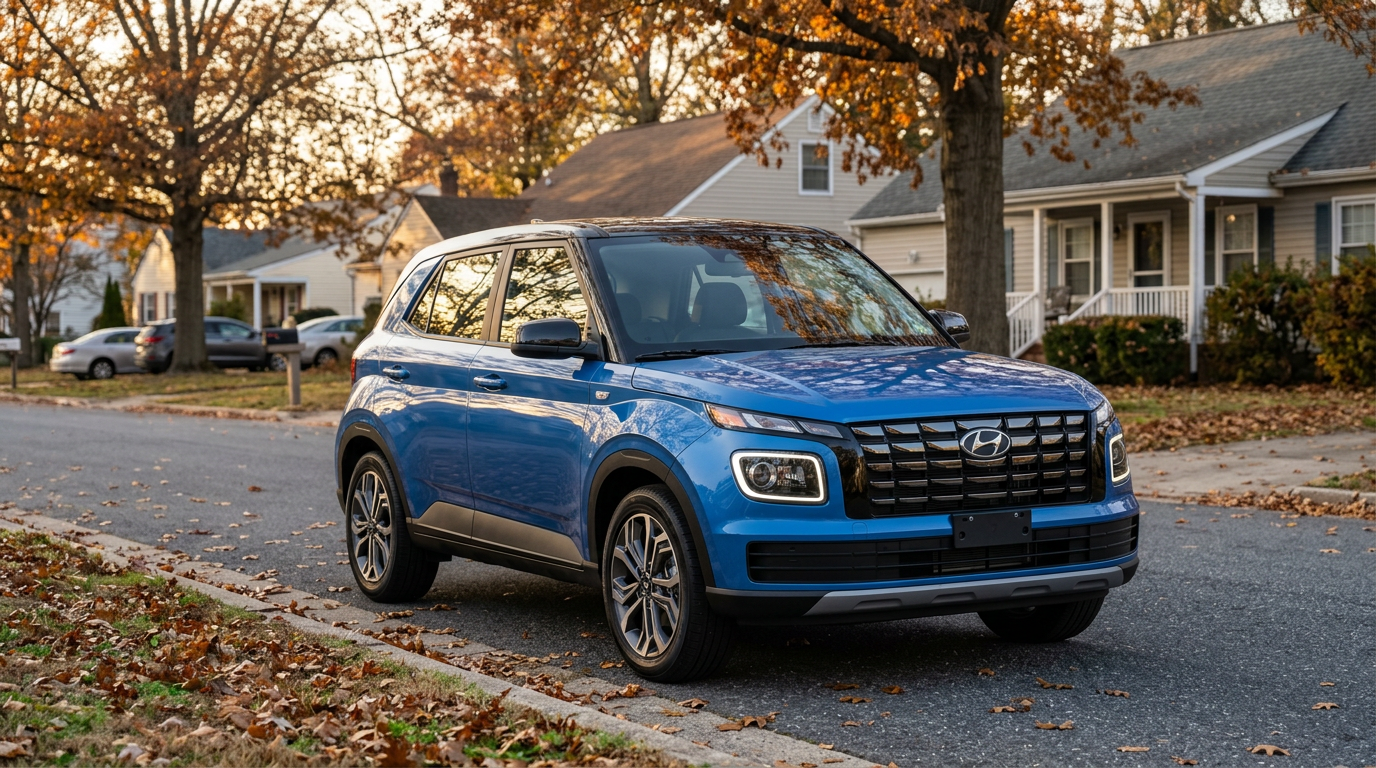
The 2026 Hyundai Venue is a strong choice for value-focused commuters and small families who want a compact SUV experience in a smaller footprint. Starting at $20,550 MSRP for the SE IVT, it delivers 121 hp, 31 combined MPG, five-passenger seating, and about 19 cu ft of cargo space in a compact footprint that parks easily in tight urban spots. The SEL IVT and SEL w/ 2-Tone Roof IVT add meaningful upgrades — heated seats, wireless charging, a sunroof, and expanded safety tech — for buyers who want more without crossing into a higher price bracket. Table of Contents How Much Does the 2026 Hyundai Venue Cost to Own for Families? Sleek Exterior Styling of the 2026 Hyundai Venue Tailored for Middletown's Neighborhood Streets Performance and Efficiency of the 2026 Hyundai Venue for Daily Commutes Interior Comfort and Space in the 2026 Hyundai Venue for Family Outings Connected Tech Features That Enhance Firefly Festival Trips and Weekend Drives Safety Systems in the 2026 Hyundai Venue Designed for School Runs and Community Events Pricing Breakdown of Every 2026 Hyundai Venue Trim for value-focused Buyers Warranty, Maintenance, and Service Insights for 2026 Hyundai Venue Owners Awards and Expert Recognition Highlighting the 2026 Hyundai Venue's Value for Drivers Frequently Asked Questions About the 2026 Hyundai Venue for Buyers How Much Does the 2026 Hyundai Venue Cost to Own for Families? The 2026 Hyundai Venue starts at $20,550 MSRP for the SE IVT, making it an affordable new crossover option on the market for families and first-time buyers managing a household budget in the $50K–$75K income range. The lineup covered here spans three trim levels — SE IVT, SEL IVT, and SEL w/ 2-Tone Roof IVT — each also offered in a "Before July 2026" variant that carries a lower destination charge of $1,600 versus the $1,650 charged on post-July builds. 2026 Hyundai Venue Pricing by Trim Feature SE IVT SE IVT (Before July 2026) SEL IVT SEL IVT (Before July 2026) SEL w/ 2-Tone Roof IVT SEL w/ 2-Tone Roof IVT (Before July 2026) Base MSRP $20,550 $20,550 $22,825 $22,825 $22,600 $22,600 Destination charge $1,650 $1,600 $1,650 $1,600 $1,650 $1,600 The SEL IVT comes in at $22,825 MSRP — a $2,275 step up from the SE — and delivers a notably richer feature set including a proximity key, push-button start, wireless charging pad, heated front seats, a leather-wrapped steering wheel, automatic climate control, a sunroof, chrome-finish roof rails, and an expanded safety suite. The SEL w/ 2-Tone Roof IVT is priced at $22,600 MSRP, sitting just below the standard SEL while offering the same core SEL features plus a distinctive two-tone roof finish and cloth/H-Tex combination upholstery. For families comparing the Venue against rivals like the Chevrolet Trax, Nissan Kicks, or Kia Soul, the Venue's starting price combined with Hyundai's warranty coverage makes the total ownership picture compelling. Sleek Exterior Styling of the 2026 Hyundai Venue Tailored for Middletown's Neighborhood Streets At 159.1 inches long, 69.7 inches wide, and 61.6 inches tall, the 2026 Hyundai Venue wears its compact dimensions with confidence. The upright SUV silhouette gives it a taller, more commanding presence than a traditional sedan — practical for visibility on Middletown's mix of residential streets and rolling suburban roads — while the short 99.2-inch wheelbase keeps it nimble enough to slip into tight parking spots at community parks, local festivals, or downtown shopping areas. The Venue's exterior design is clean and purposeful. Projector-beam halogen headlights with automatic high-beam control are standard across all trims, giving the front end a polished look without adding cost. A roof spoiler is fitted as standard, contributing to the vehicle's aerodynamic profile and giving the rear a slightly athletic stance. Painted front and rear bumpers match the body color on all trims, maintaining a cohesive appearance that reads as intentional rather than entry-level. The SEL IVT and SEL w/ 2-Tone Roof IVT add chrome/silver-finish roof rails, which serve both a visual and functional purpose — they accept optional Cross Rails (available as a dealer-installed accessory) for carrying bikes, cargo boxes, or recreational gear. The SEL w/ 2-Tone Roof IVT takes the exterior a step further with a contrasting roof finish and standard two-tone metallic paint, giving buyers a more expressive look that stands out in a parking lot. Seven exterior color options are available across the lineup: Ultimate Red, Intense Blue, Onyx Black, Lunar White, Shimmering Silver, Ecotronic Gray, and Mirage Green. The SE IVT includes metallic paint as standard; the SEL w/ 2-Tone Roof IVT features two-tone metallic paint as its defining exterior trait. All-season tires are standard on every trim — 15-inch alloys on the SE IVT and 17-inch alloys on the SEL trims — reflecting a meaningful visual upgrade as you move up the range. Performance and Efficiency of the 2026 Hyundai Venue for Daily Commutes Every 2026 Hyundai Venue in this lineup — SE IVT, SEL IVT, and SEL w/ 2-Tone Roof IVT — shares identical powertrain specs, which simplifies the buying decision considerably. The engine is Hyundai's Gamma 1.6L inline four-cylinder producing 121 hp at 6,300 rpm and 113 lb-ft of torque at 4,500 rpm. Power routes to the front wheels through a SHIFTRONIC® continuously variable transmission with a floor-mounted shift lever. EPA fuel economy ratings are 29 MPG city / 33 MPG highway / 31 MPG combined across all trims. On a full 11.9-gallon tank, that translates to an EPA-calculated range of 369 miles — enough to cover a round-trip Dover commute multiple times between fill-ups. For a government employee driving to the Delaware State Capitol or a service member commuting to Dover Air Force Base, that efficiency means fewer fuel stops per week and lower monthly operating costs. Regular 87-octane unleaded is all the Venue requires, keeping fuel costs at the lower end of the crossover spectrum. The Venue's chassis setup is worth understanding for buyers who will use it on varied terrain. Up front, an independent MacPherson strut suspension with coil springs and a stabilizer bar handles inputs smoothly. The rear uses a semi-independent torsion beam with coil springs — a layout well-suited to the flat coastal plains and gently rolling terrain that characterize the local driving environment. Electric power steering keeps the wheel light and responsive at low speeds for parking maneuvers, while providing adequate feedback on open roads. Ground clearance is 6.7 inches unladen, with an approach angle of 21.3 degrees and a departure angle of 32 degrees. These figures are appropriate for the Venue's front-wheel drive configuration and typical suburban use — they handle gravel driveways and moderate inclines without issue, though this is not a vehicle engineered for off-road use. The Traction Control System (TCS), electronic stability control, and hill-holder assist round out the chassis management systems standard across all trims. The curb-to-curb turning circle of 398.5 inches (approximately 33.2 feet) is a genuine asset in dense urban environments — tight enough to execute U-turns on typical city blocks and navigate crowded festival parking areas without multi-point turns. 2026 Hyundai Venue Engine & Performance (All Trims) Feature SE IVT SE IVT (Before July 2026) SEL IVT SEL IVT (Before July 2026) SEL w/ 2-Tone Roof IVT SEL w/ 2-Tone Roof IVT (Before July 2026) Engine 1.6L 1.6L 1.6L 1.6L 1.6L 1.6L Horsepower 121 hp 121 hp 121 hp 121 hp 121 hp 121 hp Torque 113 lb-ft 113 lb-ft 113 lb-ft 113 lb-ft 113 lb-ft 113 lb-ft Transmission SHIFTRONIC® SHIFTRONIC® SHIFTRONIC® SHIFTRONIC® SHIFTRONIC® SHIFTRONIC® Drivetrain Front-wheel drive Front-wheel drive Front-wheel drive Front-wheel drive Front-wheel drive Front-wheel drive City MPG 29 29 29 29 29 29 Highway MPG 33 33 33 33 33 33 Combined MPG 31 31 31 31 31 31 Interior Comfort and Space in the 2026 Hyundai Venue for Family Outings Five passengers fit in the Venue with a 2+3 seating configuration — front bucket seats for driver and passenger, and a three-person rear bench with asymmetrical folding. That rear bench folds down to expand cargo capacity from about 19 cu ft with all seats in place to about 32 cu ft with the rear seat folded, giving families a meaningful amount of flexibility when packing for a community park day or a trip to one of the area's historic districts. Front headroom is 39.4 inches and rear headroom is 38.6 inches — numbers that mean adults can sit upright without hunching. Front legroom is 41.3 inches, rear legroom is 34.3 inches. Front shoulder room measures 53.9 inches and rear shoulder room is 53.7 inches — nearly identical, which means rear passengers don't feel squeezed relative to those up front. Front hip room is 52.1 inches and rear hip room is 43.5 inches. 2026 Hyundai Venue Dimensions and Capacity by Trim Feature SE IVT SE IVT (Before July 2026) SEL IVT SEL IVT (Before July 2026) SEL w/ 2-Tone Roof IVT SEL w/ 2-Tone Roof IVT (Before July 2026) Curb weight 2,612 lbs 2,612 lbs 2,738 lbs 2,738 lbs 2,738 lbs 2,738 lbs Payload 1,158 lbs 1,158 lbs 1,032 lbs 1,032 lbs 1,032 lbs 1,032 lbs All trims seat 5 and share about 19 cu ft of cargo space with all seats in place. The SE IVT trims have a lighter curb weight of 2,612 lbs and a higher payload of 1,158 lbs, while the SEL-based trims weigh 2,738 lbs with a 1,032 lbs payload — the additional equipment accounting for the difference. The cargo area includes load hooks and a rigid rear parcel shelf as standard equipment on all trims. A cargo area light aids loading in low-light conditions. Interior storage includes a full floor console, dashboard storage, front cup holders, and front USB charging ports. The SE IVT comes with manual air conditioning, while the SEL IVT and SEL w/ 2-Tone Roof IVT step up to single-zone automatic climate control — a welcome upgrade for families managing cabin temperature across different preferences. The SEL IVT adds a leather-wrapped gear selector and steering wheel, giving the cabin a more refined feel without a significant price jump. The SEL w/ 2-Tone Roof IVT features cloth and H-Tex combination upholstery in either black or denim blue, adding a style dimension to the interior that distinguishes it from the standard SEL's cloth-only options. Connected Tech Features That Enhance Firefly Festival Trips and Weekend Drives The 2026 Hyundai Venue's technology suite is centered on an 8-inch touchscreen mounted centrally on the dashboard, paired with a 4.2-inch TFT instrument cluster display. The infotainment system includes AM/FM radio with digital radio capability, and the touchscreen is operated through a fixed-orientation interface with steering wheel-mounted audio controls. Wireless Apple CarPlay and wireless Android Auto are standard across all trims — a meaningful detail because it means no cable management when five people are piling in for a weekend drive. Both smartphone integration systems come with an effectively unlimited subscription period (listed as 999 months in the catalog). Bluetooth connectivity, voice activation, and app control are also standard on every trim, keeping the driver connected without requiring hands to leave the wheel. Charging is handled through 2 front USB charging ports on the SE IVT trims. The SEL trims add 2 rear USB charging ports and a wireless charging pad — the latter being particularly useful when multiple passengers need to top up devices simultaneously. A 12V power outlet at the front rounds out the charging options. All trims also include an illuminated entry system, front reading lights, and illuminated driver and passenger vanity mirrors. The SEL IVT and SEL w/ 2-Tone Roof IVT include a Proximity Key with keyless entry and keyless start, plus a push-button ignition — conveniences that make a real difference when your hands are full of groceries or festival gear. Driver mode selection with engine mapping is also included on SEL trims, giving drivers a small degree of control over the powertrain's character. A low tire pressure indicator that displays actual pressure values is standard across the lineup, and the trip computer tracks average fuel economy — both useful tools for monitoring running costs over time. Safety Systems in the 2026 Hyundai Venue Designed for School Runs and Community Events The 2026 Hyundai Venue carries a strong standard safety foundation across every trim. Six airbags are fitted as standard — dual front airbags, front side airbags, and front-and-rear side curtain airbags — providing coverage across all seating positions. Front seatbelts include pre-tensioners and height adjustment on both driver and passenger sides. All three rear seatbelt positions use 3-point designs, including the center position. LATCH child-seat anchors are fitted as standard, and the IIHS rates the LATCH system as "Acceptable." The standard driver assistance suite on all trims includes Forward Collision-Avoidance Assist (FCA) with Pedestrian Detection (camera type), which monitors the road ahead and can apply the brakes automatically at speeds as low as 6 mph if a collision risk is detected — a system that activates at low-speed urban scenarios like school zone approaches and congested parking lots. The Lane Keeping Assist System is also standard across the lineup, applying steering inputs to help keep the vehicle within its lane markings on highway drives. The ABS braking system, brake assist, and hill-holder are standard on all trims. The Traction Control System (TCS) and electronic stability control (ESC) with roll stability management are also fitted across the board. Stepping up to the SEL IVT or SEL w/ 2-Tone Roof IVT adds three additional active safety systems. Blind Spot Collision Warning (BCW) uses radar to monitor the rear flanks and alerts the driver when a vehicle enters the blind zone — particularly valuable when changing lanes on multi-lane roads. Rear Cross Traffic Collision Warning (RCCW) uses radar to detect cross-traffic while reversing, alerting the driver before a potential conflict. These two systems complement the standard rearview camera, which provides a guidance-display overlay on the touchscreen when reversing. NHTSA rates the Venue at 4 out of 5 stars overall, with a 5-star side impact rating and a 4-star frontal crash rating and 4-star rollover rating. The IIHS rates the vehicle "Good" on the small overlap front driver-side test and "Superior" for front crash prevention with the optional system. Pricing Breakdown of Every 2026 Hyundai Venue Trim for value-focused Buyers Three trim levels — SE IVT, SEL IVT, and SEL w/ 2-Tone Roof IVT — cover the Venue's range, each also offered in a "Before July 2026" variant with a $50 lower destination charge. The base MSRP is identical between the pre- and post-July builds for each trim, so the only difference is the destination charge. The SE IVT at $20,550 MSRP is the right starting point for buyers who want dependable transportation with modern connectivity. It includes the 8-inch touchscreen, wireless Apple CarPlay and Android Auto, 6 speakers, a rearview camera, cruise control, FCA with pedestrian detection, lane keeping assist, ABS, and cloth upholstery. The interior is straightforward — manual air conditioning, a plastic steering wheel, and remote power locks — but nothing feels absent for a buyer whose priority is value and reliability. The SEL IVT at $22,825 MSRP is the most feature-complete variant in the lineup. The $2,275 premium over the SE buys: automatic climate control, heated front seats, a leather-wrapped steering wheel and gear selector, a Proximity Key with keyless entry and push-button start, a wireless charging pad, 2 rear USB ports, chrome roof rails, an electric sunroof, blind spot collision warning, and rear cross traffic collision warning. For a buyer who will keep this vehicle for several years, these additions represent genuine daily-use value rather than luxury extras. The SEL w/ 2-Tone Roof IVT at $22,600 MSRP sits $225 below the standard SEL while sharing nearly all of its equipment. The key distinction is the two-tone roof finish and cloth/H-Tex combination upholstery (available in black or denim blue) rather than standard cloth, plus the absence of a sunroof. Buyers who prefer the exterior style statement over the sunroof will find this trim the better value of the two SEL configurations. For buyers weighing their options, service and parts financing options are available to help manage ownership costs beyond the purchase price. Warranty, Maintenance, and Service Insights for 2026 Hyundai Venue Owners Hyundai's warranty coverage on the 2026 Venue is one of the strongest in the subcompact crossover segment, and it applies identically across all six trim variants covered here. The basic vehicle warranty runs 5 years or 60,000 miles, whichever comes first. The powertrain warranty extends to 10 years or 100,000 miles — covering the engine, transmission, and drivetrain components that represent the largest potential repair costs over a vehicle's life. Anti-corrosion coverage runs 7 years, and the paint warranty covers 3 years or 36,000 miles. Roadside assistance is included for 5 years with no mileage limitation noted in the catalog data. For buyers who want to understand the full scope of these protections before purchasing, the Hyundai warranty details are worth reviewing alongside your purchase decision. The powertrain coverage in particular is a meaningful long-term financial protection for buyers planning to keep the Venue for the duration of the loan and beyond. Routine maintenance on the Venue's 1.6L naturally aspirated engine is straightforward — regular oil changes, air filter replacements, tire rotations, and brake inspections form the core of the scheduled service schedule. The vehicle's low curb weight (2,612 lbs for the SE IVT, 2,738 lbs for the SEL trims) keeps wear on consumables modest under normal driving conditions. Winner Hyundai's service team is available to handle routine maintenance and warranty-covered repairs. Scheduling is straightforward through our service scheduling page. Buyers who are also considering a certified pre-owned Hyundai as an alternative can browse certified pre-owned Hyundai pricing to compare total cost of ownership across new and pre-owned options. Awards and Expert Recognition Highlighting the 2026 Hyundai Venue's Value for Drivers Third-party recognition of the Venue's value proposition is consistent and credible. Kelley Blue Book awarded the Hyundai Venue its 5-Year Cost to Own Award in 2024 — a metric that accounts for depreciation, insurance, fuel, maintenance, and financing costs over a five-year ownership period. For buyers in the $50K–$75K household income range, this award signals that the Venue's ownership costs track favorably against competitors over time, not just at the point of purchase. Cars.com named the Venue its Best Value Vehicle in 2022, recognizing the combination of features, safety content, and pricing that the Venue delivers relative to its segment. Press coverage reinforces these recognitions with practical observations. Kelley Blue Book's consumer reviews note that the Venue is "surprisingly spacious inside and serves as a remarkable little crossover for daily commuting around town" — an assessment that aligns with what the interior dimensions actually show: 39.4 inches of front headroom, 41.3 inches of front legroom, and 53.9 inches of front shoulder room in a vehicle that parks in spaces many compact cars struggle with. Reviewers at South Trail Hyundai have described the 2026 Venue as "a smart choice for drivers who want a city-friendly size without sacrificing crossover style," noting that it "feels confident on busy streets and practical for daily routines." The Venue also earned a 4-star NHTSA overall safety rating with a 5-star side impact score, adding independent structural credibility to Hyundai's own safety claims. For buyers cross-shopping the Venue against the Nissan Kicks or Kia Soul, these third-party benchmarks provide a useful framework for evaluating long-term ownership quality beyond the window sticker. Frequently Asked Questions About the 2026 Hyundai Venue for Buyers Q: What is the starting MSRP for the 2026 Hyundai Venue, and which trim offers the best value? The 2026 Hyundai Venue starts at $20,550 MSRP for the SE IVT. For most buyers who want a meaningful feature upgrade without a large price jump, the SEL w/ 2-Tone Roof IVT at $22,600 MSRP offers a strong feature set — it includes heated seats, wireless charging, keyless entry, a Proximity Key, blind spot warning, rear cross traffic warning, and a distinctive two-tone exterior, all for $225 less than the standard SEL IVT. The SE IVT is a strong choice if the priority is the base purchase price with solid everyday functionality. Q: What is the fuel economy on the 2026 Hyundai Venue, and how far can it go on a full tank? All 2026 Venue trims covered here are EPA-rated at 29 MPG city, 33 MPG highway, and 31 MPG combined. With an 11.9-gallon fuel tank and a regular 87-octane requirement, the EPA-calculated range is 369 miles per tank. That range covers multiple Dover-to-Middletown round trips on a single fill-up, making the Venue a genuinely low-cost daily driver for commuters. Q: How much cargo space does the 2026 Hyundai Venue have, and can it fit a family's weekend gear? The Venue offers about 19 cu ft of cargo space with all five seats in use, expanding to about 32 cu ft when the rear bench folds down asymmetrically. That is enough room for a family's picnic supplies, a stroller, or a full load of grocery bags. The rigid rear parcel shelf and cargo hooks keep items organized and out of sight. Q: What safety features are standard on the SE IVT, and what does the SEL add? The SE IVT includes Forward Collision-Avoidance Assist (FCA) with Pedestrian Detection, Lane Keeping Assist, ABS, 6 airbags, a rearview camera, and hill-holder assist as standard. The SEL IVT and SEL w/ 2-Tone Roof IVT add Blind Spot Collision Warning (BCW) and Rear Cross Traffic Collision Warning (RCCW) — two radar-based systems that meaningfully expand situational awareness during lane changes and reversing. Q: Where can I test drive the 2026 Hyundai Venue near Dover, DE? Winner Hyundai is located at 591 S Dupont Hwy, Dover, DE 19901. You can get directions to our showroom or reach our team directly at (302) 877-2489 to confirm availability and schedule a test drive at a time that works for you. © 2026 Winner Hyundai. All rights reserved. Vehicle specification data © JATO Dynamics Limited.
Why Families Are Choosing the 2027 Hyundai Palisade for Power, Efficiency & Luxury

Why Families Are Choosing the 2027 Hyundai Palisade for Power, Efficiency & Luxury

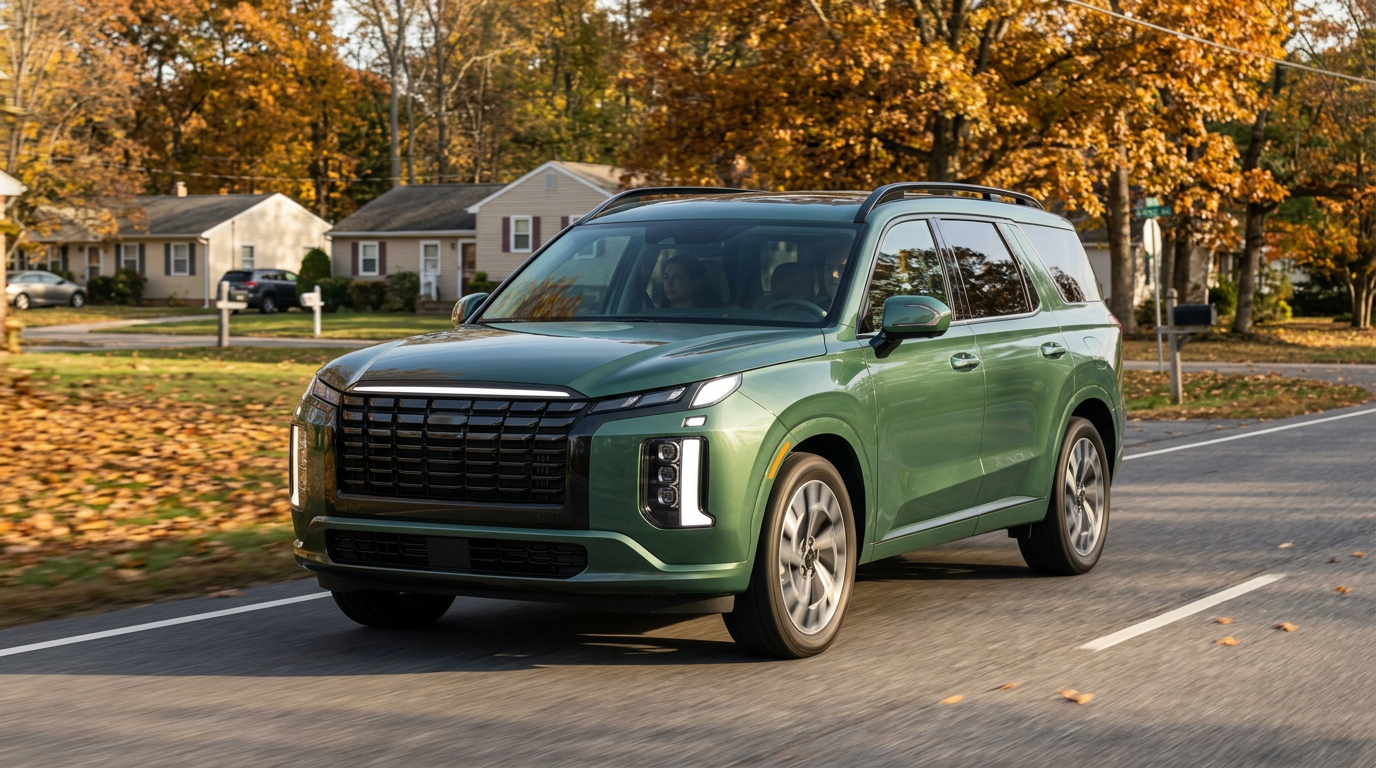
The 2027 Hyundai Palisade wins this three-row comparison by delivering an unmatched combination of standard performance, hybrid efficiency, and upscale executive refinement at an accessible price point. Powered by a standard 2.5L turbo hybrid engine producing 329 hp and 339 lb-ft of torque, the Palisade outperforms the base powertrains of the 2027 Toyota Grand Highlander and 2026 Honda Pilot while achieving up to 35 MPG on the highway. With a starting base MSRP of $44,560, the Palisade provides superior features and longer warranty coverage for less money. Table of Contents Which SUV Offers the Best Overall Value for Families: 2027 Hyundai Palisade, 2027 Toyota Grand Highlander, or 2026 Honda Pilot? Pricing and Trim Options That Fit Family Budgets Passenger Comfort and Cargo Space for Weekend Farm Visits and Community Events Power and Handling for Coastal and Suburban Roads Fuel Efficiency and Range for Busy Middletown and Dover Commuters Safety Systems Built for School Runs and Cultural Events Warranty Coverage and Maintenance Services Tailored for SUV Owners Frequently Asked Questions Comparing the 2027 Hyundai Palisade, 2027 Toyota Grand Highlander, and 2026 Honda Pilot Take the Next Step at Winner Hyundai Which SUV Offers the Best Overall Value for Families: 2027 Hyundai Palisade, 2027 Toyota Grand Highlander, or 2026 Honda Pilot? The 2027 Hyundai Palisade claims top honors as the best overall value for families by pairing a high-output 329 hp turbo hybrid powertrain with premium interior craftsmanship at a starting MSRP of $44,560. When evaluated against mainstream three-row competitors, the Palisade continuously delivers high-tier equipment that either costs extra or is completely unavailable on competing models. Shoppers evaluating the three-row crossover market often encounter compromise. The 2027 Toyota Grand Highlander Hybrid LE AWD starts higher at $45,910 base MSRP while providing just 245 hp and 175 lb-ft of torque from its non-turbo hybrid system. On the other hand, the 2026 Honda Pilot EX-L 2WD starts at $44,695 base MSRP with a traditional 3.5L V6 engine that achieves an underwhelming 21 MPG combined. The 2027 Hyundai Palisade eliminates this compromise entirely. Standard equipment across all trims includes a reconfigurable 12.3 in digital instrument cluster, a matching 12.3 in infotainment touch screen with full map navigation, a 300 v lithium-ion battery system, wireless device charging, and synthetic leather seat upholstery. Drivers navigating daily carpool routines around Middletown benefit from a versatile cabin engineered for serene long-distance comfort and instant electric torque assistance. Financially, the Palisade maintains an insurmountable edge. Buyers can contact us for current pricing to explore available incentive structures, or take advantage of online tools when applying for financing online through our secure platform. By providing superior standard horsepower, higher highway fuel economy, and comprehensive technology without forcing buyers into expensive option packages, the Palisade stands out as the smartest purchase in the segment. Pricing Manufacturer-listed pricing per trim, across compared vehicles. 2027 Hyundai Palisade Trim MSRP 2027 Toyota Grand Highlander Trim MSRP 2026 Honda Pilot Trim MSRP Blue SEL 7 Passenger Hybrid FWD $44,560 Hybrid LE AWD $45,910 EX-L 2WD $44,695 Blue SEL 8 Passenger Hybrid FWD $44,560 Hybrid Limited AWD $53,410 EX-L AWD $46,795 Blue SEL Premium 7 Passenger Hybrid FWD $47,920 Hybrid MAX Platinum AWD $60,475 Black Edition AWD $55,195 Pricing and Trim Options That Fit Family Budgets With price points spanning from $44,560 base MSRP for the entry Blue SEL trims up to $47,920 for the flagship Blue SEL Premium, the 2027 Hyundai Palisade maintains a remarkably focused, high-value lineup. Contact the dealership for current pricing and delivery details. The Palisade lineup simplifies family decision-making by offering clear, purpose-built configurations: Blue SEL 7 Passenger Hybrid FWD: $44,560 base MSRP (Delivered MSRP: $46,210). Standard 2+2+3 seating with second-row captain's chairs, H-Tex synthetic leather, dual 12.3 in screens, and 18 in alloy wheels. Blue SEL 8 Passenger Hybrid FWD: $44,560 base MSRP (Delivered MSRP: $46,210). Standard 2+3+3 seating with a second-row bench seat, sharing identical premium convenience and safety features. Blue SEL Premium 7 Passenger Hybrid FWD: $47,920 base MSRP (Delivered MSRP: $49,570). Adds a power glass sunroof, ventilated front seats, heated second-row seats, integrated door mirror position memory, and a 6-way electric driver seat adjustment with 2-way electric lumbar support. In stark contrast, competitor lineups quickly escalate into costly territory. The 2027 Toyota Grand Highlander carries a destination charge of $1,595 and scales from the base Hybrid LE AWD at $45,910 MSRP up to the Hybrid Limited AWD at $53,410 MSRP, before peaking at a staggering $60,475 MSRP for the Hybrid MAX Platinum AWD. While the Hybrid MAX Platinum trim offers 362 hp, its steep price tag severely limits its practical value for budget-conscious households. The 2026 Honda Pilot follows a similar pricing trajectory. Starting at $44,695 MSRP for the EX-L 2WD, it jumps to $46,795 MSRP for the EX-L AWD and reaches $55,195 MSRP for the top-tier Black Edition AWD. Despite these higher price tags, the Pilot lacks a hybrid powertrain across all trims, forcing buyers to pay more up front while spending significantly more at the fuel pump over time. For value-minded shoppers considering pre-owned alternatives, exploring our quality pre-owned inventory provides additional flexible choices across various price ranges. Dimensions & Capacity Capacity and dimensions by trim Specification 2027 Hyundai Palisade 2027 Toyota Grand Highlander 2026 Honda Pilot Cargo 19.1 cu ft 20.6 cu ft 18.6 cu ft Curb weight 4,652 lbs 4,565 lbs 4,678 lbs Towing 4,000 lbs 3,500 lbs 5,000 lbs Payload 1,631 lbs 1,575 lbs 1,164 lbs Seating 7 8 8 Passenger Comfort and Cargo Space for Weekend Farm Visits and Community Events The 2027 Hyundai Palisade delivers exceptional interior comfort with class-leading front legroom of 44.2 in and rear legroom of 41.4 in, ensuring ample space for adult passengers and growing children alike. Designed around executive-level ergonomics, the cabin utilizes horizontal design elements and high-grade materials to create an open, tranquil atmosphere. Interior dimensions highlight the Palisade's thoughtful spatial execution: Front Row: 41.7 in headroom ( 40.1 in with available sunroof), 44.2 in legroom, 61.4 in shoulder room, and 58.8 in hip room. Second Row: 40.7 in headroom ( 40.0 in with available sunroof), 41.4 in legroom, 61.0 in shoulder room, and 56.7 in hip room. Third Row: 37.8 in headroom ( 37.7 in with available sunroof), 32.1 in legroom, 55.6 in shoulder room, and 45.3 in hip room. When comparing third-row usability and cargo flexibility, the Palisade balances daily transportation needs with heavy-duty capacity. Behind the third row, the Palisade provides about 19 cu ft of standard cargo volume. Folding the rear seats down expands total cargo capacity to a massive about 87 cu ft. Crucially, the Palisade leads its class in payload capability with an impressive 1,631 lbs allowance, far outpacing the Grand Highlander's 1,575 lbs maximum payload and the Pilot's limited 1,164 lbs rating. While the Toyota Grand Highlander advertises about 21 cu ft of cargo space behind the third row and about 97.5 cu ft with seats folded, it compromises on front-passenger legroom ( 41.7 in) and second-row legroom ( 39.5 in). Taller drivers and second-row passengers will feel noticeably more restricted in the Toyota. The 2026 Honda Pilot falls behind both hybrid rivals, offering just about 19 cu ft of standard cargo volume behind its third row. Commuters and government professionals around Dover will appreciate the Palisade's serene cabin isolation. Laminated side acoustic glass, premium floor carpeting, and ergonomic seat contours ensure every passenger arrives relaxed, whether heading to work or taking a weekend trip. Engine & Performance Powertrain specs by trim Specification 2027 Hyundai Palisade 2027 Toyota Grand Highlander 2026 Honda Pilot Engine 2.5L 2.5L 3.5L Horsepower 329 hp 245 hp 285 hp Torque 339 lb-ft 175 lb-ft 262 lb-ft Transmission SHIFTRONIC® CVT automatic 10-speed Drivetrain Front-wheel drive All-wheel drive All-wheel drive Power and Handling for Coastal and Suburban Roads Equipped with a standard 2.5L inline 4-cylinder turbo hybrid engine generating a system total of 329 hp and 339 lb-ft of torque, the 2027 Hyundai Palisade easily outperforms the standard powertrains of both rivals. This advanced powertrain routes energy through a smooth SHIFTRONIC® 6-speed automatic transmission with manual mode and steering-wheel-mounted gearchange paddles, providing natural engine response without the rubber-band sensation common in continuously variable transmissions. The Palisade's active hybrid system incorporates two transmission-integrated motor generators: Electric Motor 1: AC permanent magnet synchronous motor delivering 17 hp ( 12.7 kW) and 75 lb-ft of torque. Electric Motor 2: AC permanent magnet synchronous motor delivering 72 hp ( 53.7 kW) and 195 lb-ft of torque. This dual-motor hybrid assistance allows the Palisade to deliver immediate low-end torque for confident merging and highway passing. Chassis dynamics are refined by a four-wheel independent suspension system featuring front MacPherson struts with a stabilizer bar and a rear multi-link design with an automatic rear leveling suspension. Stopping power is managed by 4-wheel disc brakes with 2 ventilated discs, ABS, brake assist, and electronic hand brake auto-hold. The competition struggles to match this standard mechanical refinement: 2027 Toyota Grand Highlander: The base 2.5L hybrid powertrain produces an underpowered 245 hp and 175 lb-ft of torque mated to an electronic CVT. Acceleration feels strained under full passenger loads. While Toyota offers a 362 hp Hybrid MAX variant, it requires stepping up to the $60,475 Platinum trim and sacrifices significant fuel economy. 2026 Honda Pilot: Powered by a conventional non-hybrid 3.5L V6 engine producing 285 hp and 262 lb-ft of torque paired with a 10-speed automatic transmission. The Pilot lacks electric motor torque fill, resulting in slower throttle response at lower RPMs. Regarding towing capabilities, the Palisade comes standard with a 4,000 lbs gross trailer weight braked rating ( 1,650 lbs unbraked) and standard trailer towing preparation. This comfortably exceeds the Toyota Grand Highlander Hybrid LE and Limited trims, which are capped at 3,500 lbs towing. Fuel Economy Fuel economy and range by trim Specification 2027 Hyundai Palisade 2027 Toyota Grand Highlander 2026 Honda Pilot MPG 33 city / 35 hwy / 34 combined 35 city / 32 hwy / 34 combined 19 city / 25 hwy / 21 combined Fuel Efficiency and Range for Busy Middletown and Dover Commuters The 2027 Hyundai Palisade delivers exceptional real-world efficiency with EPA-estimated fuel economy ratings of 33 city / 35 hwy / 34 combined MPG. Coupled with an 18.2 gal fuel tank capacity, the Palisade achieves a calculated total driving range of 619 mi on regular 87-octane unleaded fuel. Highway fuel economy is a key differentiator for long-distance drivers. The Palisade's 35 hwy MPG rating beats the Toyota Grand Highlander Hybrid AWD's 32 hwy MPG rating. Despite its all-wheel-drive system, the Grand Highlander Hybrid achieves 35 city / 32 hwy / 34 combined MPG with a smaller 17.2 gal fuel tank, restricting its total calculated cruising range to 585 mi —34 miles short of the Palisade. The non-hybrid 2026 Honda Pilot falls significantly behind in fuel economy analysis: 2026 Honda Pilot (3.5L V6): EPA-estimated 19 city / 25 hwy / 21 combined MPG. Driving the Honda Pilot means stopping for fuel far more frequently, resulting in higher annual fuel costs. The Palisade's energy recuperation system and 1.65 kWh usable lithium-ion battery maximize regenerative braking efficiency during stop-and-go driving, maintaining high fuel economy across all driving environments. Safety Systems Built for School Runs and Cultural Events The 2027 Hyundai Palisade sets a comprehensive safety benchmark for multi-passenger crossovers by equipping 10 standard airbags —including dual front airbags, front center airbag, front and rear side-impact airbags, driver knee airbag, and full-length side curtain airbags covering all three rows. Both the Toyota Grand Highlander and Honda Pilot carry only 8 total airbags, omitting critical rear side-impact and front center airbag protections. Hyundai integrates its complete suite of active driver assistance technologies under the Forward Collision Avoidance Assist (FCA) with Pedestrian Detection framework. Standard safety and driver assist features on the Palisade include: Forward Collision Avoidance Assist (FCA): Brakes automatically at low speeds with a minimum activation speed of just 5 mph. Lane Following Assist (LFA): Active lane control that centers the vehicle within marked travel lanes. Blind Spot Collision Warning (BCW): Radar-based overtaking sensors providing visual and acoustic alerts. Rear Cross-Traffic Collision Avoidance Assist (RCCA): Radar-based system designed to detect approaching cross-traffic while reversing. Highway Driving Assist (HDA): Level 2 partial automation highway assist combining adaptive cruise control with stop-and-go capability and map-linked corner speed adaptation. Rear Occupant Alert: Ultrasonic sensor-based detection to remind drivers of passengers in the rear seats. Demonstrating its structural integrity, the Hyundai Palisade earned the prestigious TOP SAFETY PICK+ award from the Insurance Institute for Highway Safety (IIHS) under their updated test revision criteria. While the 2027 Toyota Grand Highlander includes Toyota Safety Sense 3.0 and the 2026 Honda Pilot includes Honda Sensing, neither competitor matches the Palisade's standard 10-airbag protection array or its seamless Highway Driving Assist integration at the entry price point. Warranty Coverage and Maintenance Services Tailored for SUV Owners Hyundai backs the 2027 Palisade with America's Best Warranty, highlighted by a 10-year/100,000-mile powertrain limited warranty and a 5-year/60,000-mile new vehicle limited warranty. This extensive coverage provides double the duration and distance of the factory warranties offered by Toyota and Honda. A head-to-head warranty breakdown illustrates Hyundai's clear coverage advantage: Warranty Coverage Category 2027 Hyundai Palisade 2027 Toyota Grand Highlander 2026 Honda Pilot Bumper-to-Bumper (Whole Vehicle) 60 mth / 60,000 mi 36 mth / 36,000 mi 36 mth / 36,000 mi Powertrain Limited Warranty 120 mth / 100,000 mi 60 mth / 60,000 mi 60 mth / 60,000 mi Hybrid Battery Warranty 120 mth / 100,000 mi 120 mth / 150,000 mi N/A (Non-Hybrid) Hybrid Electrical Systems 120 mth / 100,000 mi 96 mth / 100,000 mi N/A (Non-Hybrid) Roadside Assistance 60 mth / Unlimited mi 24 mth / 25,000 mi 36 mth / 36,000 mi Anti-Corrosion Perforation 84 mth / Unlimited mi 60 mth / Unlimited mi 60 mth / Unlimited mi In unexpected breakdown or emergency situations, owners are covered exclusively by Hyundai roadside assistance programs. Drivers can connect directly with factory-trained specialists by calling Hyundai Roadside Assistance: 1-800-633-5151 for 24/7 towing to authorized service centers, flat tire assistance, and lockout support backed by genuine OEM replacement parts. To keep your vehicle operating at peak performance, owners can easily schedule service online with factory-certified technicians. Additionally, shoppers seeking pre-owned vehicles with extended factory protection can review our certified pre-owned Hyundai models for exceptional long-term reliability. Frequently Asked Questions Comparing the 2027 Hyundai Palisade, 2027 Toyota Grand Highlander, and 2026 Honda Pilot Q: Is the 2027 Hyundai Palisade more powerful than the base Toyota Grand Highlander and Honda Pilot? Yes, the 2027 Hyundai Palisade comes standard with a 2.5L turbo hybrid engine generating 329 hp and 339 lb-ft of torque. This significantly outperforms the base 2027 Toyota Grand Highlander Hybrid, which produces only 245 hp and 175 lb-ft of torque. It also offers more power and torque than the 2026 Honda Pilot's non-hybrid 3.5L V6, which generates 285 hp and 262 lb-ft of torque. Q: Which of these three-row SUVs gets the best highway fuel economy? The 2027 Hyundai Palisade achieves the highest highway fuel economy rating in this comparison at an EPA-estimated 35 MPG highway. By comparison, the 2027 Toyota Grand Highlander Hybrid AWD achieves 32 MPG highway, while the non-hybrid 2026 Honda Pilot achieves just 25 MPG highway. Combined with its 18.2 gal fuel tank, the Palisade offers a maximum calculated range of 619 mi. Q: Does the 2027 Hyundai Palisade offer a better warranty than Toyota and Honda? Yes, Hyundai provides far superior warranty protection. The 2027 Palisade includes a 10-year/100,000-mile powertrain limited warranty, a 10-year/100,000-mile hybrid system/battery warranty, and a 5-year/60,000-mile new vehicle limited warranty. Both Toyota and Honda limit their powertrain coverage to 5 years or 60,000 miles and their bumper-to-bumper coverage to 3 years or 36,000 miles. Q: How does the seating and payload capacity compare between these models? The 2027 Hyundai Palisade offers seating for 7 or 8 passengers with standard H-Tex synthetic leather seating surfaces. It boasts a class-leading maximum payload allowance of 1,631 lbs. The Toyota Grand Highlander offers up to 1,575 lbs payload capacity, while the Honda Pilot offers a significantly lower payload allowance of 1,164 lbs. Q: Where can I test drive the 2027 Hyundai Palisade? You can test drive the 2027 Hyundai Palisade at Winner Hyundai. Drivers can easily drop a pin to our Dover showroom location or give our sales team a quick call to check current vehicle availability and schedule a personal demonstration. Take the Next Step at Winner Hyundai When comparing overall value, standard performance, highway efficiency, passenger comfort, and long-term warranty peace of mind, the 2027 Hyundai Palisade emerges as the decisive winner over the 2027 Toyota Grand Highlander and 2026 Honda Pilot. Delivering 329 hp and 35 MPG highway at a starting base MSRP of $44,560, the Palisade represents the modern benchmark for family crossovers. Our professional team at Winner Hyundai is ready to help you explore every feature of this exceptional three-row SUV. Visit our showroom at 591 S Dupont Hwy, Dover, DE 19901 to compare trim levels in person, explore custom order options, and experience the refined performance of the 2027 Palisade on a test drive today. © 2026 Winner Hyundai. All rights reserved. Vehicle specification data © JATO Dynamics Limited.

Contact Us

Fill out this form below and we'll contact you shortly

By submitting your information, you agree to the sharing of your information between Hyundai Motor America and its authorized dealers.

*Required Fields